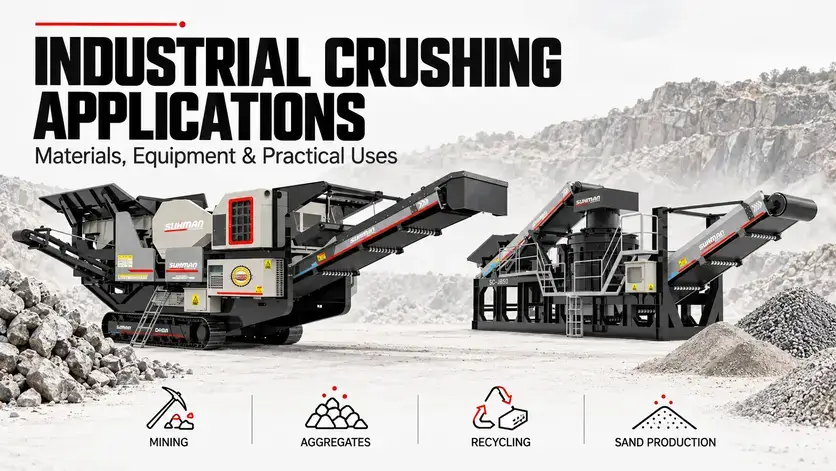
Summary:
Industrial crushing prepares raw materials for further processing or reuse. This guide explains six applications, the equipment commonly considered for each, and the information needed to plan a suitable crushing line.
A granite quarry, a demolition contractor, and an iron ore operation may all need crushing equipment. Their production goals are different. One needs graded construction aggregate. Another wants to recover usable material from concrete waste. The third needs consistent feed for downstream mineral processing.
Industrial crushing applications start with these goals. The material, its condition, and the required output determine which equipment deserves consideration.
This guide focuses on rock, ore, and construction materials. It connects common applications with practical selection questions, example configurations, and SUHMAN projects.
What Is Industrial Crushing?
Industrial crushing reduces large pieces of material into smaller particles. In a production line, it can prepare material for transport, further processing, or use as aggregate. Mining, quarrying, and construction material recycling are established applications. Metso’s crusher guide describes these uses and the main equipment families.
Crushing usually works alongside other processes. A crusher reduces size; a screen separates material into size fractions. The finished product may also require cleaning, metal removal, or further processing.
The term has a wider meaning in other industries. Food, fertilizer, and chemical plants also use size-reduction equipment, including machines that break up stored or processed material that has formed lumps. Those requirements call for a separate equipment assessment. Jersey Crusher provides examples of these applications.
Six Key Industrial Crushing Applications
1. Quarrying and Aggregate Production
Quarries process natural stone into products for concrete, asphalt, road foundations, and other construction work. An aggregate producer may need several saleable sizes from the same feed material.
Start with the product schedule: which sizes will customers buy, in what quantities, and under which specifications? That information helps define the crushing and screening arrangement.
For a hard-rock project, equipment discussions often center on a jaw crusher followed by a cone crusher and screening. A less abrasive material may support a different arrangement. The selection should reflect tested rock properties and operating costs.
SUHMAN’s granite aggregate project in Guangdong provides a useful example. The published case describes an SE-1060 jaw crusher, SY-HP300 cone crusher, and SS-7018 screening plant, with reported production of 200–220 t/h under that project’s conditions.
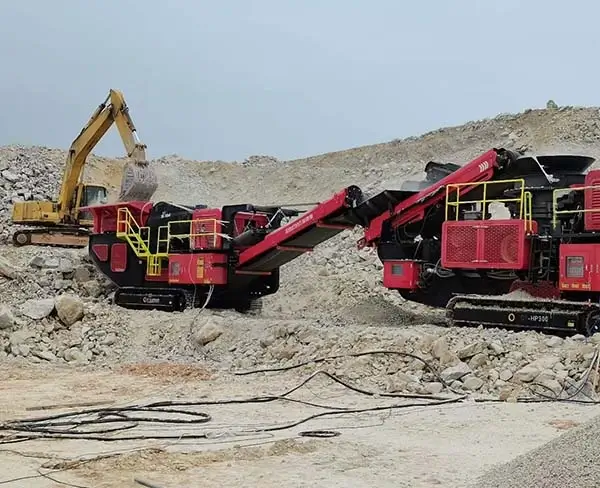
Mobile crushing equipment at an aggregate production site. Image from SUHMAN’s Guangdong granite project page.
For buyers defining their product range, our guide to crushed stone sizes and grades explains common size designations and uses. Confirm the required grading with your customer before choosing screen openings.
2. Mining and Ore Preparation
In mining, the next processing step helps determine the crushing target. Ask what feed size the downstream system requires, how much it can accept, and how changes in ore condition affect the whole operation.
Also include site conditions in the equipment brief. A suitable configuration for one climate may need changes for another.
The iron ore crushing project in Mohe illustrates this point. SUHMAN’s published case describes jaw crushing, cone crushing, and screening with low-temperature configurations. It reports approximately 1,800 tons per day during winter operation and identifies hydraulic performance, lubrication, and reliable startup as project priorities.
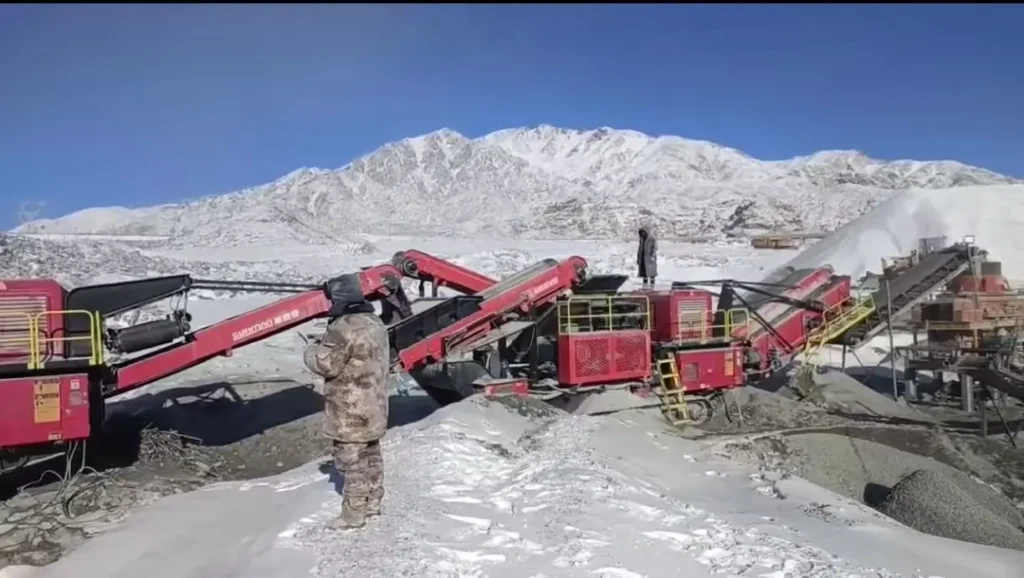
Winter conditions add equipment requirements beyond feed size and capacity. Image from SUHMAN’s Mohe iron ore project page.
This example shows why an ore-processing inquiry should include more than a production target. Material information, operating temperature, working hours, and downstream requirements all belong in the initial discussion.
3. Concrete and Demolition Waste Recycling
Demolition material can vary from clean concrete to mixed loads containing bricks, reinforcement, soil, and other debris. Define the incoming material before discussing a recycling line.
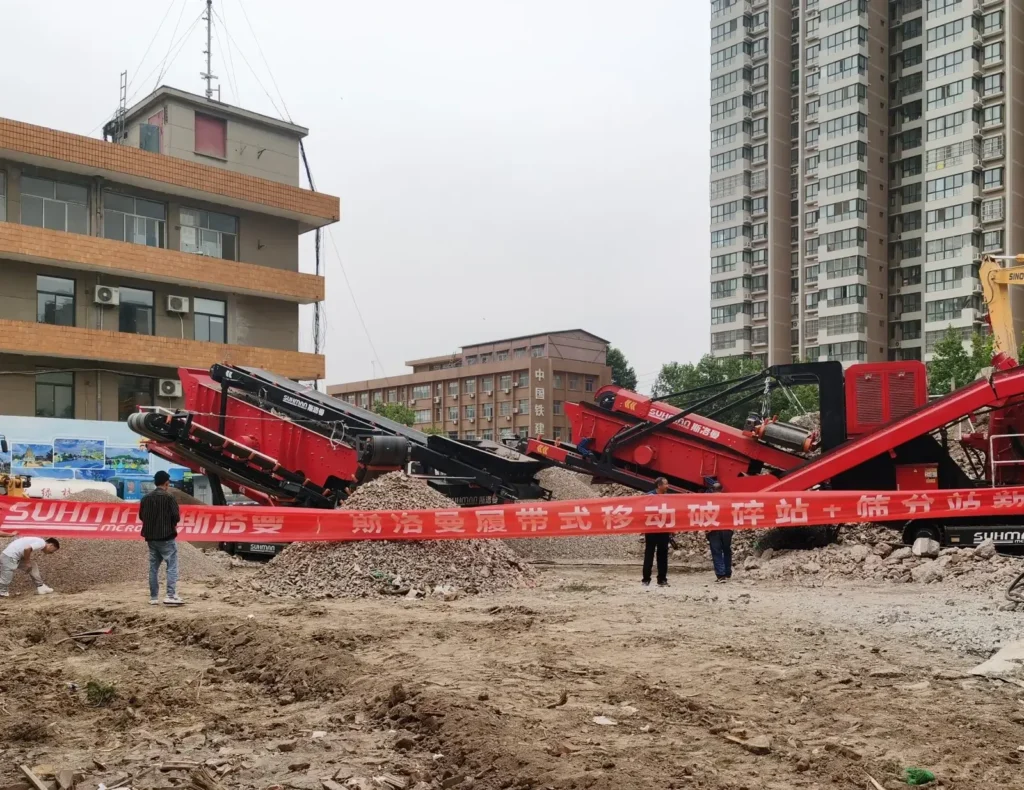
Mobile crushing and screening equipment for on-site rubble processing. Image illustrates the equipment setup; the project example is described below.
Our concrete recycling equipment guide covers equipment options and selection considerations. A project brief should identify the largest pieces, likely contaminants, required separation steps, and intended use of the recycled output.
SUHMAN’s C&D waste recycling project in Thailand uses an SF-580D mobile impact crusher with an SS-7018 screening plant. The case describes processing concrete, bricks, and mixed demolition material into graded reusable aggregate.
When planning a similar project, establish the acceptance criteria for both incoming waste and finished material. If the intended outlet is road construction or backfilling, confirm the customer’s requirements before committing to an output specification. Crushing is one part of the recovery process.
4. Asphalt Recycling
Asphalt recycling requires a clear description of the incoming material. Road slabs, milled material, and stockpiles containing compacted lumps present different processing questions.
Before requesting a configuration, record the size distribution and identify how much material already falls within the target range. Ask the supplier to explain where screening belongs and which fraction actually needs crushing.
The equipment discussion should cover:
- The required recycled asphalt pavement (RAP) size range.
- Acceptable fines content for the intended outlet.
- Feed condition, including moisture and material temperature.
- Screening performance and the handling of oversize material.
Define whether the output will go to an asphalt producer, a base-course application, or another approved use. Each outlet should have its own acceptance requirements. Avoid treating a general crusher capacity figure as proof that a particular RAP specification will be achieved.
5. Manufactured Sand Production
Manufactured sand projects need a defined product target: grading, particle shape, allowable fines, and the requirements of the concrete or mortar producer.
A VSI crusher can serve as a later-stage shaping and size-reduction unit. SUHMAN’s SC-J85D modular VSI sand-making machine is an equipment option to assess for this role. Its product page describes rock-on-rock and rock-on-steel crushing modes and applications involving manufactured sand and aggregate shaping.
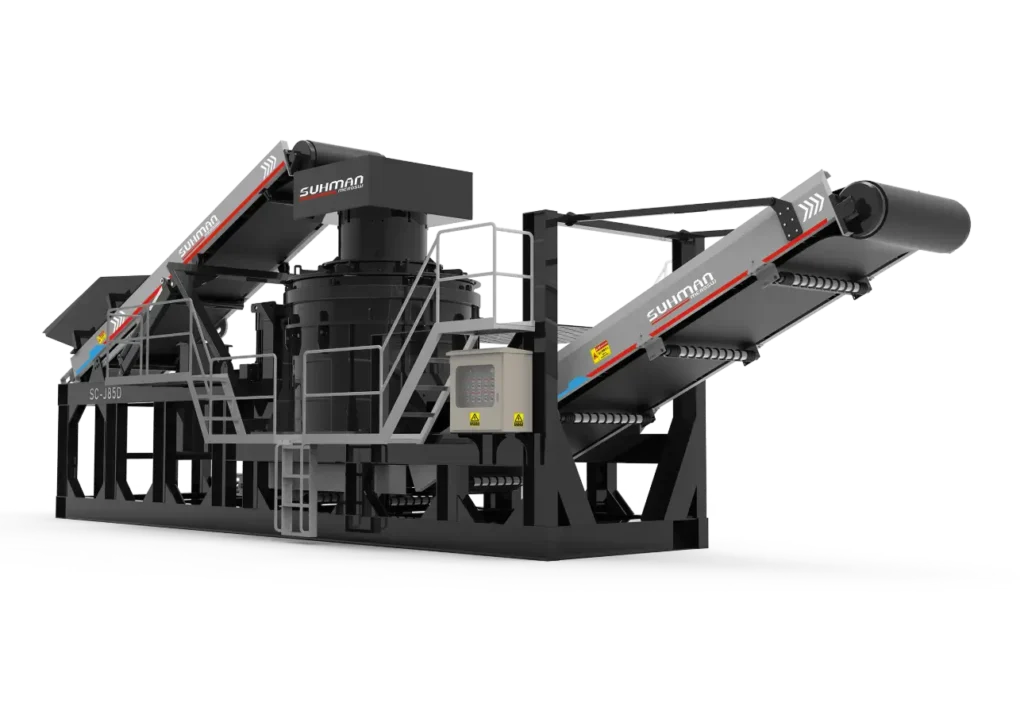
The SC-J85D modular VSI is an option to assess for manufactured sand production and aggregate shaping.
Plan the sand-making section as a complete process. Ask how the proposed system will control product grading, handle excess fines, and manage variable feed conditions. If washing or classification is proposed, include water availability, power, and space in the project assessment.
Sample evaluation should address the final sand product as well as the crusher feed. The useful question is whether the proposed process can consistently supply the material your customer needs.
6. Cement and Industrial Mineral Preparation
Limestone, gypsum, and other industrial minerals have different processing requirements. Establish whether the crushing stage is preparing feed for another machine or producing material for a particular end use.
Material behavior matters. McLanahan’s primary crusher selection guide discusses several equipment families and distinguishes between hard, abrasive feed and softer, friable, or sticky materials. It also identifies industrial applications for hammermills, including limestone and gypsum.
For a project inquiry, specify the required feed size for the next stage, the acceptable amount of fines, and any limits on contamination. Explain how the material changes across the deposit or supply source. These details help the supplier assess whether a conventional rock-crushing arrangement fits the process or another equipment type needs consideration.
Matching Crusher Types to Applications
Use the following table to organize an initial equipment discussion. Final selection requires material data and an assessment of the complete process.
| Equipment | Typical role | Applications to assess |
|---|---|---|
| Jaw crusher | Primary size reduction | Large rock, ore, and prepared concrete feed |
| Cone crusher | Secondary and tertiary crushing | Hard-rock aggregate and ore processing |
| Horizontal shaft impact crusher (HSI) | Primary, secondary, or tertiary crushing, depending on design | Suitable less-abrasive stone and recycling applications |
| Vertical shaft impact crusher (VSI) | Later-stage shaping and size reduction | Manufactured sand and aggregate shaping |
These stage assignments follow Metso’s explanation of crusher types. Jaw crushers commonly handle primary crushing. An HSI can operate at several stages; its position depends on the machine and application.
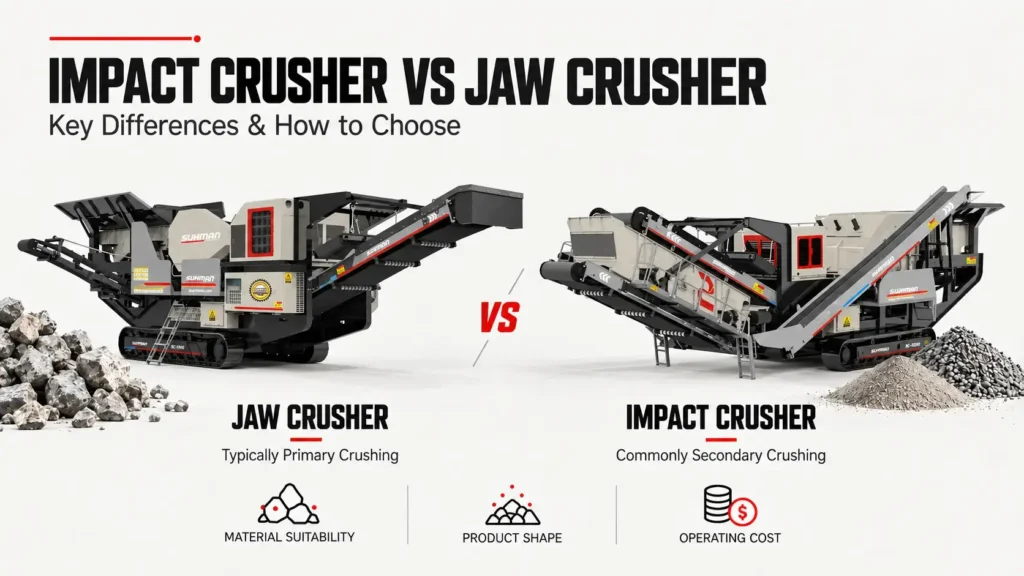
Jaw and impact crushers serve different application needs. Actual stage selection depends on feed properties and machine design.
For a closer comparison, see our impact crusher vs jaw crusher guide. You can also compare SUHMAN’s mobile jaw crushers, mobile cone crushers, and mobile impact crushers once the application requirements are defined.
Typical Crushing Setups by Application
These simplified examples are starting points for discussion. They do not specify a complete engineered plant.
| Application | Example process sequence | Questions to resolve |
|---|---|---|
| Hard-rock aggregate | Feed preparation → jaw crushing → cone crushing → screening | How abrasive is the feed? Which fractions are saleable? Does oversize need recirculation? |
| Concrete recycling | Sorting and feed preparation → impact crushing → metal separation → screening | What contaminants are present? What separation steps are required? Where will the output be used? |
| Manufactured sand | Prepared crushed feed → VSI processing → screening and classification as required | Is the feed suitable for the VSI? How will grading and fines be controlled? Is wet processing needed? |
The first two arrangements reflect the Guangdong and Thailand configurations described above. The third illustrates how a VSI could fit into a larger sand-making process.
Include screening in the initial scope. Our mobile screening plant range provides options to review alongside the crushing equipment. Where feed preparation requires coarse separation, the scalping screen guide offers further background.
Ask the supplier to show the material flow between stages, including any returned oversize. This makes it easier to assess whether the proposed line supports the required finished-product output.
When Does Mobile Crushing Make Sense?
Mobile crushing deserves consideration when the processing location changes or when material can be processed near its source. SUHMAN’s jaw crusher range includes tracked and modular configurations for different mobility and installation needs. View the range and application guidance.
Compare the options against a practical project schedule:
- How often will the equipment move within or between sites?
- How much material is available at each location?
- What transport and setup work will each move involve?
- Is suitable power available where the plant will operate?
- Is there enough room for feeding, maintenance, and separate stockpiles?
A temporary recycling job and a long-running aggregate operation may answer these questions very differently. Request a comparison of tracked, modular, and fixed arrangements where relevant. Include relocation and site work in the cost assessment.
How to Choose the Right Crushing Setup
Start with a material description and a finished-product requirement. McLanahan identifies feed size, desired product size, capacity, compressive strength, and moisture content among the factors that influence primary crusher selection. Read its selection guidance.
Turn those factors into a brief that suppliers can evaluate:
| Information to provide | Detail that makes it useful |
|---|---|
| Raw material | Rock or waste type, source, photos, and available test results |
| Feed size | Largest pieces and an approximate size distribution |
| Feed condition | Moisture, clay, reinforcement, and other likely contaminants |
| Required output | Each finished size, its intended use, and relevant customer specifications |
| Production target | Required finished tons per hour or day and planned operating hours |
| Site conditions | Layout, access, climate, power, water, and relocation needs |
Be clear about what “capacity” means in a quotation. Ask whether a quoted figure describes feed throughput, a particular machine, or finished output from the complete line. Request the operating assumptions behind it.
Then compare operating costs under the same conditions. Useful items include wear parts, energy, labor, maintenance, material handling, and relocation. A planning metric is total operating cost divided by saleable tons produced. Define the included costs consistently before comparing alternatives.
Finally, ask what evidence supports the proposed configuration: material testing, a comparable project, or an engineering assessment. A relevant case study gives context; your own material and site data determine how closely that context applies.
Discuss Your Application with Crushplant
SUHMAN supplies mobile and modular crushing and screening equipment for quarrying, mining, aggregate production, and recycling projects.
To begin a configuration review, share your material type, maximum feed size, required finished sizes, production target, and project location. Photos of the material and site can help clarify the operating conditions.
Send your crushing requirements to our team to discuss equipment options and the information needed for a project-specific quotation.
FAQs
What are the main industrial crushing applications?
They include quarry aggregate production, ore preparation, concrete and demolition waste recycling, asphalt recycling, manufactured sand production, and industrial mineral preparation. The equipment choice depends on the material and required output.
Is a jaw crusher always needed before an impact crusher?
No. A jaw crusher commonly handles primary crushing, but an appropriately designed HSI can also accept primary feed. Assess the feed size, material properties, machine design, and product target. The Metso guide linked above explains these stage differences.
How should I approach crusher selection for hard rock?
Provide material test results where available, along with feed size and output requirements. Ask the supplier to evaluate a compression-crushing arrangement and explain the expected wear, required stages, and screening configuration for your material.
Can one crushing line process both natural stone and demolition waste?
Some equipment may serve both applications, but each feed needs its own assessment. Confirm preparation, contaminant removal, wear-part suitability, settings, and finished-product requirements before changing materials.
What information is needed for a crushing plant quotation?
Provide the raw material, feed size, target finished sizes, required production, site conditions, and destination. Include moisture, clay, or reinforcement details where relevant, plus any available material tests and photos.