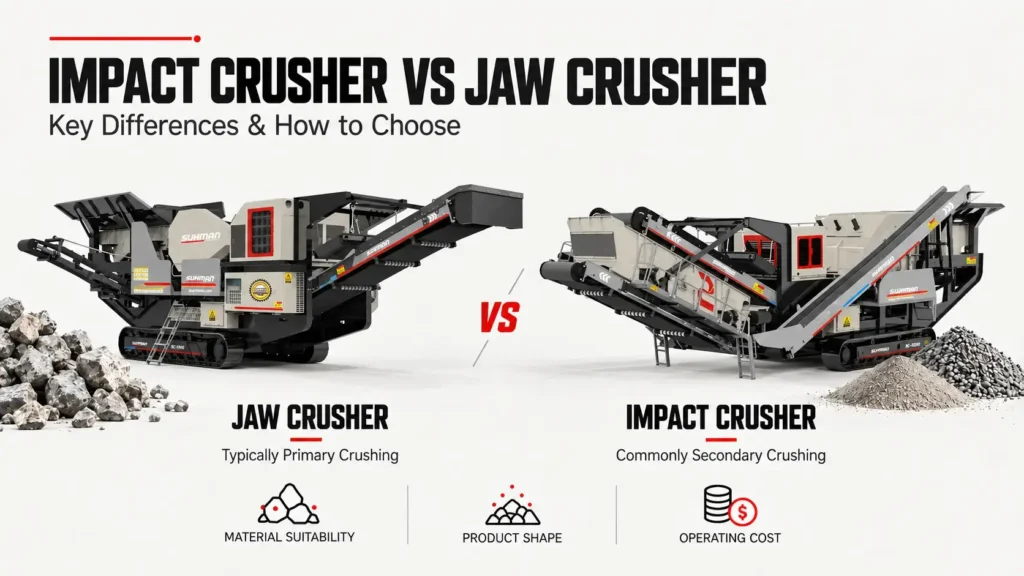
Should you choose an impact crusher or a jaw crusher for your next project? Both can reduce rock or demolition material into smaller pieces. The useful question is which machine can turn your feed into the product you need at a workable cost.
A jaw crusher uses compression and is a common starting point for large, hard, abrasive feed. An impact crusher uses high-speed impacts and is often considered when suitable material needs greater reduction and better particle shape. Some plants use both machines in sequence.
Jaw crushers are typically used for primary crushing, while impact crushers are commonly used for secondary crushing to further reduce material size and improve particle shape. In a typical two-stage setup, the jaw crusher breaks down large feed first, and the impact crusher processes the smaller material that follows. JXSC Machine: Jaw vs Impact
This arrangement depends on the material. A suitably designed impact crusher can also handle primary crushing, particularly in lower-abrasion applications. Metso: Impact Crushers
This guide focuses on horizontal shaft impact crushers (HSI) compared with jaw crushers. Vertical shaft impact crushers (VSI) have different duties and are commonly used toward the end of a circuit for shaping and fine crushing. Metso: Crusher Types
Impact Crusher vs Jaw Crusher: Quick Comparison
| Selection factor | Jaw crusher | Impact crusher (HSI) |
|---|---|---|
| Crushing action | Compresses material between two jaws | Breaks material through rotor-driven impacts |
| Common role | Typically primary crushing: reducing large feed for the next stage | Commonly secondary crushing: further reduction and shaping; suitable designs can also handle primary crushing |
| Material considerations | Often favored for hard, abrasive feed | Often favored for less abrasive material suitable for impact crushing |
| Product shape | May leave more flat or elongated particles | Generally produces a more cubical product |
| Reduction potential | Further crushing may be needed for the target product | Can achieve substantial reduction in one stage |
| Main crushing wear parts | Jaw plates and cheek plates | Blow bars, impact plates, and chamber liners |
| Selection priority | Feed handling and reliable initial reduction | Product requirements balanced against wear costs |
These are starting points for selection. Actual performance depends on the machine, feed, settings, and surrounding equipment. Compare proposed configurations using the same material and output requirements. Anaconda: Crusher Comparison; JXSC Machine: Jaw vs Impact
How Does Each Crusher Work?
Jaw crusher: compression between two plates
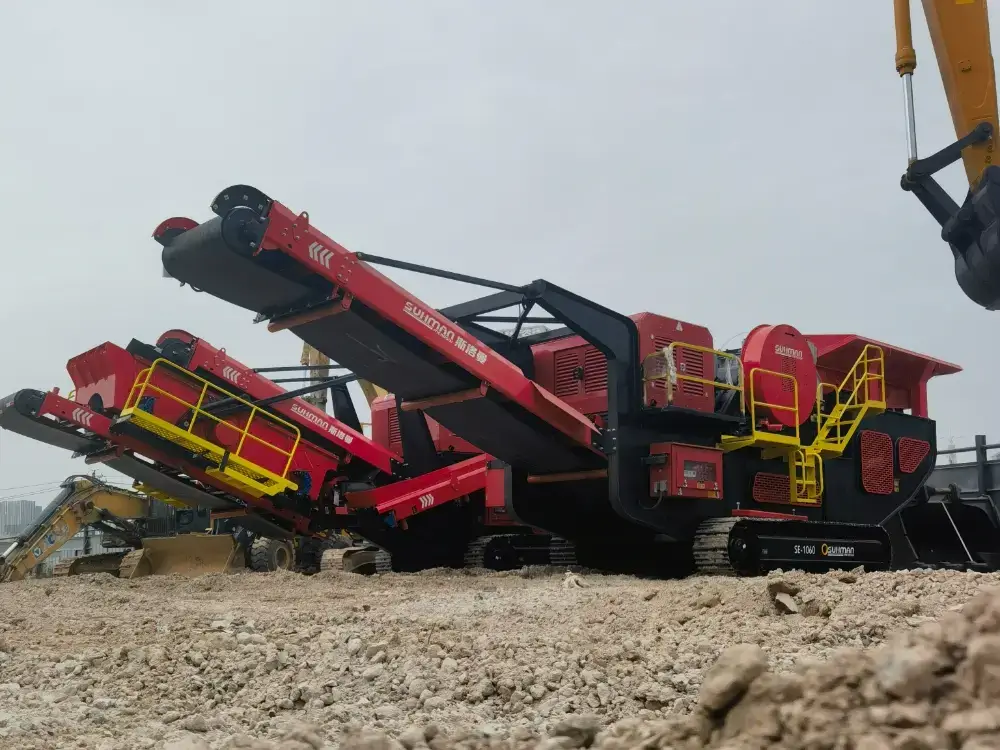
SUHMAN SE-1160 mobile jaw crusher, an example of equipment used for primary crushing.
A jaw crusher has a fixed jaw and a moving jaw. As the moving jaw closes, it compresses the material inside the chamber. Broken pieces move downward and leave through the discharge opening.
This is why jaw crushers commonly serve as the primary crusher in a production line. They reduce large feed to a manageable size for the next stage. The discharge setting influences the product, while the finished specification determines whether further processing is necessary. Metso: Crusher Types
Impact crusher: high-speed impact and repeated breakage
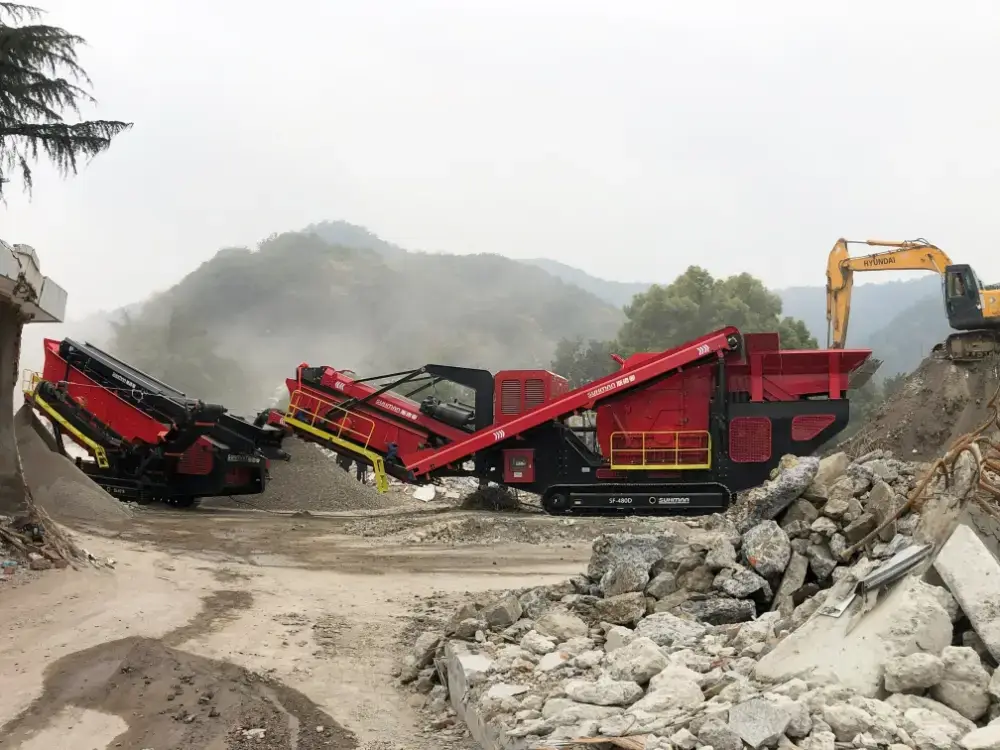
SUHMAN mobile impact crusher with its feeding and conveying equipment.
An HSI crusher has a rotating rotor fitted with blow bars. Material entering the chamber is struck and thrown against impact surfaces. Further collisions break the particles down.
This action combines size reduction with shaping, making the HSI a common secondary crusher for suitable materials. Certain designs can also process prepared feed directly as a primary crusher, depending on the material and final product. Metso: Impact Crushers
For buyers, the mechanism matters because it affects wear, product characteristics, and the number of processing stages worth considering.
Key Differences That Affect Your Operation
1. Material hardness and abrasiveness
Hardness alone is an incomplete basis for choosing a crusher. Abrasiveness also affects the economics of the crushing process.
For hard, abrasive rock, compression crushing is often the stronger economic starting point. HSI crushers are commonly evaluated for less abrasive feed, where impact reduction can be achieved without excessive wear costs. Metso treats both rock characteristics and operating economics as central to technology selection. Metso: Choosing and Maintaining Crushing Equipment
A material description such as “limestone” or “concrete” gives a supplier useful context but leaves important questions open. Provide representative samples or test results when available. Explain how much the feed changes between sources.
2. Feed size and preparation
A jaw crusher is often selected to handle large pieces at the beginning of a process. However, the acceptable feed size is specific to the model. Some primary impact crushers also accept large feed.
Record the largest pieces, their shape, and how often oversize occurs. A few long slabs can create a different feeding problem from a steady stream of evenly sized rock. Metso identifies feed acceptance and bridging as important primary-crusher selection issues. Metso: Crusher Types
Before comparing quotations, ask:
- What is the recommended maximum feed size?
- What preparation is needed before loading?
- How will fines, moisture, and unwanted material be handled?
- What happens when the incoming feed changes?
3. Product shape, gradation, and fines
Impact crushing generally produces a more cubical product. Jaw-crushed material may contain more elongated or flat particles. However, particle shape and product grading are separate requirements.
Grading describes the distribution of particle sizes. A product with a good shape can still contain too much oversize or an unsuitable amount of fines.
Screens separate size fractions, while a return conveyor can send oversize back for further crushing. Machinery Partner discusses these differences in relation to finished aggregate, resale, and the role of screening. Machinery Partner: Crushers and Crushing Stages
Define the intended use first. Backfill, road base, and aggregate for concrete production may require different acceptance criteria. Ask for results against your actual specification.
4. Production capacity
There is no useful universal answer to “Which crusher has more capacity?” Each category contains machines of widely different sizes and duties.
ZENITH, for example, compares the capacities of specific jaw and impact crusher series. Those figures describe its equipment range; they should not become a general ranking of the two technologies. ZENITH: Jaw and Impact Crusher Differences
For a purchasing comparison, request expected performance under one shared set of conditions:
- The same representative feed.
- The same target product specification.
- A clearly described screening and recirculation arrangement.
- Expected operating hours and availability.
Also distinguish material passing through the crusher from finished product leaving the complete plant.
5. Wear parts and maintenance
Jaw plates, blow bars, and liners are recurring operating expenses. Their replacement frequency depends on the application, component selection, and operating conditions.
Maintenance planning should include the work involved in each change, the lifting equipment required, and the availability of replacement parts. Metso also emphasizes regular inspections and selecting wear components to suit the chamber and material. Metso: Choosing and Maintaining Crushing Equipment
Ask suppliers to explain the assumptions behind any wear-life estimate. A statement such as “lasts six months” needs operating hours, tonnage, material details, and replacement criteria to be meaningful.
6. Purchase price and cost per finished ton
An attractive machine price is only one part of a plant investment. Screening, conveyors, feed preparation, and servicing can change the overall comparison.
Rackers recommends evaluating cost per ton in the context of the material and complete operation. Rackers Equipment
For an initial operating-cost comparison, use:
Operating cost per finished ton = Operating expenses during a period ÷ Accepted finished tons produced during that period
Include energy, wear parts, maintenance, and labor consistently. For a fuller ownership comparison, also account for financing or depreciation and other project-specific costs.
Consider this simplified illustration:
| Illustrative operation | Daily operating expenses | Accepted finished product | Operating cost per finished ton |
|---|---|---|---|
| Setup A | $1,200 | 400 tons | $3.00 |
| Setup B | $1,500 | 600 tons | $2.50 |
These figures are hypothetical and represent no particular crusher type. They show why higher daily spending can still produce a lower unit cost when more acceptable product is delivered.
Which Crusher Fits Your Material and Application?
The following scenarios are starting points for a supplier discussion. Final selection requires the actual feed and product requirements.
Hard-rock quarry
For large, abrasive quarry feed, evaluate a jaw crusher for the initial reduction stage. If the operation needs smaller finished aggregate, assess the downstream equipment at the same time.
A cone crusher may be a better secondary candidate than an HSI when abrasiveness makes impact wear expensive. Metso identifies cone crushing as a common choice for hard or abrasive material in later stages. Metso: Choosing and Maintaining Crushing Equipment
The purchasing question becomes: which complete circuit can consistently meet the required specification?
Limestone aggregate production
For suitable, less abrasive limestone, an HSI deserves evaluation, particularly where reduction and particle shape both matter. Feed condition and product requirements still determine whether a standalone machine or a multi-stage arrangement makes sense. ZENITH: Jaw and Impact Crusher Differences
Imagine two customers processing similar feed. One needs a coarse product for internal use. The other sells several screened sizes. Their material may be similar, but their equipment proposals should reflect different production goals.
Concrete and demolition recycling
Both crusher types appear in recycling operations. Feed preparation, steel contamination, and finished sizing are important comparison points. Anaconda notes that impact crushers benefit from properly prepared material and that closed-circuit arrangements provide screening and recirculation. Anaconda: Crusher Comparison
For a proposed recycling setup, clarify:
- Whether the feed is concrete only or mixed demolition waste.
- The size of incoming slabs and blocks.
- How exposed steel and other unwanted material will be managed.
- Whether the output is for internal use or sale.
- What screening and separation equipment is included.
RUBBLE MASTER’s concrete-recycling case study illustrates how product quality and an integrated screen can influence a contractor’s equipment choice. It describes a specific operation; comparable results require comparable conditions. RUBBLE MASTER: Concrete-Recycling Case Study
Can Jaw and Impact Crushers Work Together?
Yes. Primary jaw crushing followed by secondary impact crushing and screening is a common arrangement for suitable, lower-abrasion materials such as many limestones.
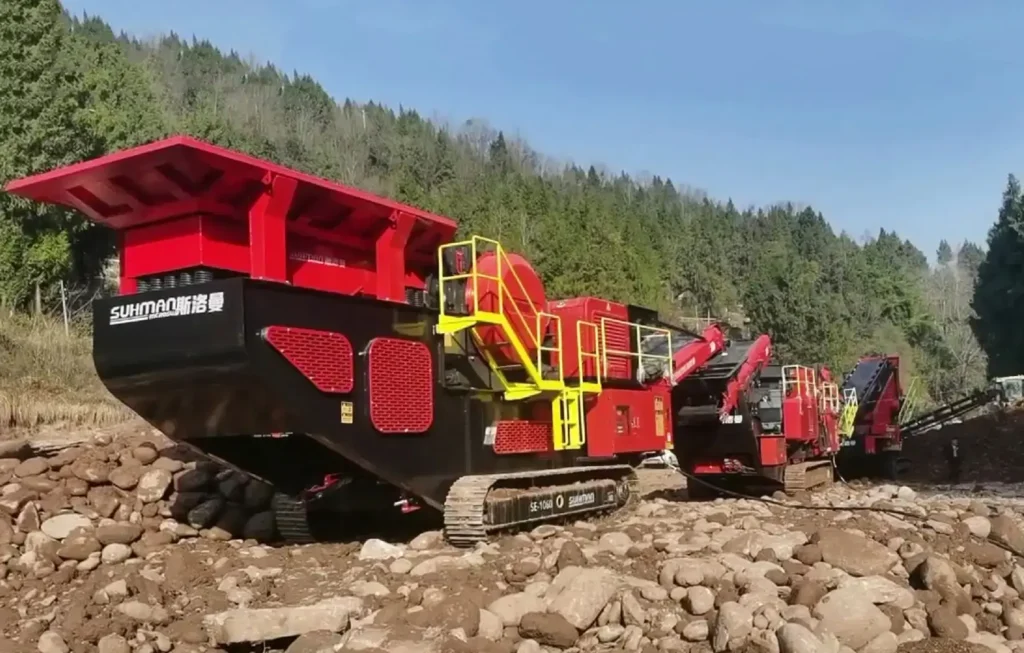
SUHMAN Mobile crusher and screening plant: SE-1060+SY-HP300+SS-6518
The stages have distinct jobs:
- Primary jaw crusher: reduces large incoming pieces to a manageable feed size.
- Secondary impact crusher: further reduces the material and improves particle shape.
- Screen: separates the required product sizes; oversize can return for further crushing where the circuit includes a return conveyor.
A jaw-plus-cone arrangement may be more economical for highly abrasive rock. A standalone impact plant is another option when it can accept the prepared feed and achieve the required product. The right choice depends on the complete process. Metso: Choosing and Maintaining Crushing Equipment
Compare the alternatives as complete systems. An extra stage may improve control, but it also introduces additional equipment and operating requirements.
What to Prepare Before Requesting a Recommendation
A clear operating brief helps suppliers explain and justify their proposals. Include:
| Information | What to provide |
|---|---|
| Feed material | Source, material description, samples or available test data |
| Feed condition | Maximum dimensions, size variation, moisture, fines, contamination |
| Finished product | Target sizes, grading and shape requirements, intended use |
| Production target | Required finished tons per hour and operating schedule |
| Site conditions | Space, access, mobility needs, available power |
| Existing equipment | Feeders, crushers, screens, conveyors, separators |
| Support needs | Destination, service access, spare-parts expectations |
These inputs support a material-specific discussion rather than a recommendation based only on a machine name. DIMEC: Crusher Selection Guide
Planning a crushing project? Share your feed material, maximum feed size, target product sizes, and required output with the Suhman team to discuss a suitable configuration.
FAQs
Is an impact crusher better than a jaw crusher?
The better choice depends on the task. Start with the feed properties, required product, and complete processing arrangement. Assess wear and operating costs under those conditions rather than assuming either technology is always superior.
Can an impact crusher be used as a primary crusher?
Yes. Although impact crushers commonly serve as secondary crushers, suitable designs can handle primary crushing in applications such as lower-abrasion rock processing and concrete recycling. Confirm the proposed model’s feed limits, material suitability, and preparation requirements.
Which crusher is better for concrete recycling?
Evaluate the incoming concrete, steel and other contamination, preparation needs, and required finished product. A screen-equipped impact plant is one option; a jaw-based arrangement may suit other project requirements.
Does an impact crusher always produce a finished, saleable aggregate?
No. Saleability depends on the buyer’s specification. Check grading, particle shape, and other acceptance criteria. Screening and further processing may be needed to produce the required material.
Should I choose a mobile jaw crusher or a mobile impact crusher?
Choose the crushing technology around the material and product first. Then evaluate transport dimensions, site access, setup requirements, and the equipment needed alongside it. Mobility is an additional selection factor for either technology.