Crushed stone
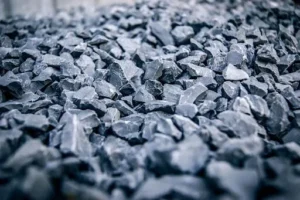
Crushed stone is an aggregate material produced by mechanically crushing and screening natural rock. Common raw materials include:
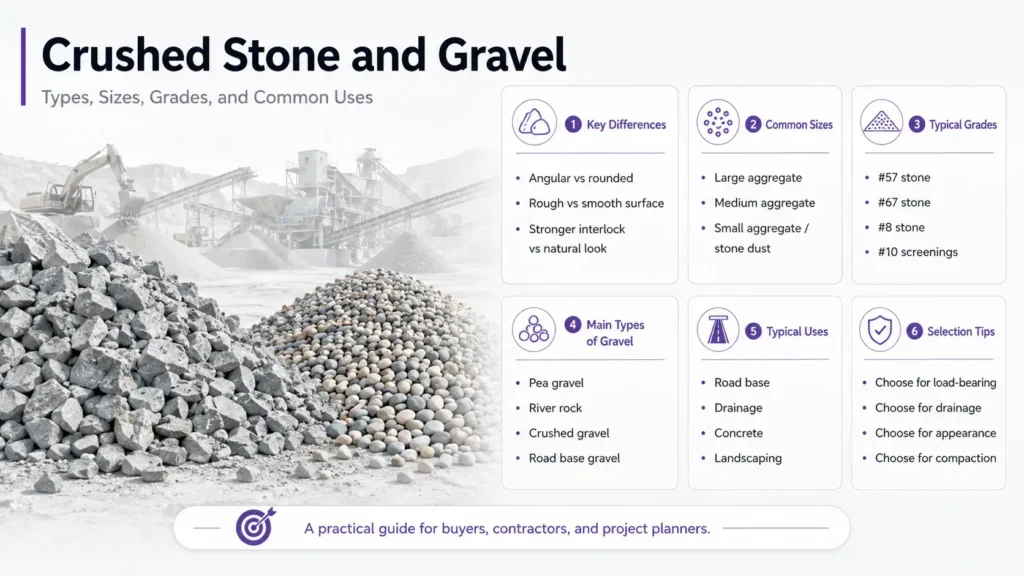
Crushed stone is characterized by its angular shape, rough surface, and strong interlocking ability. Because of these properties, it is more suitable for engineering applications that require load-bearing strength and structural stability, such as road base layers, concrete aggregates, railway ballast, drainage layers, and other construction projects.
Gravel
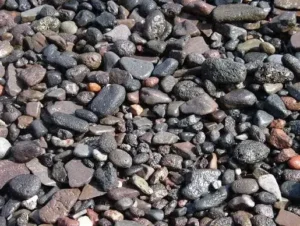
Gravel is mainly sourced from riverbeds, lakes, alluvial deposits, or natural quarry deposits. It is typically screened and washed before use. Gravel particles are usually more rounded and smoother in surface texture, as they are formed through long-term water movement or natural weathering.
Gravel is commonly used for:
- Garden landscaping
- Driveway surfacing
- Drainage systems
- Concrete mixing
- Decorative ground cover
| Item | Crushed Stone | Gravel |
|---|---|---|
| Source | Mechanically crushed from large natural rocks | Naturally deposited or sourced from riverbed materials |
| Shape | Angular and sharp-edged | More rounded |
| Surface Texture | Rough | Smooth |
| Interlocking Ability | Strong | Relatively weak |
| Load-Bearing Capacity | Better | Moderate |
| Common Uses | Road base, concrete, railway ballast, and construction projects | Landscaping, drainage, driveways, and decorative applications |
Crushed stone is more commonly used for engineering and structural applications, while gravel is more commonly used for general-purpose and landscaping applications.
If a project requires strong compaction, stability, and load-bearing performance, crushed stone is usually the better choice.
If a project focuses more on natural appearance, drainage, or decorative effect, gravel is commonly used.
Crushed Stone Sizes
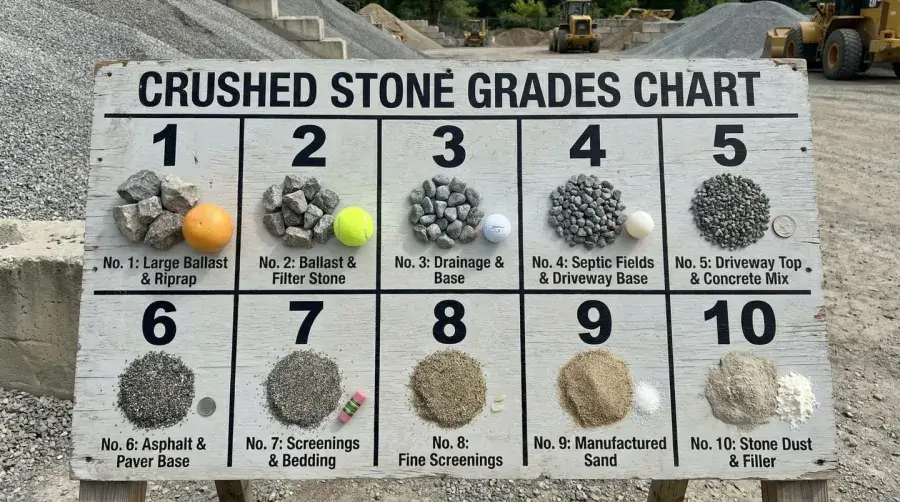
The size of crushed stone usually refers not to a single particle size, but to a particle size range. For example, #57 stone does not mean a 57 mm stone. Instead, it is a size designation based on screening and gradation.
According to common DOT gradation tables, the nominal size of #57 stone is typically 1″ to No. 4 sieve, which can be approximately understood as a crushed stone gradation ranging from 25 mm to 4.75 mm.
| Grade | Common English Name | Approximate Size | Typical Applications |
|---|---|---|---|
| #1 | No. 1 Stone | 3-1/2″ – 1-1/2″ / 89–38 mm | Large fill, deep road base, erosion control, heavy-duty foundations |
| #2 | No. 2 Stone | 2-1/2″ – 1-1/2″ / 64–38 mm | Road subbase, drainage base, heavy-duty engineering foundations |
| #3 | No. 3 Stone | 2″ – 1″ / 50–25 mm | Railway ballast, thick road base, drainage fill |
| #4 | No. 4 Stone | 1-1/2″ – 3/4″ / 38–19 mm | Road base, drainage layers, coarse aggregate |
| #5 | No. 5 Stone | 1″ – 1/2″ / 25–12.5 mm | General road base, coarse aggregate for concrete, drainage |
| #57 | No. 57 Stone | 1″ – No. 4 / 25–4.75 mm | One of the most common grades; drainage, concrete, driveways, foundation backfill |
| #67 | No. 67 Stone | 3/4″ – No. 4 / 19–4.75 mm | Concrete, pavement base, slab base, more even base layers |
| #7 | No. 7 Stone | 1/2″ – No. 4 / 12.5–4.75 mm | Asphalt, concrete, thin paving layers, surface materials |
| #8 | No. 8 Stone | 3/8″ – No. 8 / 9.5–2.36 mm | Permeable pavement bedding, concrete, landscaping, decorative surface layers |
| #9 | No. 9 Stone | No. 4 – No. 16 / 4.75–1.18 mm | Fine aggregate, asphalt, leveling layers |
| #10 | No. 10 Stone / Stone Dust / Screenings | No. 4 – No. 200 / 4.75–0.075 mm | Stone dust, paving leveling, compacted base, concrete blocks |
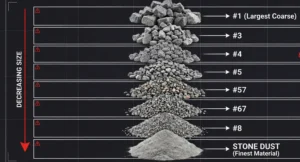
Large-size crushed stone is commonly used for road base, railway ballast, heavy-duty base layers, and drainage layers.
Medium-size crushed stone is commonly used for concrete, driveways, road base, and drainage systems.
Small-size crushed stone, stone dust, and screenings are commonly used for paving leveling, asphalt, concrete blocks, and compacted base applications.
Most Common Crushed Stone Grades
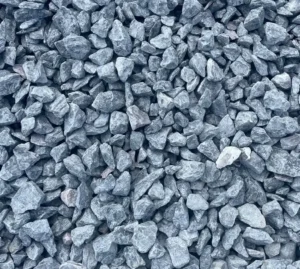
#57 stone
#57 stone is one of the most common general-purpose crushed stone grades. It is suitable for drainage systems, French drains, foundation drainage, concrete aggregate, and permeable pavement base layers. In ICPI and permeable pavement applications, ASTM No. 57 stone is often used as a base layer, while smaller grades such as No. 8 or No. 9 are used for joint fill or bedding layers.
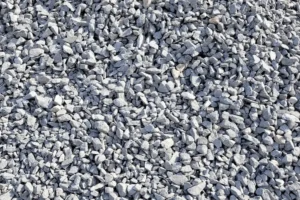
#67 stone
#67 stone is slightly finer than #57 stone. It is commonly used for concrete, road base, slab base, and areas that require a more tightly placed aggregate layer. Because the particles are smaller, #67 stone can create a smoother surface than #57 stone, although its drainage voids are usually smaller.
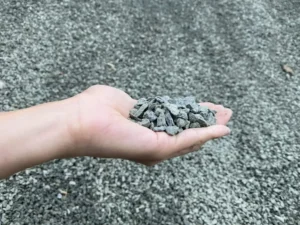
#8 stone
#8 stone is a smaller crushed stone grade. It is commonly used for concrete, permeable pavement bedding layers, landscape surfaces, and decorative paving. In permeable pavement systems, smaller crushed stone is often used for upper leveling or joint filling, while larger crushed stone is used in lower layers for load-bearing support and water storage.
#10 stone
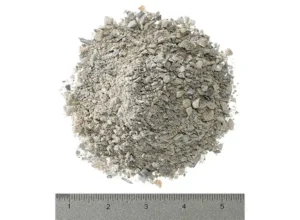
#10 stone, also known as screenings or stone dust, is closer to a fine aggregate or stone powder. It is suitable for paving leveling, joint filling, compacted base applications, or mixing with larger crushed stone to create a denser and more stable base material.
The larger the crushed stone, the stronger it is for load-bearing, drainage, and fill applications. Grades such as #1, #2, and #3 are suitable for heavy-duty engineering projects.
Medium-size crushed stone provides the strongest overall versatility. Grades such as #57 and #67 are widely used for roads, drainage, concrete, and driveways.
The smaller the crushed stone, the smoother the surface and the easier it is to compact. Grades such as #8, #9, and #10 are suitable for paving, leveling, decorative applications, and fine aggregate uses.
Open-Graded vs. Dense-Graded Crushed Stone
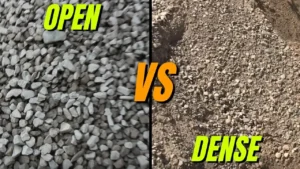
In addition to size designations, crushed stone is also commonly classified by its gradation structure.
Open-graded stone contains fewer fine particles, leaving larger void spaces between the stones and providing better drainage performance. Grades such as #57 and #67 are commonly used for drainage, permeable pavement, retaining wall backfill, and similar applications. In permeable pavement systems, the interconnected voids in open-graded aggregate allow stormwater to pass through and be temporarily stored within the base layer.
Dense-graded aggregate, also known as crusher run in many applications, contains both crushed stone and fine particles. It can be compacted into a denser and more stable layer, making it suitable for road base, driveway base, and paving base applications. Crusher run is usually a mixture of larger crushed stone and screenings or stone dust. For example, #57 stone mixed with #10 stone dust can form a tighter and more compact base material.
Common Types of Gravel
In actual procurement, the most common types of gravel include the following:
Pea Gravel
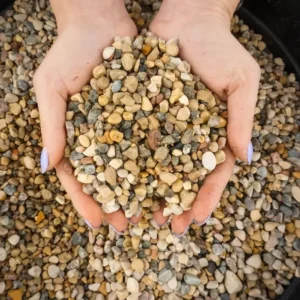
Pea gravel is a very common type of small rounded gravel. Its name comes from its pea-like size.
The typical size is approximately:
Around 3/8 inch, or about 9–10 mm
Pea gravel consists of small, rounded particles and is suitable for gardens, patios, walkways, and decorative ground cover.
River Gravel / River Rock
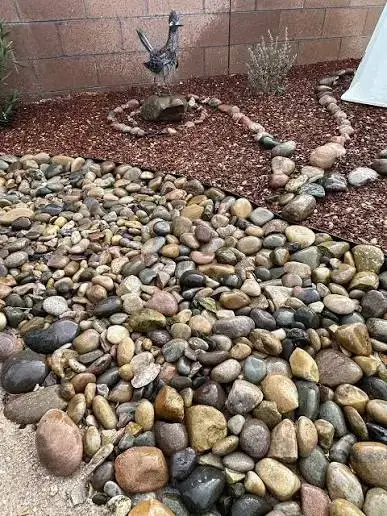
River gravel, also known as river rock, is a natural rounded gravel suitable for landscaping, water features, and drainage channels.
It is formed by long-term water movement, which gives the particles a rounded shape and smooth surface.
Key features include:
- Natural appearance
- Rich color variation
- Mostly round or oval particles
- Strong decorative value
- Not ideal for high-load-bearing base layers
Crushed Gravel
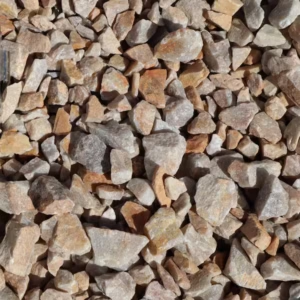
Crushed gravel is produced by further crushing natural gravel. It is similar to crushed stone, but the raw material is usually natural gravel rather than large quarried rock.
Key features include:
- More angular than natural rounded gravel
- Better compaction performance
- Stronger stability
- More suitable for road base and driveway base than river gravel
Crushed gravel is commonly used for road base, driveways, drainage layers, and concrete aggregate.
Washed Gravel
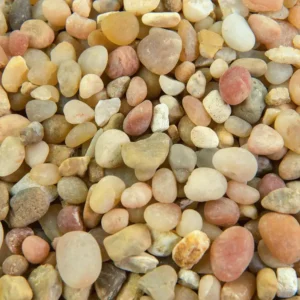
Washed pea gravel
Washed gravel is gravel that has been cleaned to reduce dust, clay, and fine particles. It is suitable for drainage, concrete, and landscaping projects.
Drainage Gravel
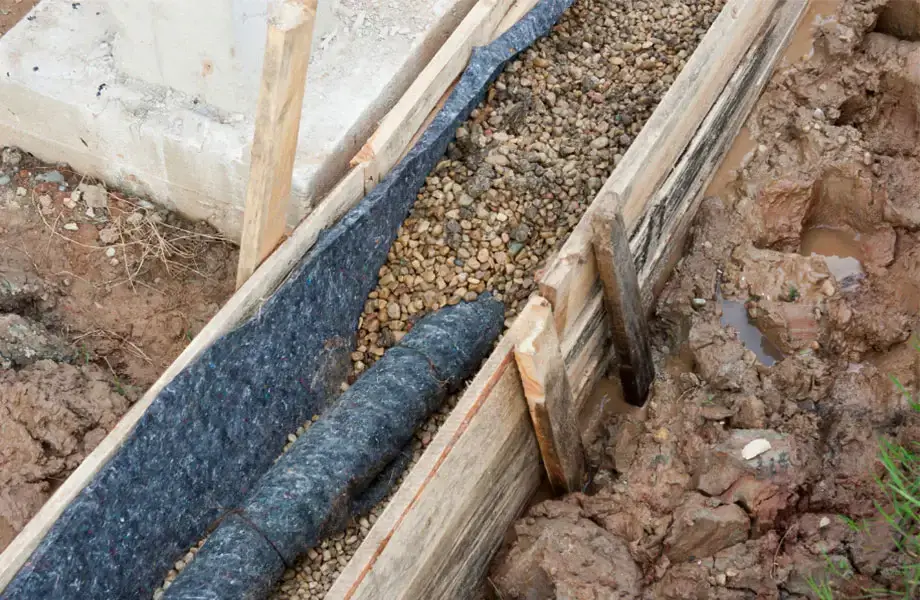
Drainage gravel is used in drainage systems and requires good void space so that water can pass through easily without clogging.
Road Base Gravel
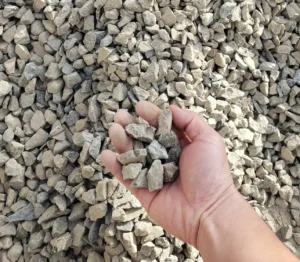
Road base gravel is usually a mixture of different particle sizes and contains fine particles. After compaction, it forms a stable base layer suitable for driveways and road base applications.
| Type | Key Features | Common Applications |
|---|---|---|
| Pea Gravel | Small particles, rounded shape, strong decorative value | Garden paths, patios, flower beds, dog runs |
| River Rock | Smooth, natural, rich in color variation | Landscaping, water features, drainage channels |
| Crushed Gravel | Angular particles, good compaction performance | Driveways, road base, parking lots |
| Drainage Gravel | Large void spaces, good drainage performance | French drains, drainage ditches, foundation drainage |
| Road Base Gravel | Mixed particle sizes, compactable | Road base, driveway base |
| Decorative Gravel | More attractive in color and shape | Gardens, courtyards, commercial landscaping |
| Washed Gravel | Cleaned material with less dust and fines | Concrete, drainage, landscaping |
| Bank Gravel | Natural mixed material containing sand and soil | Fill, low-grade base layers |
For a natural decorative effect, choose pea gravel or river gravel.
For drainage performance, choose washed gravel or drainage gravel.
For load-bearing strength and compaction, choose crushed gravel or road base gravel.
For low-cost fill applications, choose bank gravel.