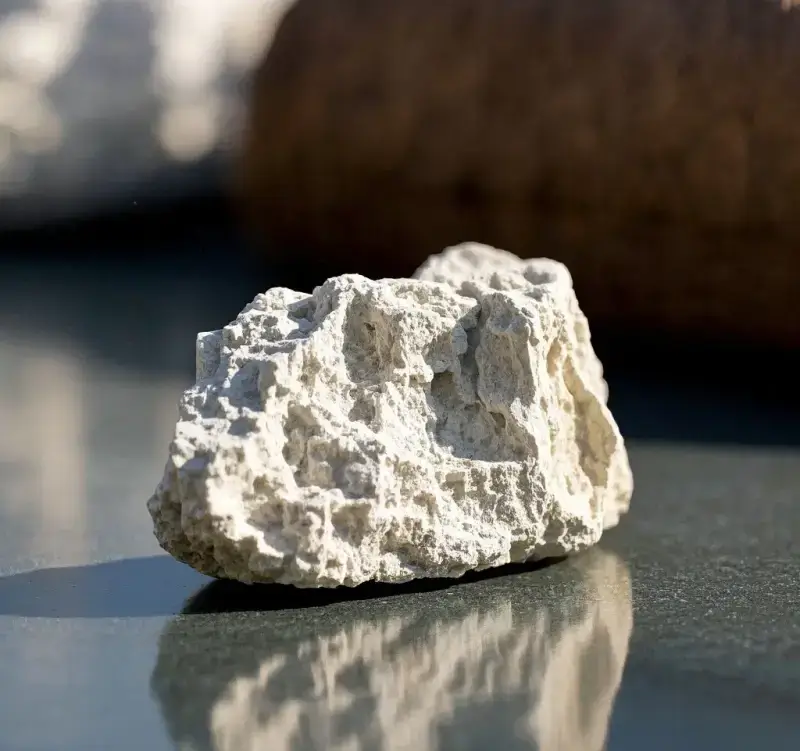
Limestone is one of the most common rocks on Earth. It covers large areas of the planet’s surface and plays an important role in nature, industry, and human history. This article explains what limestone is, how it forms, what it looks like, and how people use it.
Formation
Limestone is a sedimentary rock. It forms mainly from calcium carbonate (CaCO₃). There are two main ways it develops.
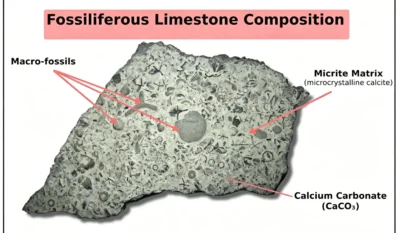
Biological formation is the most common. Over millions of years, marine organisms such as corals, mollusks, and foraminifera build shells and skeletons from calcium carbonate. When these organisms die, their remains sink to the seafloor. They accumulate in layers and gradually compact and harden into limestone. Most limestone found on land today formed at the bottom of ancient, shallow seas.
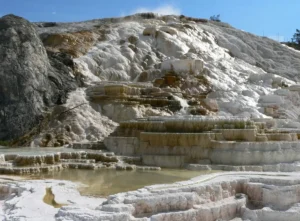
Chemical precipitation is the second way. In some environments, calcium carbonate dissolves in water and then crystallizes out when conditions change. This happens in warm, clear, shallow seas, in cave systems, and around hot springs.
Both processes take place over very long periods of time. Limestone deposits found today represent millions of years of geological history.
Properties
Limestone has several distinct physical and chemical properties.
Composition: Limestone is made primarily of the mineral calcite (CaCO₃). Some varieties also contain dolomite, clay, sand, or iron.
Color: Most limestone is white, grey, or cream-colored. Impurities such as iron oxides can produce yellow, red, or brown tones.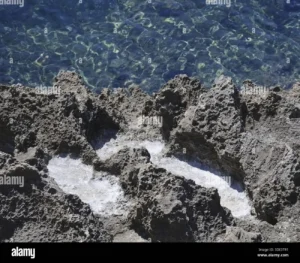
Hardness: Limestone ranks about 3 on the Mohs hardness scale. This makes it relatively soft compared to many other rocks. It can be scratched with a steel knife.
Acid reaction: Limestone reacts with dilute hydrochloric acid and produces visible bubbling (CO₂ gas). This is a standard field test used to identify the rock.
Porosity: Many limestones are porous. Water can move through the rock, especially along cracks and joints. Over time, this allows dissolution and the formation of underground features.
Weathering: Limestone dissolves slowly in slightly acidic water, including normal rainwater. This property makes it vulnerable to weathering over long timescales and leads to the distinctive landscapes described below.
Types
There are several recognized types of limestone, each formed under different conditions.
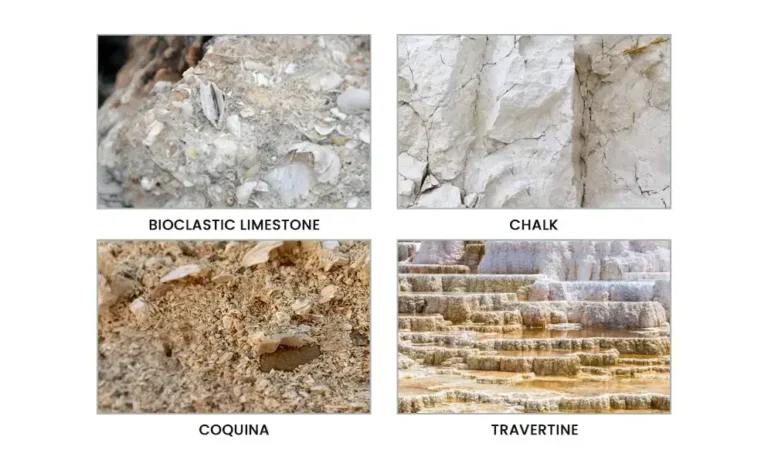
Chalk is a soft, white, fine-grained limestone. It forms from the remains of microscopic marine organisms called coccoliths. The White Cliffs of Dover in England are a well-known example.
Oolitic limestone consists of small, rounded grains called ooids. Each ooid forms when layers of calcium carbonate build up around a small particle in shallow, agitated water. Indiana Limestone in the United States is a widely used example.
Travertine forms around hot springs and in cave environments. Calcium carbonate precipitates out of mineral-rich water, creating layered, banded deposits. It is often used as a decorative stone.
Coquina is a loose or lightly cemented rock made almost entirely of shell fragments and fossils. It is coarse-textured and relatively soft.
Micrite (or micritic limestone) is a fine-grained variety made of very small carbonate particles. It is dense and typically looks smooth.
Marble is not a type of limestone in the sedimentary sense, but it is formed from limestone. Heat and pressure during geological events cause limestone to recrystallize into marble, a metamorphic rock.
Uses
Humans have used limestone for thousands of years. It remains one of the most economically important rocks in the world.
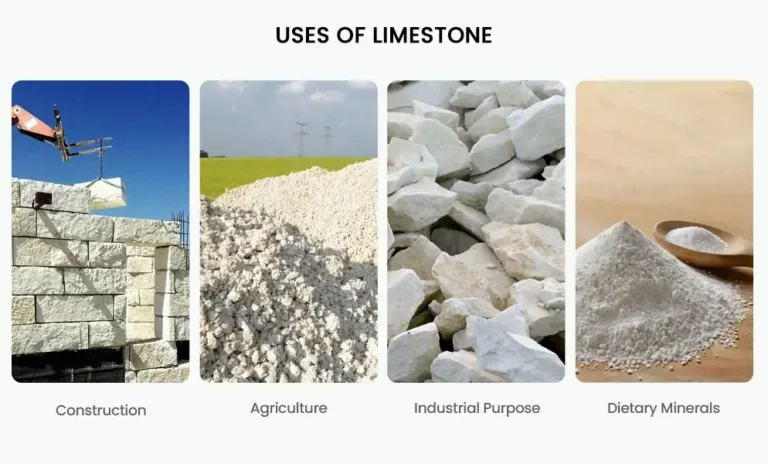
Construction: Limestone has been used as a building material since ancient times. The pyramids of Giza were built largely from limestone blocks. Many historic churches, government buildings, and monuments around the world use limestone as a facing stone or structural material.
Cement and concrete: Limestone is a key raw material in the production of Portland cement. Cement is the binding agent in concrete, which is the most widely used construction material in the world.
Steel production: Limestone (in the form of quicklime) is used in blast furnaces as a flux. It combines with impurities in iron ore, helping remove them as slag.
Agriculture: Ground limestone is spread on acidic soils to raise the pH level. This improves conditions for crop growth. It is one of the most widely used soil amendments in farming.
Water treatment: Lime derived from limestone is used to remove impurities from drinking water and to neutralize acidic wastewater.
Industrial minerals: Finely ground limestone is used as a filler in paper, paint, plastics, and rubber. It improves texture, opacity, and stability in these products.
Pharmaceuticals and food: High-purity calcium carbonate from limestone is used as a calcium supplement, an antacid, and a food additive.
Karst Geography
When water slowly dissolves limestone over thousands of years, it creates dramatic landscapes known as karst. These landscapes are found on every continent and cover roughly 10–15% of the Earth’s land surface. Some of the world’s most striking examples include the caves of Carlsbad Caverns in New Mexico, the tower karst of Guilin in China, and the rocky limestone pavements of the Burren in Ireland.
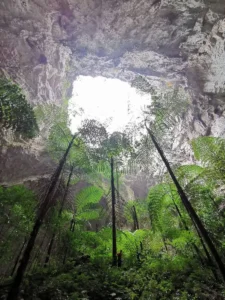
Sinkholes form when underground cavities collapse. They can develop suddenly or over a long period. Some sinkholes are small depressions; others are hundreds of meters wide and deep.
Caves develop as acidic water follows cracks and joints in the rock and slowly dissolves the limestone. Over time, these passages widen into cave systems. Cave decorations such as stalactites (hanging from the ceiling) and stalagmites (rising from the floor) form from calcium carbonate deposited by dripping water.
Underground drainage is common in karst regions. Rivers and streams may disappear into the ground and flow through cave networks rather than on the surface. This makes water management more complex in these areas.
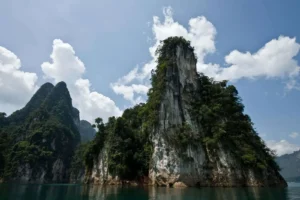
Tower karst is a dramatic form seen in places like Guilin in China and Halong Bay in Vietnam. Erosion leaves behind tall, steep limestone pillars rising from flat ground or water.
Dolines and poljes are other common karst features. Dolines are closed depressions formed by dissolution or collapse. Poljes are large, flat-floored basins surrounded by limestone hills.
Well-known karst areas include the Yucatán Peninsula in Mexico, the Dinaric Alps in southeastern Europe, the Guizhou Plateau in China, and the Nullarbor Plain in Australia.
How Limestone Is Processed
Processing limestone turns raw rock into usable products. The steps depend on the intended end use.
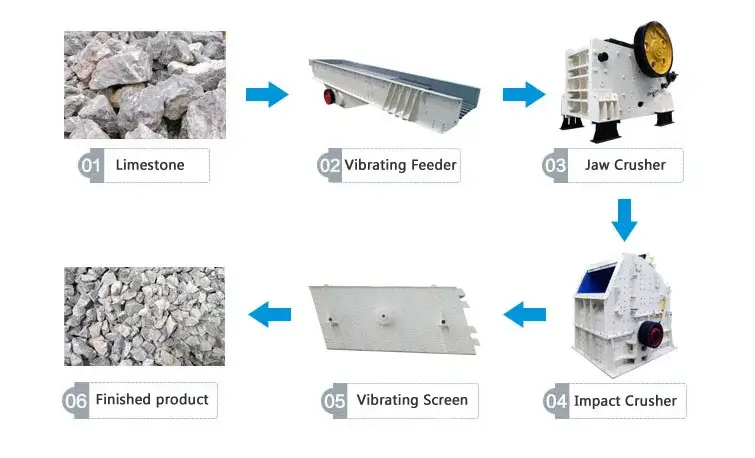
Step 1: Quarrying
Limestone is extracted from open-pit quarries. Workers drill holes in the rock face and use controlled blasting to break large sections loose. Excavators and trucks then move the broken rock to a crusher. Some limestone is also extracted by cutting, especially when intact blocks are needed for construction.
Step 2: Primary Crushing
Large chunks of blasted rock go through a primary crusher. Jaw crushers and gyratory crushers are commonly used at this stage. They reduce the rock to smaller pieces, typically under 150–200 mm in size.
Step 3: Secondary Crushing and Screening
The material then passes through secondary and sometimes tertiary crushers, such as cone crushers or impact crushers. Vibrating screens separate particles by size. Material that is too large goes back for further crushing. Undersized material is collected separately.
Step 4: Grading and Stockpiling
Crushed limestone is sorted into different size grades. Coarse grades are used as construction aggregate for road bases, concrete production, and fill material. Finer grades go to the next stage of processing.
Step 5a: Calcination (for lime production)
When limestone is heated in a kiln at temperatures between 900 °C and 1,000 °C, it undergoes a chemical reaction called calcination:
CaCO₃ → CaO + CO₂
The product is quicklime (CaO), a highly reactive material. Adding water to quicklime (a process called slaking) produces slaked lime (Ca(OH)₂), also called hydrated lime. Slaked lime is used in steelmaking, water treatment, soil stabilization, and as a chemical feedstock.
Step 5b: Fine Grinding (for industrial powder)
For applications in paint, paper, plastics, and food, limestone is ground into a very fine powder in ball mills or roller mills. This product is called ground calcium carbonate (GCC). Particle size is carefully controlled to meet the specifications of different industries.
Step 5c: Cement Production
Limestone for cement goes through a more involved process. It is crushed and mixed with clay and other materials, then fed into a large rotary kiln and heated to around 1,450°C. This produces a material called clinker. The clinker is cooled and ground together with a small amount of gypsum to produce Portland cement.
Quality Control
Throughout processing, samples are tested for chemical purity, particle size, and calcium carbonate content. Different applications require different purity levels. Pharmaceutical-grade calcium carbonate, for example, must meet strict standards for heavy metal content and particle size.
Summary
Limestone is a versatile and widely distributed rock with a long geological history. It forms from the remains of marine organisms or from chemical precipitation. It is used in construction, industry, agriculture, and manufacturing. In karst regions, its solubility shapes entire landscapes over geological time. Processing limestone — from quarrying through calcination, grinding, and cement production — turns this common rock into materials that support modern infrastructure and industry.
FAQ about Limestone
What color is limestone?
Varies
Most limestone is white, grey, or cream. Iron and other impurities can produce shades of yellow, tan, brown, or even pink. The exact color depends on the mineral content and where it formed.
How do you clean mildew and rust from outside limestone walls?
For mildew, use a soft brush with a diluted pH-neutral cleaner or a specialist stone cleaner. Avoid bleach — it can discolor limestone. For rust stains, use a poultice made from a rust-removing agent designed for natural stone. Never use wire brushes or acidic cleaners, as they will etch and damage the surface.
Does limestone kill moss?
Yes—indirectly
Limestone raises soil pH, making conditions less favorable for moss, which prefers acidic environments. Agricultural lime is commonly used to suppress moss on lawns. It does not kill moss directly on contact, but over time, it discourages moss growth by altering soil chemistry.
Is limestone an igneous rock?
No
Limestone is a sedimentary rock. It forms from accumulated marine organisms and chemical precipitation — not from cooled magma. Igneous rocks (like granite or basalt) form from solidified molten rock. Limestone belongs to a completely different rock family.
Is limestone porous?
Yes
Most limestone is porous to some degree. Water moves through it along tiny pores and cracks. This porosity is what allows rainwater to dissolve limestone slowly over time, eventually forming caves and karst landscapes. Porosity varies by type — dense micritic limestone is less porous than chalk or oolitic limestone.
Is limestone toxic?
Not in general
Limestone in its natural form is not toxic. Calcium carbonate is used in food, medicine, and dietary supplements. However, quicklime (CaO)—produced by heating limestone—is a different matter. Quicklime is caustic and can cause burns to skin, eyes, and the respiratory tract if inhaled as dust. Always use protective equipment when handling processed lime products.
What is the pH of limestone?
~8–9
Limestone itself is alkaline. When it dissolves in water, it forms a solution with a pH of roughly 8 to 9. Slaked lime (Ca(OH)₂) in water reaches pH 12–13. This alkalinity is why limestone and lime are used to neutralize acidic soils and acidic wastewater.
Where do you find limestone?
Worldwide
Limestone is found on every continent. Major deposits occur across the United States (Indiana, Texas, Florida), the UK (the Cotswolds, Yorkshire), France, China, India, the Caribbean, and the Middle East. In general, wherever shallow tropical seas once existed, limestone is likely to be found.
Why were the pyramids covered in limestone?
Historical
The outer casing of the Great Pyramid of Giza was originally covered in highly polished white Tura limestone. This gave the pyramids a smooth, bright, reflective surface visible from a great distance. Over centuries, most of this casing stone was stripped away and reused in other construction projects, particularly in medieval Cairo. Today, only a small amount of casing stone remains at the base of the pyramid.
Does limestone kill grass?
No—it can help
Limestone does not kill grass. When applied correctly to acidic soils, it raises the pH and can actually improve grass health. Overapplication, however, can push the pH too high and make it harder for grass to absorb certain nutrients. Always test your soil pH before adding limestone.
Does limestone react with acid?
Yes
Limestone reacts readily with acids. Dilute hydrochloric acid causes it to fizz and bubble — this is the release of carbon dioxide gas. This reaction is: CaCO₃ + 2HCl → CaCl₂ + H₂O + CO₂. Even mild acids like carbonic acid (from rainwater absorbing CO₂) are enough to slowly dissolve limestone over geological time, creating caves and karst landscapes.
Is limestone acidic?
No — it’s alkaline
Limestone is alkaline, not acidic. It is made of calcium carbonate, which neutralizes acids. This is precisely why it is used to raise soil pH, treat acidic water, and reduce stomach acid as an antacid medication. The confusion sometimes arises because limestone weathers in acid — but the rock itself is basic.
Is limestone expensive?
Depends on use
As crushed aggregate or agricultural lime, limestone is one of the cheapest materials available — typically just a few dollars per ton. As a building or decorative stone (cut slabs, tiles, cladding), prices rise significantly based on quality, finish, and origin. Premium decorative limestone can cost anywhere from $30 to over $200 per square meter. Processing into cement or quicklime adds further cost.