Introduction
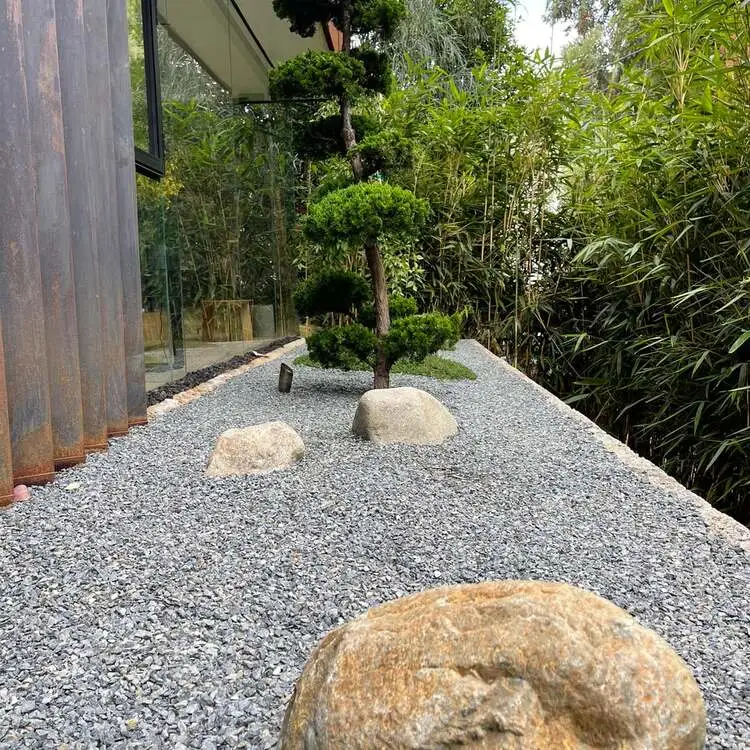
Crushed granite is widely used for driveways, walkways, patios, garden paths, and construction bases. It has a natural look, strong hardness, and good load-bearing potential when it is installed correctly.
But crushed granite is not a “set it and forget it” material. Many problems discussed by homeowners are related to poor base preparation, weak compaction, bad drainage, weeds, loose particles, and tracking into the house. In one Reddit discussion, a homeowner reported that a 2-inch decomposed granite layer became soft after rain. Several replies focused on the same point: the layer was thin, and the base was not strong enough. (Reddit)
This guide explains what crushed granite is, where it works well, where it may cause problems, and how it is produced by granite crushing equipment.
What Is Crushed Granite?
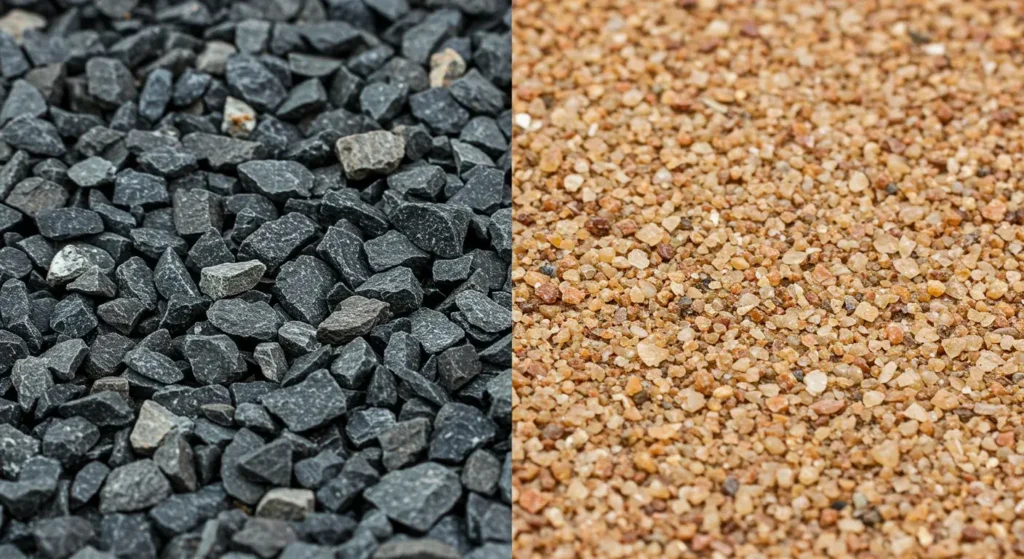
Crushed granite is natural granite rock that has been mechanically broken into smaller angular pieces. It is different from natural rounded gravel. Rounded gravel is shaped by natural erosion. Crushed granite is produced by quarrying granite and crushing it into controlled sizes.
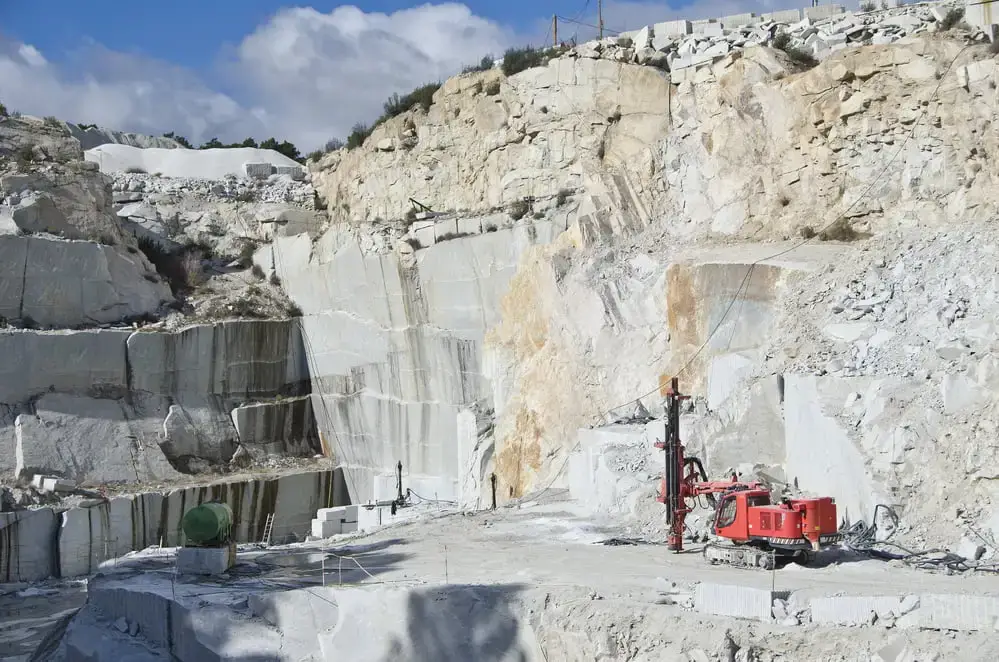
Granite itself is a hard igneous rock mainly made of quartz and feldspar minerals. Because of its hardness and durability, granite is widely used as a construction and aggregate material. (Wikipedia)
Crushed granite may be sold as:
- crushed granite gravel
- crushed granite stone
- crushed granite rock
- crushed granite fines
- crusher run granite
- decomposed granite, also called DG in landscaping
In the construction industry, crushed stone is a basic aggregate material. The U.S. Geological Survey reported that the United States produced about 1.5 billion tons of crushed stone in 2023. Granite accounted for about 15% of total domestic crushed stone production. About 70% of crushed stone was used as construction aggregate, mainly for road construction and maintenance. (pubs.usgs.gov)
Crushed Granite vs Decomposed Granite: Are They the Same?
Crushed granite and decomposed granite are often used as if they mean the same thing. They are related, but they are not always the same.
| Comparison Dimension | Crushed Granite | Decomposed Granite (DG) | |||
|---|---|---|---|---|---|
| Formation | Mechanically crushed | Natural weathering and decomposition | |||
| Particle Characteristics | Larger pieces with sharp, angular edges | Smaller, sandy/gravelly particles with a softer texture | |||
| Compaction & Stability | Interlocks tightly, rarely shifts or moves | Compacts well, but the surface layer retains some loose grit | |||
| Primary Applications | Construction & Infrastructure(Focuses on load-bearing and support) | Landscaping & Gardens(Focuses on aesthetics and natural feel) |
Crushed Granite
Crushed granite usually refers to mechanically crushed granite rock. It can include different sizes, from larger stones to fine particles. Because the particles are angular, they can lock together better than rounded gravel when compacted.
This makes crushed granite useful for:
- driveways
- road base
- drainage layers
- patios
- walkways
- construction aggregate
Decomposed Granite
Decomposed granite is granite that has weathered into smaller pieces. Its texture is much softer than mechanically crushed stone, resembling a mixture of coarse sand, gravel, and a small amount of fine soil. While it compacts easily, the surface retains a natural, loose, gritty feel and offers excellent water permeability. It is commonly used for garden paths, walkways, parks, patios, and low-water landscapes. (Wikipedia)
In landscaping, decomposed granite is often valued for its natural appearance. But because it contains fine particles, it can become loose, dusty, or soft when the base is not prepared well.
Stabilized Decomposed Granite
Stabilized decomposed granite contains a binder or stabilizer. The purpose is to reduce movement, dust, and washout. Some products use polymer stabilizers. Some contractors may use cement-based methods in special situations. However, stabilized DG is still not the same as concrete. It may still need maintenance over time.
What Is Crushed Granite Used For?
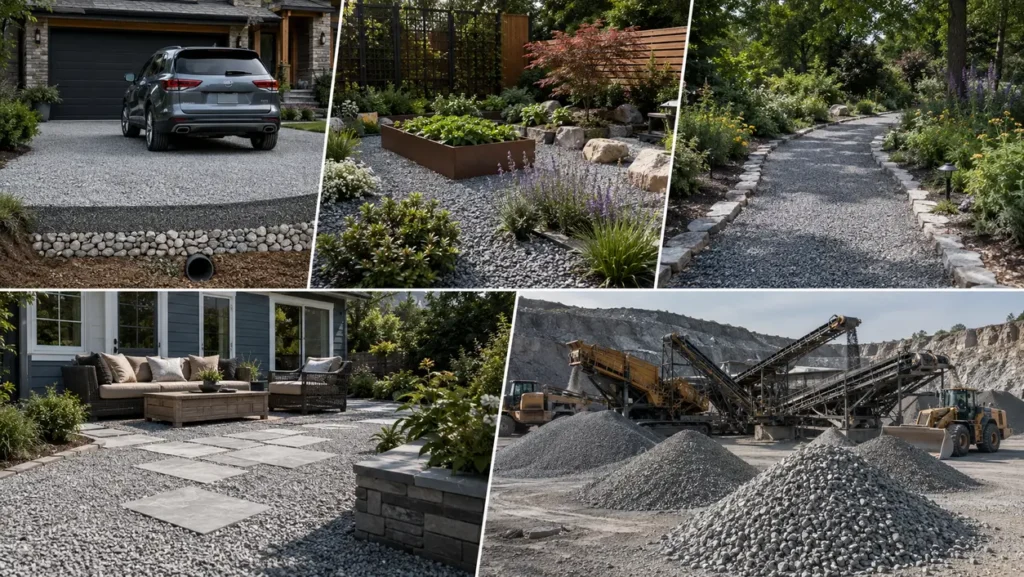
Crushed granite has two main markets. One is landscaping and outdoor surfaces. The other is construction aggregate.
Crushed Granite for Driveways
Crushed granite is often used for residential driveways, rural roads, and parking areas. It can form a strong surface if the base is prepared correctly.
For driveways, the most important factors are:
- strong subgrade
- enough base depth
- proper drainage
- layer-by-layer compaction
- suitable stone size
- regular maintenance
A driveway carries more load than a garden path. So it usually needs a stronger base than a walkway or decorative area.
Crushed Granite for Landscaping
Crushed granite is also used in landscaping because it looks natural and does not decompose like wood mulch. It can be used around planting areas, raised beds, dry gardens, and commercial outdoor spaces.
But it should not be treated as a zero-maintenance material. Community discussions often mention weeds, soil contamination, and loose particles as common problems. In one Reddit thread, users warned that weeds can still grow through decomposed granite, even when landscape fabric is used. (Reddit)
Crushed Granite Walkways and Paths
Crushed granite works well for paths when users walk with shoes. It can be easier to walk on than large loose stones. It also compacts better than many rounded gravels.
For walkways, choose a size that is not too large. Very large stones can be uncomfortable. Very fine material may track more easily into the house.
Crushed Granite Patios
Crushed granite can be used for patios, especially when the design needs a natural look. It can also be combined with pavers. For example, pavers can create a more stable walking area, while crushed granite fills or surrounds the space.
For patios near a house entrance, tracking should be considered. Houzz users discussed small stones getting stuck in shoes and being brought indoors. Some users suggested mats, boot scrapers, and removing shoes indoors to reduce the problem. (Houzz)
Road Base and Construction Aggregate
Crushed granite is also used in construction. It can be used for road base, drainage base, concrete aggregate, asphalt aggregate, and general construction fill.
This is where granite crushing equipment becomes important. Quarry operators need to produce stable sizes, clean gradation, and consistent output. That requires the right combination of jaw crusher, cone crusher, impact crusher, and screening equipment.
Pros and Cons of Crushed Granite
| Pros | Cons |
|---|---|
| Natural appearance | Can track into the house |
| Durable and hard | May feel sharp under bare feet |
| Better compaction than rounded gravel | Weeds may still grow |
| Useful for paths, patios, and driveways | Can wash out without edging or drainage |
| Available in different sizes | Needs compaction and maintenance |
| Suitable for construction aggregate | Fine particles may become soft after rain |
The main point is simple: crushed granite is not a bad material. But it must match the use case. A driveway, a garden path, and a children’s play area all need different surface choices.
Common Crushed Granite Problems and DG Discussed by Homeowners
1. It Turns Soft or Mushy After Rain
This is one of the most common complaints about decomposed granite. The problem is often not the granite itself. It is usually related to one or more of these factors:
- the layer is too thin
- the subgrade is not compacted
- there is no road base
- water cannot drain away
- too much fine material is exposed at the surface
In one Reddit thread, the original poster said a 2-inch DG layer became soft after rain. Replies pointed out that 2 inches was thin and that a compacted base was needed. One user described excavating 6–8 inches, adding base, tamping by machine, then placing DG in layers. (Reddit)
2. Weeds Grow Through Crushed Granite
Crushed granite can reduce weed growth, but it does not stop weeds completely. Seeds can land on the surface. Dust and organic matter can collect between particles. Soil from nearby garden beds can also mix into the granite.
Weed fabric may help in some cases, but it does not remove maintenance. In a NoLawns discussion, one user said weeds still grew through decomposed granite even with landscape fabric underneath. (Reddit)
To reduce weeds:
- remove organic soil before installation
- avoid mixing garden soil into the granite
- use strong edging
- keep nearby planting beds controlled
- remove weeds early before roots become deep
3. Crushed Granite Tracks Into the House
Fine granite particles and small stones can stick to shoes, pet paws, and tire treads. This is a bigger issue near doors, patios, and indoor flooring.
Houzz users discussed this problem in detail. Several users said small stones were carried inside by shoes or pets. One user noted that 1/4-inch or 3/8-inch stones can come in on shoes, while larger stones may be harder to walk on. (Houzz)
To reduce tracking:
- use pavers near entrances
- add outdoor and indoor mats
- use a boot scraper
- avoid very fine loose material beside doors
- create a transition zone between DG and the house
4. It Spreads Into Lawn or Garden Beds
Crushed granite can move over time. It may spread because of foot traffic, rainwater, slopes, or lack of edging.
This does not mean crushed granite cannot be used. It means the material needs containment.
Good edging options include:
- steel edging
- concrete pavers
- brick border
- timber edging
- stone curb
- bender board
For sloped areas, crushed granite needs extra care. Without proper drainage or stabilizers, rainwater can move the fine particles downhill.
5. It Can Feel Sharp Under Bare Feet
Crushed granite has angular particles. That is good for compaction. But it can be uncomfortable for bare feet.
This is important for:
- poolside areas
- children’s play areas
- pet areas
- outdoor living spaces where people walk barefoot
In a NoLawns discussion about decomposed granite and children, several users warned that DG can track indoors and may not be comfortable for kids or pets. (Reddit)
For barefoot areas, pavers, concrete, artificial turf, natural turf, or smoother stone may be better options.
How to Install Crushed Granite Properly
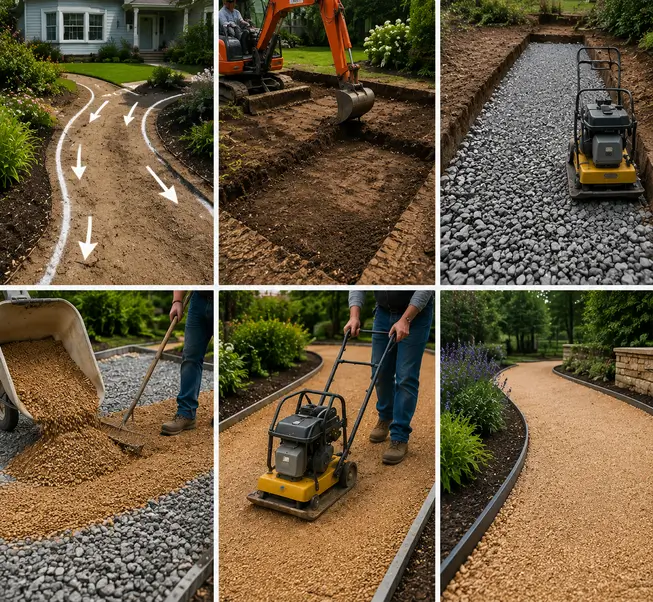
Correct installation depends on the application. A driveway needs a stronger structure than a light garden path. But the basic steps are similar.
Step 1: Plan the Area and Drainage
Before adding crushed granite, check where the water will go. Water should not collect under the surface. It should drain away from buildings.
Poor drainage is one reason DG becomes soft after rain. In the Reddit rain-related discussion, users repeatedly connected the problem with thin material, a weak base, and insufficient compaction. (Reddit)
Step 2: Excavate the Area
Remove grass, loose soil, roots, and organic material. Organic material breaks down and can create soft spots.
The depth depends on the use:
| Application | General Depth Direction |
|---|---|
| Decorative ground cover | shallow layer may be enough |
| Garden path | moderate depth with compaction |
| Patio | compacted base recommended |
| Driveway | deeper base and stronger compaction required |
| Road base | engineered base design required |
Do not use one universal depth for every project. Traffic load and soil conditions matter.
Step 3: Add Road Base or Crushed Stone Base
Many failed projects happen because users place crushed granite directly on weak soil. A base layer helps distribute load and improve stability.
For driveways and patios, a compacted aggregate base is usually more reliable than DG alone. In one Reddit reply, a user recommended digging down, sloping the grade away from the house, adding road base, tamping, and then adding crushed granite. (Reddit)
Step 4: Add Crushed Granite in Layers
Do not dump one thick pile and leave it loose. Spread the material evenly. Lightly wet the surface if needed. Then compact it.
Layer-by-layer placement is better than one thick loose layer. This helps reduce soft spots and uneven settlement.
Step 5: Use a Plate Compactor
For decomposed granite, crushed granite fines, and compacted landscape paths, compaction is often important. These materials contain fine particles, so they can form a firmer walking surface when placed in thin layers and compacted.
In a Reddit discussion about laying decomposed granite in a large yard, the original poster asked whether a plate compactor was necessary or whether the DG would settle naturally after wetting and smoothing. Several users replied that a plate compactor gave better results, especially for larger areas or patio-like surfaces. This discussion is about DG, not all types of crushed granite. (Reddit)
For clean crushed granite stone, such as 3/4-inch drainage stone, the purpose is different. It is usually used for drainage, base layers, or decorative stone. It does not compact into the same firm surface as DG or granite fines.
Step 6: Add Edging
Edging keeps the granite in place. Without edging, crushed granite can spread into lawns, beds, and paved areas.
Good edging is especially important for:
- curves
- slopes
- garden beds
- driveway edges
- patio borders
- areas with foot traffic
Do You Need a Stabilizer for Crushed Granite or DG?
A stabilizer is not always required. But it can help in some cases.
When Stabilizer May Help
Stabilizer may be useful for:
- patios
- walkways near entrances
- slopes
- areas with frequent foot traffic
- areas where dust is a concern
- surfaces that need a firmer finish
When Stabilizer May Not Solve Everything
A stabilizer cannot fix every problem. If the base is weak, drainage is poor, or the layer is too thin, the surface may still fail.
Some forum users discussed products such as pathway stabilizers, mulch glue, cement, or polymeric materials. But these discussions also show that results can vary. For a reliable project, the base, grading, and compaction still matter. (Reddit)
Stabilized DG Is Not Concrete
Stabilized DG may become firmer than loose DG. But it is not the same as poured concrete. It can still crack, erode, loosen, or need repair depending on weather, traffic, and installation quality.
Crushed Granite vs Other Materials
Crushed Granite vs Pea Gravel
Crushed granite has angular particles. Pea gravel is rounded. This difference matters.
Crushed granite usually compacts better and stays in place better. Pea gravel looks smooth and can be comfortable underfoot, but it can move more easily. It may also be unstable under wheels, chairs, or foot traffic.
For walking paths and driveways, angular crushed stone is often more stable than rounded pea gravel.
Crushed Granite vs Limestone Gravel
Granite is generally hard and durable. Limestone is also widely used as aggregate, but it may be more common or more affordable in some local markets.
The better choice depends on:
- local availability
- price
- color preference
- final use
- drainage needs
- load-bearing requirements
Crushed Granite vs Concrete
Concrete is smoother and more permanent. It is often easier to clean and better for areas where a stable, hard surface is needed.
Crushed granite is more natural in appearance. It can also allow more water movement than a solid concrete slab when installed as a permeable surface. But it has more loose particles and more maintenance.
A Houzz commenter directly raised this tradeoff, suggesting concrete if the driveway needs a smooth and lower-maintenance surface. (Houzz)
Crushed Granite vs Pavers
Pavers are cleaner and more stable. Crushed granite is usually simpler and more natural-looking.
Many projects use both:
- pavers for the main walking surface
- crushed granite as a filler or surrounding material
- edging to hold everything in place
This can reduce tracking and improve comfort near entrances.
Crushed Granite Sizes and Which One to Choose
The right size depends on the use. There is no single best size for every project.
| Size / Type | Best For | Notes |
|---|---|---|
| Granite fines | Paths, compacted surfaces, DG-style areas | Easy to compact, but may track more |
| 1/4 inch | Light decorative paths | Small particles may stick to shoes |
| 3/8 inch | Garden paths, landscaping | Common for walkable areas |
| 1/2 inch | Patios, ground cover | More visible texture |
| 3/4 inch | Driveways, road base, drainage | Better for heavier use |
| Crusher run granite | Base layer, driveways | Contains fines and larger particles for compaction |
For areas close to the house, do not only choose by appearance. Also consider tracking, comfort, and cleaning.
For driveways, do not only choose the top layer. The base layer is often more important.
How Much Crushed Granite Do You Need?
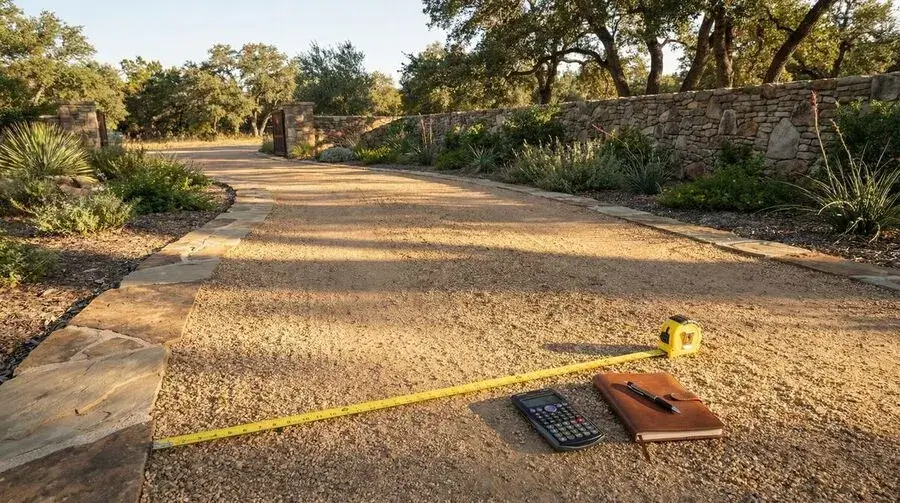
The basic volume formula is simple:
Length × Width × Depth = Volume
For example, if a path is 20 feet long, 4 feet wide, and 3 inches deep:
- convert 3 inches to 0.25 feet
- 20 × 4 × 0.25 = 20 cubic feet
Then convert cubic feet to cubic yards:
20 ÷ 27 = 0.74 cubic yards
It is also wise to allow extra material. Compaction reduces volume. Uneven ground may need more material. Some material may be lost during spreading and edging.
General Depth Direction
| Application | Typical Direction |
|---|---|
| Walkway | thinner than driveway |
| Patio surface | compacted layers recommended |
| Driveway surface | stronger base required |
| Road base | engineered thickness required |
| Decorative cover | shallow layer may be enough |
These are general planning points. Local soil, climate, slope, and load should guide the final design.
Crushed Granite Cost Factors
Crushed granite cost can vary widely by location. It is not safe to give one fixed price for all markets.
The final cost depends on:
- local quarry availability
- granite color and source
- particle size
- screened or unscreened material
- delivery distance
- order quantity
- labor cost
- base material cost
- edging cost
- stabilizer cost
Transportation is especially important for aggregate products because crushed stone is heavy and usually sold locally. The USGS also notes that crushed stone prices can rise in urban and industrial areas when quarries are farther from population centers or local shortages occur. (pubs.usgs.gov)
How Crushed Granite Is Produced
Crushed granite used in landscaping and construction does not appear naturally in finished sizes. It is produced through quarrying, crushing, screening, and stockpiling.
1. Granite Quarrying
Large granite rock is extracted from a quarry. The raw stone is too large for most direct uses, so it must be reduced into smaller sizes.
2. Primary Crushing with Jaw Crusher
A jaw crusher is commonly used for primary crushing. It accepts large rock and reduces it into smaller pieces.
For hard stone such as granite, the primary crusher must be strong enough to handle high compressive strength and abrasive material.
3. Secondary Crushing with Cone Crusher
After primary crushing, the material often goes to a cone crusher for secondary crushing. Cone crushers are commonly used for hard rock aggregate production because they can produce smaller and more controlled particle sizes.
4. Screening and Sizing
After crushing, vibrating screens separate the material into different sizes. Screening is important because crushed granite products are sold by size and gradation.
Screening can produce:
- granite fines
- 3/8 inch material
- 1/2 inch material
- 3/4 inch material
- larger drainage stone
- crusher run granite
- road base material
Screening machines separate particles by size using screen openings and vibration. This makes it possible to create different aggregate products from the same granite feed. (Wikipedia)
5. Stockpiling and Delivery
After screening, each size is stored in a separate stockpile. From there, it can be loaded for delivery to construction sites, landscape suppliers, concrete plants, asphalt plants, or road projects.
How to Choose Granite Crushing Equipment
For quarry owners, contractors, and aggregate producers, the right equipment depends on the final product target.
Before choosing a granite crushing plant, check these points:
Feed Size
Large blasted granite needs a primary crusher with enough feed opening. A jaw crusher is usually used at this stage.
Required Output Size
If the target product is 3/4 inch aggregate, the plant must include secondary crushing and screening. If the target includes fines or manufactured sand, the process may need shaping or fine screening.
Capacity Per Hour
A small contractor may need a compact mobile crusher. A quarry may need a full crushing and screening line with higher capacity.
Rock Hardness and Abrasion
Granite is hard and abrasive. Wear parts cost should be considered before choosing a crusher.
Final Application
The equipment choice changes depending on whether the final material is for:
- driveway gravel
- road base
- concrete aggregate
- asphalt aggregate
- drainage stone
- landscaping material
- manufactured sand
Mobility Requirement
A mobile granite crushing plant is useful when the project site changes often. It can reduce raw material transport and allow on-site aggregate production.
Screening Accuracy
If the buyer needs several finished sizes, screening accuracy becomes very important. A good crushing plant should not only crush the rock. It should also separate it into stable product grades.
FAQ about Crushed Granite
Is crushed granite the same as decomposed granite?
Not exactly. Crushed granite is mechanically crushed granite rock. Decomposed granite is granite that has weathered into smaller particles. In landscaping, the two terms are sometimes used loosely, but the particle size and fines content can be different.
Is crushed granite good for driveways?
Yes, crushed granite can be used for driveways. But it needs a strong base, good drainage, and proper compaction. A thin loose layer is not enough for long-term driveway use.
Does crushed granite need a base?
For patios, driveways, and heavy-use paths, a compacted base is strongly recommended. For light decorative areas, a deep base may not always be needed, but the ground should still be prepared properly.
How do you stop crushed granite from washing away?
Use proper grading, compacted base, layer-by-layer compaction, and strong edging. Avoid using loose fines on steep slopes unless the design includes stabilization and drainage control.
How do you prevent weeds in crushed granite?
Remove organic soil before installation. Keep garden soil away from the surface. Use edging. Maintain the area regularly. Landscape fabric may help, but it does not guarantee a weed-free surface.
Does crushed granite track into the house?
Yes, it can. Fine particles and small stones may stick to shoes, tires, and pet paws. This is more likely near entrances. Mats, pavers, boot scrapers, and transition zones can reduce the problem.
Is crushed granite better than pea gravel?
For compaction and stability, crushed granite is often better than pea gravel because it has angular particles. For barefoot comfort, pea gravel may feel smoother, but it can move more easily.
What size crushed granite is best for walkways?
Smaller sizes such as fines, 1/4 inch, or 3/8 inch are common for walkways. But very fine material may track more easily. The best size depends on comfort, appearance, drainage, and maintenance needs.
Can crushed granite be compacted?
Yes. Crushed granite can be compacted, especially when it contains fines. A plate compactor is usually better than hand tamping for larger paths, patios, or driveways.
What machine is used to crush granite?
Granite is commonly crushed with a jaw crusher for primary crushing and a cone crusher for secondary crushing. Vibrating screens are then used to separate the crushed material into different sizes.
Conclusion
Crushed granite is a durable and useful material. It can work well for driveways, walkways, patios, landscaping, drainage, road base, and construction aggregate.
But it is not maintenance-free. Most problems come from poor installation, weak base preparation, bad drainage, lack of compaction, missing edging, or using the wrong size for the application.
For homeowners, the key is to choose the right size and install it correctly. For contractors and quarry operators, the key is to produce stable aggregate sizes with suitable granite crushing and screening equipment.
If you need to produce crushed granite for construction aggregate, road base, driveway material, or landscaping stone, the crushing plant should be selected based on feed size, output size, capacity, rock hardness, and final product requirements.