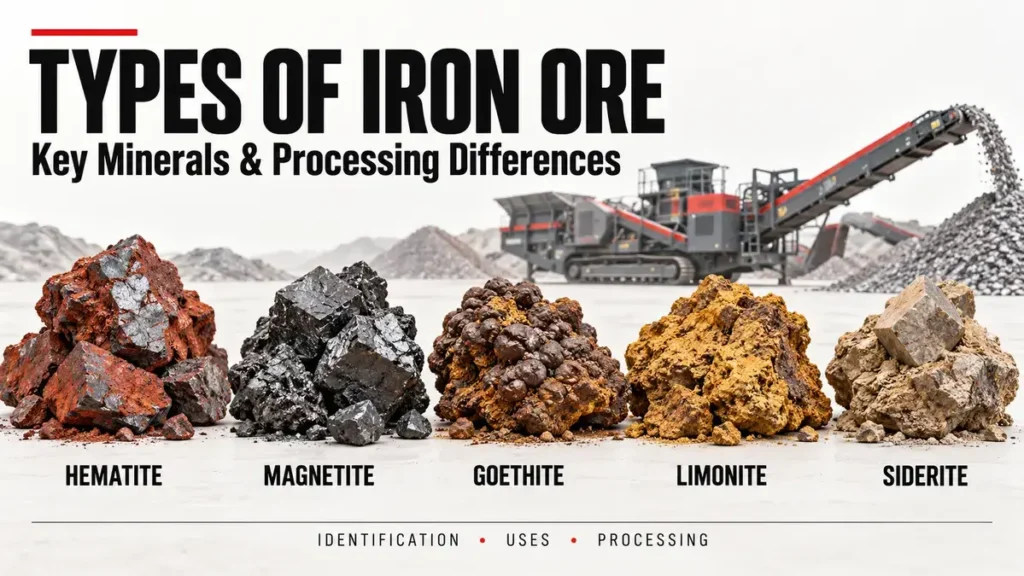
Types of Iron Ore: Key Minerals and Processing Differences
Hematite, magnetite, goethite, limonite, and siderite are common names you will encounter when comparing types of iron ore. They differ in composition, appearance, and processing behavior. Hematite and magnetite are the main minerals used for iron production, while limonite describes a variable mixture of iron-bearing minerals.
For a mining or processing project, identifying the ore is the starting point. You also need to know its iron grade, impurities, particle sizes, and response to treatment. These factors help determine whether the project needs simple ore preparation or a more complex concentration process.
This guide compares the main types, explains commonly confused terms, and connects ore properties with crushing and screening decisions.
What Is Iron Ore?
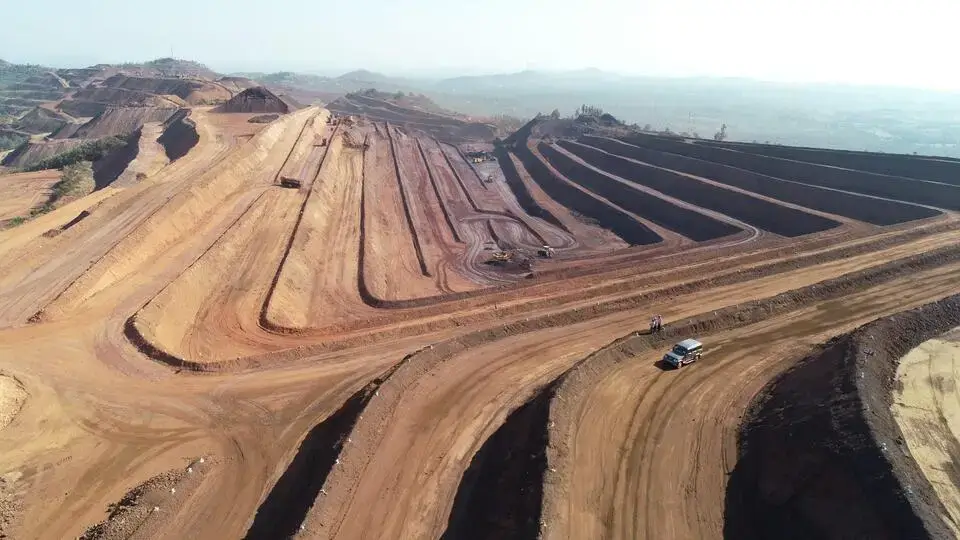
Iron ore is rock from which iron can be extracted economically. The valuable iron occurs in minerals within the rock, together with other minerals that may have little value for the intended product. These unwanted minerals are commonly called gangue.
An ore sample can contain several iron-bearing minerals. A description such as “hematite ore” identifies an important component. Mineralogical analysis can identify which minerals are present and measure their proportions. Ore-characterization tests help assess how the ore responds to processing.
When discussing a project, keep three questions separate: which minerals contain the iron, how much iron the feed contains, and how much of that iron the proposed process can recover.
What Are the Main Types of Iron Ore?
The five profiles below summarize the main properties of hematite, magnetite, goethite, limonite, and siderite. Iron percentages refer to ideal pure minerals, rather than assayed ore grades. Mohs hardness describes mineral specimens; it does not, by itself, predict whole-ore crushing performance.
1. Hematite: A Major Iron Ore Mineral with a Red Streak
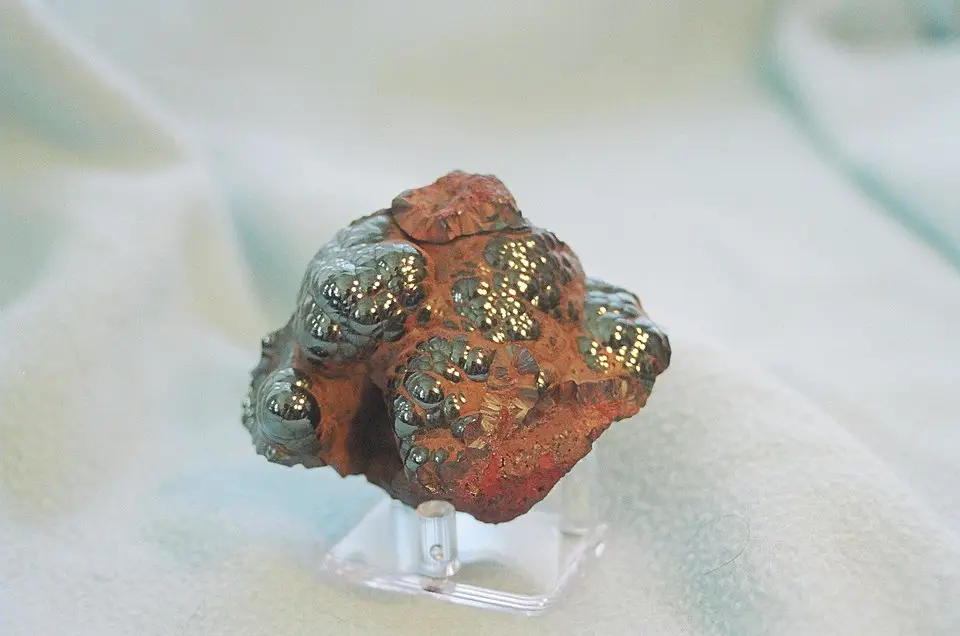
Hematite is one of the principal minerals used for iron production. Its appearance ranges from earthy red material to metallic gray specimens, while its reddish streak provides a useful identification clue.
| Property | Hematite |
|---|---|
| Mineral group | Iron oxide |
| Chemical formula | Fe₂O₃ |
| Theoretical iron content | Approximately 69.9% Fe in the ideal pure mineral |
| Typical color | Earthy red to steel-gray |
| Streak | Red to reddish-brown |
| Mohs hardness | 5–6 |
| Common forms | Thin plates, rounded masses, earthy material, and small rounded grains in oolitic material |
| Typical occurrence | Iron formations, sedimentary deposits, weathering products, and some hydrothermal veins |
| Main uses | Iron production and natural red iron oxide pigments |
Hematite can occur alongside magnetite, goethite, and siderite. Its red pigments find applications in coatings and construction products.
Appearance and identification. Hematite can look surprisingly different from one specimen to another. Some material is earthy and red; other specimens are steel-gray with a metallic shine. It also occurs as thin plates, rounded masses, and small rounded grains in oolitic material. Its red to reddish-brown streak is a useful identification clue across these different appearances. The Handbook of Mineralogy lists a Mohs hardness of 5–6.
Occurrence and uses. Hematite occurs in iron formations, sedimentary deposits, weathering products, and some hydrothermal veins. It can occur alongside magnetite, goethite, and siderite. Beyond ironmaking, hematite is used as a natural red iron oxide pigment, including in coloring materials for coatings and construction products.
Processing considerations. Some hematite-rich deposits provide ore suitable for direct shipping after preparation. Suitability depends on mineral composition and product requirements. Malvern Panalytical’s study explains how the proportions of iron minerals and gangue help determine whether an ore can follow a direct-shipping route or needs beneficiation.
For a hematite project, establish where the unwanted minerals occur. Surface contamination and minerals enclosed within iron-rich particles present different separation problems. The useful distinction is between material that already meets the product specification after preparation and material that requires further liberation and concentration.
2. Magnetite: Strongly Magnetic Iron Ore Suited to Concentration
Magnetite has the highest theoretical iron content among the defined minerals compared here. Its strong magnetic response is a useful identification feature and supports magnetic separation.
| Property | Magnetite |
|---|---|
| Mineral group | Iron oxide |
| Chemical formula | Fe₃O₄ |
| Theoretical iron content | Approximately 72.4% Fe in the ideal pure mineral |
| Typical color | Black to gray-black |
| Streak | Black |
| Mohs hardness | 5.5–6.5 |
| Magnetic response | Strongly magnetic |
| Common forms | Granular or massive material; octahedral crystals |
| Typical occurrence | Igneous and metamorphic rocks, iron formations, and detrital deposits |
| Main uses | Ironmaking feed, including magnetite concentrates |
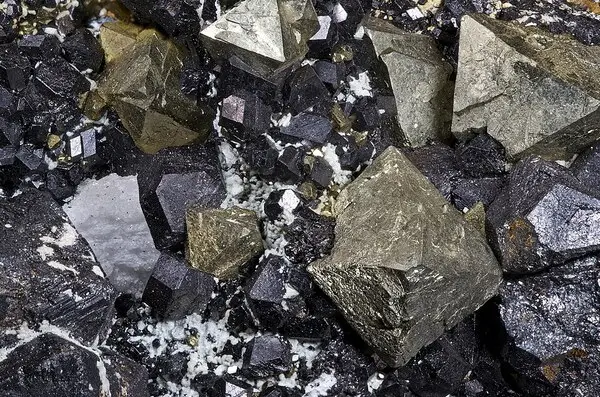
Octahedral crystals resemble two four-sided pyramids joined at their bases. Magnetite also accumulates in detrital deposits through the transport and concentration of mineral grains.
Appearance and identification. Magnetite is commonly black or gray-black, with a black streak and metallic to submetallic luster. Its strong magnetic response is a particularly useful field clue. It occurs as granular or massive material and as octahedral crystals, shaped like two four-sided pyramids joined at their bases. Its Mohs hardness is 5.5–6.5.
Occurrence and uses. Magnetite occurs in igneous and metamorphic rocks, iron formations, and detrital deposits formed through the transport and accumulation of mineral grains. For ironmaking, magnetite projects can produce concentrated feed with high iron content and low impurity levels. Australia Minerals identifies this upgrading potential as an important feature of Australian magnetite resources.
Processing considerations. Magnetism provides a separation mechanism, while mineral liberation determines how effectively attached gangue can be removed. Minnesota’s taconite operations illustrate a route involving crushing, grinding, magnetic separation, and pellet production.
A lower-grade magnetite feed can be upgraded into a high-grade concentrate. Australia Minerals identifies this upgrading potential as an important feature of Australian magnetite resources. Assess the resulting product grade together with iron recovery and preparation requirements. A hand-magnet response does not measure the quality or yield of the eventual concentrate.
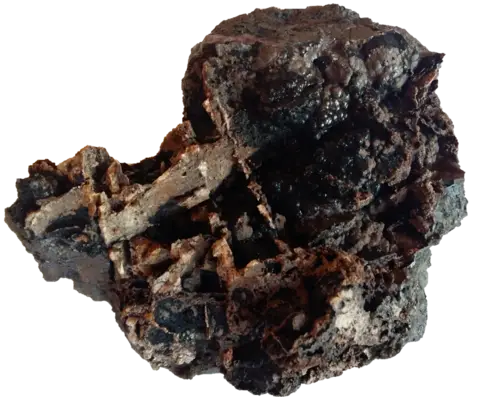
3. Goethite: An Iron Oxyhydroxide Common in Weathered Deposits
Goethite is a defined mineral containing hydroxyl groups within its structure. This structural component is distinct from free moisture held between particles or on their surfaces.
| Property | Goethite |
|---|---|
| Mineral group | Iron oxyhydroxide |
| Chemical formula | α-FeO(OH) |
| Theoretical iron content | Approximately 62.9% Fe in the ideal pure mineral |
| Typical color | Yellowish brown to dark brown |
| Streak | Ocher to yellow-brown |
| Mohs hardness | 5–5.5 |
| Common forms | Needles, radiating fibrous aggregates, rounded masses, and earthy material |
| Typical occurrence | Weathered iron-bearing deposits; environments where dissolved iron oxidizes and precipitates |
| Main uses | An iron-bearing component of ores; natural yellow and brown iron oxide pigments |
Appearance and identification. Goethite ranges from yellowish brown to dark brown and typically produces an ocher to yellow-brown streak. It can form needles, radiating fibrous aggregates, rounded masses, and earthy material. The Handbook of Mineralogy lists a Mohs hardness of 5–5.5. These varied forms help explain why goethite-bearing samples can look quite different in the field.
Occurrence and uses. Goethite commonly forms through the weathering of iron-bearing minerals in oxygenated environments. It can also precipitate when dissolved iron is oxidized. It contributes iron to mixed ores and is among the minerals used for natural yellow and brown iron oxide pigments.
Processing considerations. Goethite-rich ores deserve attention to both mineral composition and texture. In Malvern Panalytical’s study of lateritic iron ores, the samples contained different proportions of goethite, hematite, quartz, clay minerals, and other components. These differences are relevant to ore blending and beneficiation planning.
Goethite also affects downstream thermal behavior. Research found that its decomposition during heating contributed to energy demand. For crushing and screening, document whether the actual feed is competent, porous, earthy, or clay-bearing. For thermal treatment, establish how its mineral composition changes on heating. Keep surface moisture and mineral decomposition separate in the assessment.
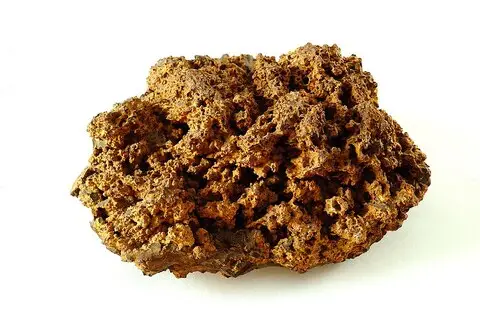
4. Limonite: A Variable Mixture of Weathered Iron Minerals
Limonite is a broad name for iron-rich material containing variable mixtures of hydrated iron oxide minerals, commonly including goethite. Its composition and physical properties can differ substantially between samples.
| Property | Limonite |
|---|---|
| Mineral group | Variable mixture of iron-bearing minerals |
| Chemical formula | No single fixed formula |
| Theoretical iron content | No fixed value; composition varies |
| Typical color | Yellow-brown to dark brown |
| Streak | Yellowish-brown |
| Mohs hardness | Variable; the broad material name has no single representative value |
| Common forms | Earthy material, hard masses, nodules, beds, and boulders |
| Typical occurrence | Weathering products of iron-bearing minerals, sometimes associated with residual clay |
| Main uses | Iron ore and natural yellow or brown pigments, depending on material quality |
Limonite can develop through the weathering of minerals such as pyrite and marcasite, with remnants of the original minerals sometimes surviving.
The term also appears in nickel laterite deposits. USGS describes a limonite zone containing nickel-bearing goethite within weathering profiles developed on ultramafic rocks. A project described as “limonite processing” may therefore target iron, nickel, or associated metals. Define the intended recovered product before selecting a flowsheet.
Appearance and identification. Limonite is commonly yellow-brown to dark brown, with a dull appearance and a yellowish-brown streak. Its consistency can range from soft, earthy material to hard masses. The Missouri Geological Survey describes limonite in forms including boulders, beds, and nodules associated with residual clay. A fixed hardness value would therefore be misleading for the broad material name.
Formation and uses. Limonite develops through the weathering of other iron-bearing minerals. The Missouri factsheet describes occurrences formed from minerals such as pyrite and marcasite, with remnants of the original minerals sometimes surviving. Limonitic material has been used as iron ore, while suitable material also provides natural yellow and brown pigments.
Processing considerations. Record the proportions of hard lumps, earthy material, and clay in representative samples. If washing is proposed, measure the iron content of both the washed coarse product and the fine stream before deciding what to reject.
For more detail, see our guide to limonite properties and processing.
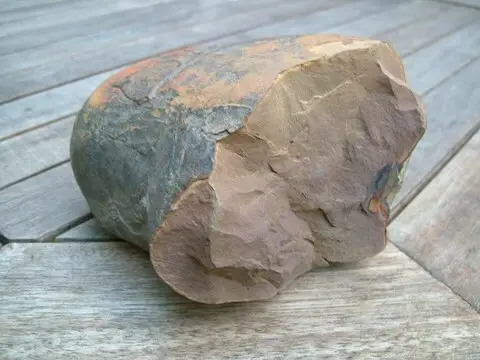
5. Siderite: An Iron Carbonate with Distinct Processing Requirements
Siderite is an iron carbonate. Its ideal iron percentage is lower than those of hematite, magnetite, and goethite, and natural specimens can vary chemically through substitution by other elements.
| Property | Siderite |
|---|---|
| Mineral group | Iron carbonate |
| Chemical formula | FeCO₃ |
| Theoretical iron content | Approximately 48.2% Fe in the ideal pure mineral |
| Typical color | Gray, yellowish, or brown |
| Streak | White |
| Mohs hardness | 3.75–4.25 |
| Common forms | Rhombohedral crystals with well-developed cleavage; massive, fibrous, or concretionary material |
| Typical occurrence | Sedimentary iron deposits, concretions, metamorphosed iron formations, and hydrothermal veins |
| Main uses | A source of iron in suitable ores |
Associated minerals can include quartz, barite, fluorite, and pyrite. These associations matter when discussing ore quality: the ideal FeCO₃ formula does not describe the gangue or sulfur-bearing material accompanying siderite in mined rock.
Appearance and identification. Siderite can be gray, yellowish, or brown and has a white streak. It commonly forms rhombohedral crystals with well-developed cleavage, as well as massive, fibrous, and concretionary material. Its Mohs hardness is 3.75–4.25. The combination of its carbonate identity, crystal features, and streak helps distinguish it from the iron oxides described above.
Occurrence and associations. Siderite occurs in sedimentary iron deposits, concretions, metamorphosed iron formations, and hydrothermal veins. The Handbook of Mineralogy lists associated minerals including quartz, barite, fluorite, and pyrite. These associations matter when discussing ore quality: an ideal FeCO₃ formula says nothing about how much gangue or sulfur-bearing material accompanies it in the mined rock.
Processing considerations. Research has investigated magnetization roasting followed by magnetic separation. Under controlled treatment conditions, the iron-bearing phase can be converted into magnetite, improving its response to magnetic separation.
Alongside crushing and liberation, evaluate the proposed thermal conversion, energy demand, and the grade and recovery obtained after separation. The cited study demonstrates a treatment route for the tested ore; establish operating conditions and results for the deposit under consideration.
Iron Ore Types Compared at a Glance
| Mineral or material | Composition | Theoretical Fe in the ideal pure mineral | Useful identification clue |
|---|---|---|---|
| Hematite | Fe₂O₃ | 69.9% | Red to reddish-brown streak |
| Magnetite | Fe₃O₄ | 72.4% | Strong magnetism and black streak |
| Goethite | FeO(OH) | 62.9% | Yellow-brown or ocher streak |
| Limonite | Variable mixture of iron-bearing minerals | No fixed value | Commonly earthy brown with a yellow-brown streak |
| Siderite | FeCO₃ | 48.2% | White streak; often gray or brown |
Data note: Formulas and identification features follow the Handbook of Mineralogy entries and Missouri Geological Survey factsheet. The iron percentages above are calculated from ideal formulas using CIAAW abridged standard atomic weights of Fe = 55.845, O = 15.999, H = 1.0080, and C = 12.011, rounded to one decimal place. These values describe ideal pure minerals. Determine mined ore grades through representative sampling and assays.
Where Do Taconite, BIF, Lump, Fines, and Pellets Fit In?
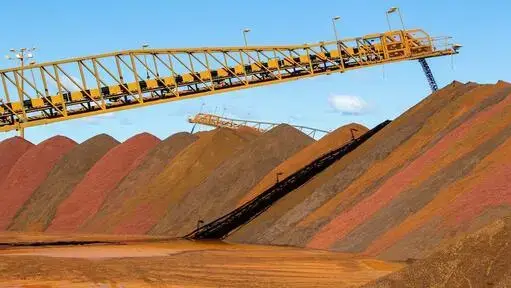
Iron ore discussions often mix mineral names, geological descriptions, and product names. These terms answer different questions.
| Term | What it describes |
|---|---|
| Hematite, magnetite, goethite, siderite | Individual mineral species |
| Limonite | A broad name for variable iron-rich mineral mixtures |
| Banded iron formation, or BIF | Rock with alternating iron-rich and silica-rich layers |
| Taconite | A low-grade iron-bearing rock associated with major mining operations in Minnesota |
| Lump and fines | Commercial ore products separated by particle size and defined by specifications |
| Concentrate | A product enriched in valuable minerals through separation |
| Pellets | Manufactured agglomerates formed from fine feed and hardened for handling and use |
Geoscience Australia explains the layered structure of BIF, while Minnesota DNR describes the production of concentrate and pellets from taconite.
Commercial examples make the distinction clear: Rio Tinto markets lump and fines from its Australian operations, and pellets and concentrate from its Iron Ore Company of Canada business. These names describe saleable products.
For equipment discussions, specify both the incoming ore and the required product. “Magnetite-bearing feed for concentrate production” gives a clearer starting point than “iron ore.”
How Does Ore Type Affect Processing?
Processing aims to prepare a suitable feed and, where necessary, separate valuable minerals from gangue. Typical operations include crushing, screening, scrubbing, grinding, and concentration. The required combination depends on the ore and target product.
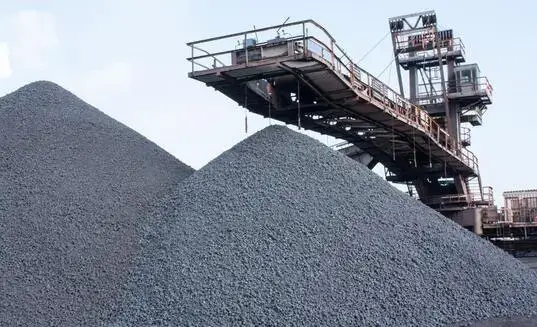
Magnetic response influences separation
Magnetite’s strong magnetic response makes magnetic separation a logical option to investigate. A mixed feed needs additional assessment because the iron may occur in several minerals. Establish which minerals enter the concentrate and which remain in other streams.
The taconite example shows how crushing, grinding, and magnetic separation can work together. It provides a useful illustration of one ore-processing route.
Clay and fines influence preparation
Scrubbing can help remove adhering clay and silt from suitable feeds. For a wet or clay-rich ore, use trials to decide where washing belongs and how each resulting stream should be handled.
A practical trial should compare the feed, washed coarse material, and fine stream. Measure iron in each stream before deciding which fraction to reject or process further.
Mineral associations influence the required size reduction
Grinding helps expose iron minerals that remain attached to gangue after crushing. The project question is how much size reduction produces a useful separation response.
Compare candidate grind sizes through testwork. Request concentrate grade, iron recovery, and the conditions used for each result. This gives equipment suppliers a clearer target than a request to produce the finest possible material.
How to Select Crushing and Screening Equipment for Iron Ore
Start with the duty each machine must perform. Define the incoming lump size, required discharge, material behavior, and next processing step.
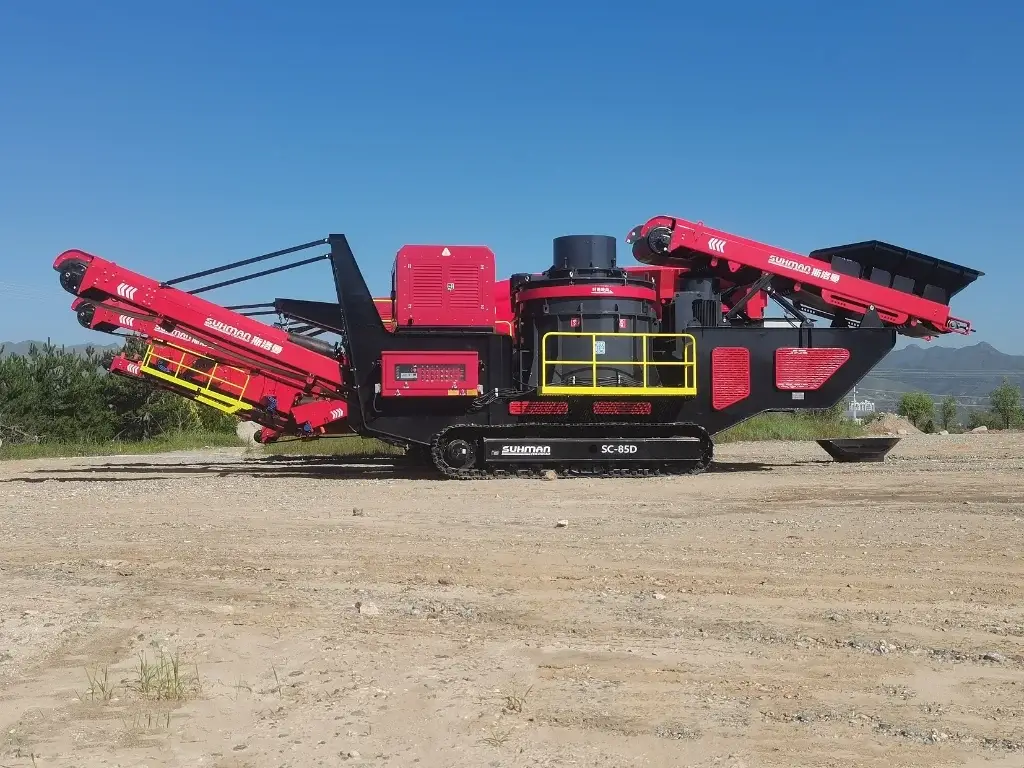
Primary and subsequent crushing
Jaw crushers commonly perform primary reduction. Large mining plants may also use primary gyratory crushers. Cone crushers commonly serve later reduction stages, including duties involving hard or abrasive material. These roles follow Metso’s crusher-selection guidance.
For a candidate jaw-and-cone arrangement, confirm that the first stage can deliver suitable feed to the second. Check the expected size distribution and the proposed screening arrangement. Our cone crusher vs. jaw crusher comparison explains their different roles.
Conventional impact crushers deserve particular wear assessment when the feed is abrasive. Metso describes their main applications as nonabrasive materials.
Screening and material handling
Screens separate material into the required size fractions. Ask suppliers to demonstrate the proposed separation under representative moisture and clay conditions. Include oversize return material in the circuit assessment.
Our material screening equipment guide explains related equipment options and selection factors.
Mobile or stationary equipment
Mobile crushing can be worth evaluating when preparation needs to follow changing working locations. Metso identifies mobility and reduced haulage as potential benefits in suitable operations.
For your project, compare access, relocation frequency, power, maintenance, water handling, and integration with downstream equipment. A long-term central processing location may support a stationary arrangement; phased development may give mobility greater value.
SUHMAN options to review include mobile jaw crushers, mobile cone crushers, and screening plants. Match each candidate to a defined duty and request performance estimates based on your actual ore.