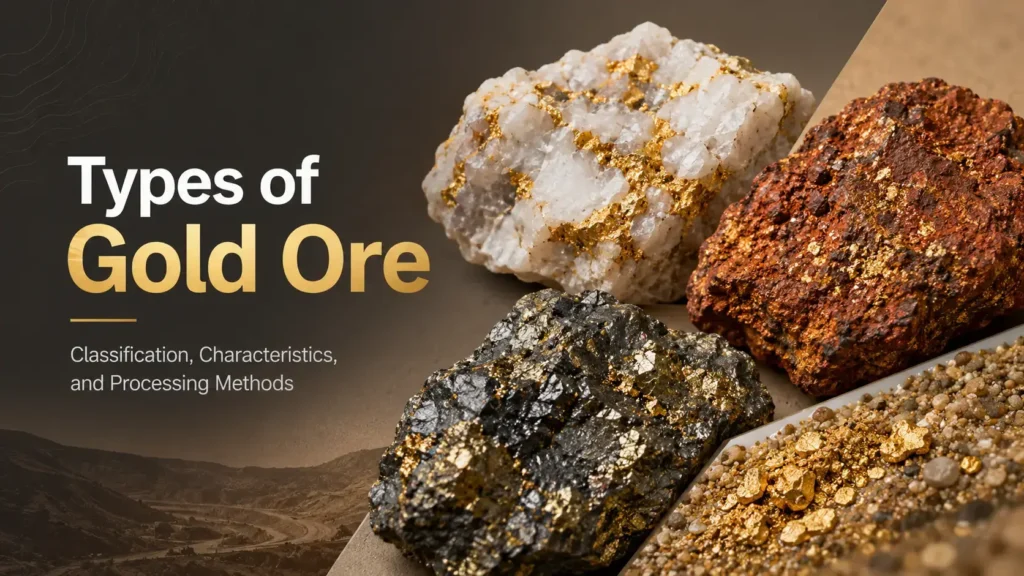
Comparative Table
| Type | Formation and setting | Typical host minerals | Difficulty | Common recovery methods | Environmental or health notes |
|---|---|---|---|---|---|
|
1. Quartz Gold Ore |
Hydrothermal veins, lodes, stockworks in faults and shear zones | Quartz, native gold, pyrite, arsenopyrite ± galena, sphalerite, chalcopyrite | Easy–Medium | Gravity + cyanidation; add flotation if sulfides rise | Cyanidation is common; sulfide-rich variants need tighter tailings management. |
|
2. Oxide Gold Ore |
Weathered/supergene cap above primary ore; laterite or saprolite | Fe oxides, clay, quartz, remnant gold | Easy | Heap leach, CIP/CIL, direct cyanidation, gravity | Usually lower sulfide burden, but cyanide and water management still matter. |
|
3. Sulfide Gold Ore |
Primary hydrothermal ore in veins, disseminations, replacements | Pyrite, pyrrhotite, marcasite, chalcopyrite, arsenopyrite | Medium–Hard | Cyanidation if non-refractory; flotation + cyanidation; pretreatment if locked | Sulfide oxidation and residue chemistry increase complexity. |
|
4. Carbonaceous Gold Ore |
Common in sediment-hosted/Carlin-type systems | Carbonaceous matter, pyrite, arsenopyrite, quartz, carbonate | Hard | Flotation, oxidation, cyanidation with preg-robbing control | Preg-robbing raises reagent use; some ores are double-refractory. |
|
5. Arsenic-Bearing Gold Ore |
Sulfidic ore rich in arsenopyrite overlaps with Carlin and orogenic systems | Arsenopyrite, pyrite ± realgar/other As phases | Hard | Flotation + POX/BIOX/roasting/UFG + cyanidation | Arsenic is a major health and environmental hazard; stabilization is essential. |
|
6. Telluride Gold Ore |
Often alkalic/epithermal breccia and vein systems linked to alkaline intrusions | Calaverite, sylvanite, krennerite, petzite, native gold | Medium–Hard | Oxidative pretreatment, then cyanidation; some alternative leaches | Roasting can work but is environmentally less favored. |
|
7. Copper-Gold Ore |
Common in porphyry Cu-Au stockworks and disseminated systems | Chalcopyrite, bornite, pyrite, quartz veinlets, native gold | Medium | Flotation to Cu-Au concentrate; cyanidation only with care; SART-type options | Copper can consume cyanide and make direct leaching uneconomic. |
|
8. Silver-Gold Ore |
Common in epithermal veins and stockworks | Electrum, kustelite, native silver, acanthite, quartz | Medium | Cyanidation, often with modified conditions; gravity may help coarse gold | High Ag or Ag-rich electrum can complicate leaching and recovery. |
|
9. Placer Gold Ore |
Mechanical concentration after weathering and transport or residual accumulation | Liberated gold with heavy minerals such as magnetite, ilmenite, garnet, scheelite | Easy | Washing, screening, sluices, jigs, tables, centrifugal concentrators | Reagent demand is low; gravity is the natural route. |
|
10. Alluvial Gold Ore |
River, stream, fan, floodplain, or palaeochannel deposits | Rounded to flattened liberated gold in gravel and sand | Easy | Gravity concentration | Fine-gold losses and clay handling are bigger issues than chemistry. |
| 11Eluvial Gold Ore | Residual to near-residual concentration near source outcrop | Angular liberated gold in shallow weathered cover | Easy | Gravity concentration, selective mining | Usually low reagent use, but grade continuity is patchy. |
|
12. Free-Milling Gold Ore |
Any setting where gold is readily exposed by normal grinding | Commonly native gold in quartz, oxide products, or placer grains | Easy | Gravity, cyanidation, CIL/CIP | Cyanide use is typical but pretreatment is usually unnecessary. |
|
13. Refractory Gold Ore |
Any setting where gold is locked, invisible, preg-robbing, or chemically slow to dissolve | Pyrite, arsenopyrite, tellurides, carbonaceous matter | Hard | Flotation + roasting, POX, BIOX, or UFG before cyanidation | Higher capital, higher reagent intensity, and stricter emissions/residue control. |
1. Quartz Gold Ore
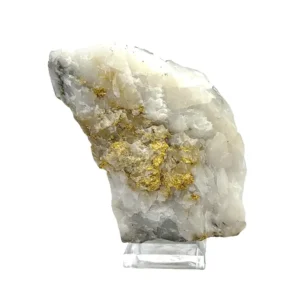
Quartz gold ore” refers to gold ore in which gold is associated with quartz veins. It is one of the easiest types of gold ore for general readers to understand, because many people imagine gold ore as “white quartz with visible gold particles inside.”
In this type of ore, quartz is usually the main gangue mineral. Gold may occur as native gold, fine gold particles, or in association with minerals such as pyrite.
Common Appearance
- White or grayish-white quartz rock
- Gold-colored particles within quartz veins
- May also contain pyrite or iron oxides
- In some cases, gold is not visible to the naked eye and grade testing is required
Processing Characteristics
If the gold particles are relatively coarse and readily liberated, this ore may be suitable for gravity separation, grinding, and cyanide leaching. However, if the gold is locked within sulfide minerals, flotation or further pretreatment may be required.
2. Oxide Gold Ore
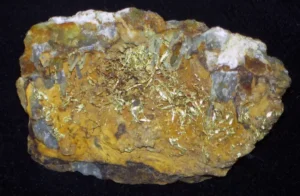
“Oxide gold ore” refers to gold ore formed after primary gold deposits have undergone long-term weathering and oxidation. It is commonly found in the shallow parts of ore bodies, near the surface of open-pit mines, or within weathered zones.
In this type of ore, sulfide minerals have usually been oxidized. They often form iron oxides such as limonite, hematite, and goethite. As a result, the ore commonly appears reddish-brown, yellowish-brown, or rusty in color.
Common Appearance
- Reddish-brown
- Yellowish-brown
- Rust-colored
- Earthy or weathered texture
- May contain iron oxides and clay minerals
Processing Characteristics
Oxide gold ore is generally easier to process than sulfide gold ore. Since part of the sulfide minerals have already been oxidized and decomposed, the gold is often more exposed. This makes the ore suitable for crushing, grinding, heap leaching, and CIL/CIP leaching.
3. Sulfide Gold Ore
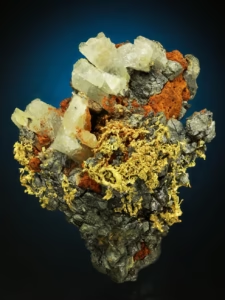
Gold on Arsenopyrite – Belshazzar Mine, Quartzburg District, Boise County, Idaho
“Sulfide gold ore” refers to gold ore in which gold is associated with sulfide minerals. Common sulfide minerals include pyrite, arsenopyrite, chalcopyrite, galena, and sphalerite.
Common Associated Minerals
- Pyrite: iron sulfide
- Arsenopyrite: arsenic-bearing sulfide mineral
- Chalcopyrite: copper iron sulfide
- Galena: lead sulfide
- Sphalerite: zinc sulfide
Common Appearance
- Dark gray or gray-black ore
- Metallic luster
- May show brassy-yellow flashes from pyrite
- Gold particles may be very fine and difficult to identify with the naked eye
Processing Characteristics
Sulfide gold ore is more complex than oxide gold ore. Gold may be locked within pyrite or arsenopyrite, so conventional gravity separation or direct leaching may not achieve good recovery. In actual processing, flotation is often used first to concentrate the sulfide minerals. The concentrate may then undergo roasting, oxidation, leaching, or CIL/CIP treatment.
4. Carbonaceous Gold Ore
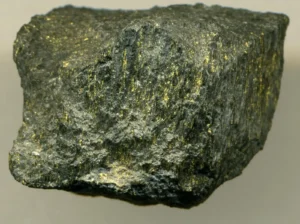
Blyvooruitzicht Gold Mine, Carletonville Goldfield, West Witwatersrand (“West Wits”), South Africa.

Carbonaceous Gold Ore is gold ore that contains natural carbonaceous matter, graphitic material, or organic carbon. This type of ore is special because the carbonaceous material may adsorb dissolved gold, reducing gold recovery.
A common industry term is:
preg-robbing gold ore
This means that natural carbonaceous matter in the ore can “rob” gold-cyanide complexes from the leaching solution, affecting downstream recovery. Related studies also note that carbonaceous matter in carbonaceous gold ore can behave like activated carbon by adsorbing gold-cyanide complexes, which causes the preg-robbing problem.
Common Appearance
- Black or dark gray
- May contain graphitic material, organic carbon, or carbonaceous shale
- Sometimes the appearance is not obvious, and mineralogical testing is needed for confirmation
Processing Characteristics
Carbonaceous gold ore is usually considered a complex ore. Common processing approaches include flotation, oxidation pretreatment, CIL circuit optimization, resin adsorption, and methods to reduce the activity of carbonaceous matter.
5. Arsenic-Bearing Gold Ore
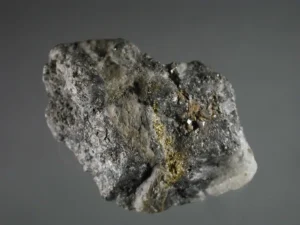
“Arsenic-bearing gold ore” refers to gold ore that contains arsenic-bearing minerals. The most typical associated mineral is arsenopyrite. This type of ore often overlaps with sulfide gold ore and refractory gold ore.
In other words, arsenic-bearing gold ore can often also be classified as the following:
- Sulfide Gold Ore
- Refractory Gold Ore
- Arsenopyrite-Bearing Gold Ore
Common Associated Minerals
- Arsenopyrite: arsenic-bearing sulfide mineral
- Pyrite: iron sulfide
- Stibnite: antimony sulfide, sometimes present
- Other minerals related to arsenic, antimony, or mercury
Common Appearance
- Gray, silvery-gray, or dark gray
- Strong metallic luster
- Gold is usually not visible to the naked eye
- Assay testing is required to confirm arsenic content and gold grade
Processing Characteristics
Arsenic-Bearing Gold Ore has two main processing challenges.
First, gold may be locked within arsenopyrite, resulting in low recovery during direct cyanide leaching.
Second, arsenic creates environmental and safety concerns. Roasting, oxidation, and tailings treatment all require stricter control.
6. Telluride Gold Ore
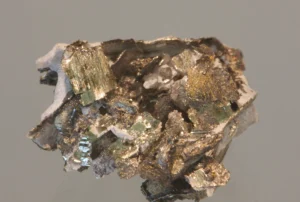
“Telluride gold ore” refers to gold ore in which gold occurs in the form of telluride minerals. This type of ore is less common than quartz gold ore, oxide gold ore, or sulfide gold ore, but it can have significant economic value in certain gold mining districts.
Gold telluride minerals include calaverite, sylvanite, and krennerite. According to USGS materials, in addition to native gold and sulfide-related gold minerals, several types of gold telluride minerals also occur in nature.
Common Characteristics
- Gold does not occur as ordinary native gold
- Gold combines with tellurium to form gold telluride minerals
- The processing method differs from that used for ordinary oxide gold ore.
- Flotation, roasting, heated leaching, or special pretreatment may sometimes be required
Processing Characteristics
Gold recovery from Telluride Gold Ore is usually more complex. Studies have also noted that gold telluride ores may require higher temperatures or specific processing conditions to improve leaching kinetics.
7. Copper-Gold Ore
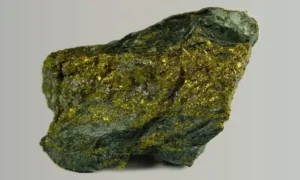
Copper-gold ore with chalcopyrite mineralization in dark host rock
“Copper-gold ore” refers to ore that contains both copper and gold. In many cases, copper is the main metal, while gold is recovered as an associated precious metal. In some ore bodies, however, gold also has high economic value and can be an important recovery target.
Common Expressions
- copper-gold ore
- Cu-Au ore
- copper-gold deposit
- copper-gold flotation
- copper-gold processing plant
Common Mineral Composition
Common copper minerals in Copper-Gold Ore include:
- Chalcopyrite: copper-iron sulfide
- Bornite: copper iron sulfide
- Chalcocite: copper sulfide
- Covellite: copper sulfide
- Malachite: copper carbonate mineral, commonly found in oxidized copper ores
- Azurite: copper carbonate mineral, commonly found in oxidized copper ores
Gold may occur as native gold, fine gold particles, or in association with sulfide minerals.
Appearance Characteristics
The appearance of copper-gold ore can vary widely, but common features include the following:
- Brassy metallic luster from chalcopyrite
- Blue-green oxidized copper minerals such as malachite and azurite
- Dark gray or black sulfide ore
- In some cases, gold is not visible to the naked eye, and assay testing is required to confirm gold grade
Processing Characteristics
Copper-gold ore is usually not processed by gravity separation alone. In actual production, flotation is more commonly used.
A typical process includes:
- Crushing
- Grinding
- Flotation
- Copper-gold concentrate production
- Smelting/refining to recover copper and gold
If the ore is oxidized copper-gold ore, the process may be more complex, because flotation performance is usually less stable for oxidized copper minerals than for copper sulfide minerals.
8. Silver-Gold Ore
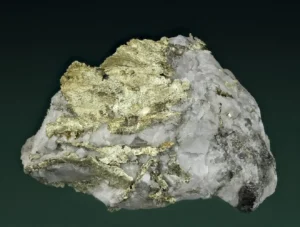
“Silver-gold ore” refers to ore that contains both gold and silver. It is relatively common in precious metal deposits, especially in some hydrothermal gold-silver deposits.
Common Expressions
- silver-gold ore
- gold-silver ore
- Au-Ag ore
- silver-bearing gold ore
- gold-silver processing
Common Mineral Composition
Silver-gold ore may contain the following:
- Native gold
- Native silver
- Electrum: natural gold-silver alloy
- Acanthite: silver sulfide
- Argentite: high-temperature form of silver sulfide
- Galena: lead sulfide, sometimes silver-bearing
- Sphalerite: zinc sulfide, sometimes associated with silver, lead, and zinc minerals
Among these, electrum is especially important. It is a natural gold-silver alloy. In many gold-silver ores, gold and silver are not completely separate. Instead, they occur as an alloy or in closely associated mineral forms.
Appearance Characteristics
Silver-gold ore is not necessarily gold-colored or silver-white. Common appearances include:
- Gray or dark gray ore
- Gold and silver minerals associated with quartz veins
- Metallic luster when sulfide minerals are present
- Brown, yellow, or rusty colors after oxidation
- It is usually difficult to accurately judge gold and silver content by visual inspection alone
Processing Characteristics
The processing method for silver-gold ore depends on how gold and silver occur in the ore.
Common processes include:
- Crushing
- Grinding
- Gravity separation, suitable for some coarse gold and silver particles
- Flotation, suitable for sulfide-type gold-silver ores
- Cyanide leaching, commonly used for gold and silver recovery
- Refining, used to separate gold and silver
If the silver content is high, leaching time, reagent consumption, and the recovery circuit may differ from those used for ordinary gold ore.
Differences Between Copper-Gold Ore and Silver-Gold Ore
| Item | Copper-Gold Ore | Silver-Gold Ore |
|---|---|---|
| Classification Basis | Copper and gold occur together | Gold and silver occur together |
| Common Metal Combination | Cu + Au | Au + Ag |
| Common Minerals | Chalcopyrite, bornite, chalcocite | Native gold, native silver, electrum, acanthite |
| Common Processing Method | Mainly flotation | Gravity separation, flotation, cyanide leaching |
| Main Product | Copper-gold concentrate | Gold-silver concentrate / gold-silver leaching product |
| Suitable Page Context | copper-gold processing, copper-gold flotation | gold-silver ore processing, precious metal recovery |
Types of Gold Ore by Depositional Environment and Occurrence Setting
These gold ore types are not classified by mineral composition or processing difficulty. Instead, they are classified by where gold is deposited and how it becomes concentrated after being weathered from a primary gold deposit.
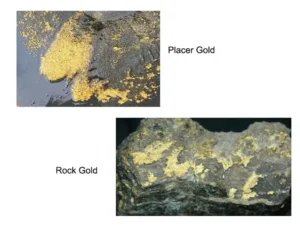
One important relationship should be noted:
Placer gold ore is the broader category, while alluvial and eluvial gold ore are specific types of placer gold ore.
In other words:
- Placer Gold Ore = the general term for placer gold deposits
- Alluvial Gold Ore = river-deposited placer gold
- Eluvial Gold Ore = near-source residual or slope placer gold
1. Placer Gold Ore
Placer gold ore refers to gold ore formed after gold is weathered and released from a primary gold deposit, then transported and concentrated by water flow, gravity, weathering, or related natural processes.
The main difference between placer gold ore and other types, such as quartz or sulfide gold ore, is that placer gold is usually not found in solid rock. Instead, it occurs in sand, gravel, riverbed sediments, or loose overburden.
Common Forms
Placer gold usually occurs in forms such as:
- Gold grains
- Gold flakes
- Fine gold powder
- Small gold nuggets
- Gold mixed with sand, gravel, and clay
Processing Characteristics
The core processing method for placer gold ore is washing, screening, and gravity separation. Because gold has a high density, gravity separation can be used to separate gold from sand and gravel.
Common equipment includes:
- Trommel screen
- Vibrating screen
- Sluice box
- Jig separator
- Shaking table
- Centrifugal concentrator
- Gold wash plant
2. Alluvial Gold Ore
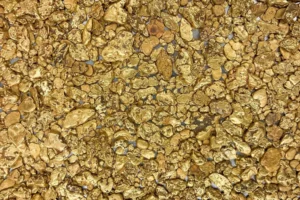
Alluvial gold ore is the most common and typical type of placer gold ore. It mainly forms in rivers, riverbeds, floodplains, and alluvial plains.
Simply put, alluvial gold ore is placer gold that has been transported and deposited by river water.
Common Locations
Alluvial gold ore is commonly found in:
- Riverbeds
- River banks
- Floodplains
- Alluvial plains
- Old river channels
- Gravel layers
Appearance Characteristics
Alluvial gold ore is usually not a solid piece of ore. Instead, gold particles are mixed with sand, soil, gravel, and pebbles.
Common forms include:
- Loose sand and gravel
- Muddy sand and gravel
- River pebble layers
- Associated black sand
- Gold grains, flakes, and fine gold powder mixed with sediment
Processing Characteristics
Alluvial gold ore usually does not require complex crushing and grinding because the gold has already been naturally liberated from the original rock. The main focus is to separate mud, sand, and gravel, then recover gold through gravity separation.
A common process includes:
- Feeding
- Washing
- Screening
- Desliming
- Gravity separation
- Gold concentrate collection
3. Eluvial Gold Ore
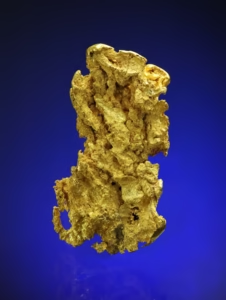
Crystalline Eluvial Gold Specimen from Rio Guayape, Honduras
Eluvial gold ore is also a type of placer gold ore, but it is different from alluvial gold ore.
Alluvial gold is transported and deposited by river water. Eluvial gold, however, forms after a primary gold deposit is weathered, but the gold is not transported far by water. Instead, it becomes concentrated in place or nearby, such as on slopes, at the foot of slopes, or within weathered zones.
Simply put, eluvial gold ore is placer or weathered gold found closer to the original gold source.
Common Locations
Eluvial gold ore is commonly found in:
- Slopes
- Foot slopes
- Weathered zones
- Residual layers
- Areas near primary gold deposits
- Areas near exposed quartz veins
Appearance Characteristics
Eluvial gold ore may be closer to primary ore than alluvial gold ore. It often contains:
- Weathered rock fragments
- Quartz fragments
- Clay
- Iron oxides
- Sand and gravel
- Coarse gold particles or flaky gold
Because the transport distance is short, the gold particles may be coarser and less rounded than river-deposited placer gold.
Processing Characteristics
The processing difficulty of Eluvial Gold Ore is generally between primary gold ore and alluvial placer gold.
If the material is relatively loose, washing, screening, and gravity separation can be used. If it contains many weathered rock fragments or quartz fragments, light crushing or liberation may be required.
A common process includes:
- Excavation
- Washing
- Screening
- Scrubbing
- Gravity separation
- Concentrate recovery
Differences Between Placer Gold Ore, Alluvial Gold Ore, and Eluvial Gold Ore
| Type | Classification Relationship | Formation Method | Common Location | Processing Method | |
|---|---|---|---|---|---|
| Placer Gold Ore | Broad category | Concentrated after primary gold is weathered | Rivers, slopes, gravel layers, and similar environments | Washing, screening, gravity separation | |
| Alluvial Gold Ore | A type of Placer Gold Ore | Transported and deposited by rivers | Riverbeds, floodplains, old river channels | Washing, desliming, gravity separation | |
| Eluvial Gold Ore | A type of Placer Gold Ore | Concentrated in place or near the source after weathering | Slopes, foot slopes, weathered zones | Washing, screening, scrubbing, gravity separation |
Types of Gold Ore by Processing Difficulty
This category does not focus on what the ore looks like, or on the main minerals it contains. Instead, it focuses on one key question:
Can the gold be easily liberated and recovered from the ore?
This makes these two types highly suitable for pages such as Gold Ore Processing, Gold Ore Beneficiation, or Gold Extraction Plant because they are directly related to equipment selection and process design.
1. Free-Milling Gold Ore
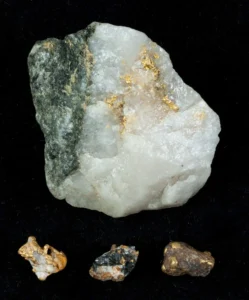
“Free-milling gold ore” refers to gold ore from which gold can be relatively easily liberated and recovered.
Simply put, after crushing and grinding, the gold particles are readily exposed. High recovery can often be achieved through conventional gravity separation or cyanide leaching.
It is not a fixed mineral type. Instead, it describes a processing characteristic. Many types of quartz, gold ore, and oxide gold ore may also be classified as free-milling gold ore.
Common Characteristics
Free-milling gold ore usually has the following characteristics:
- Gold particles are relatively easy to liberate
- Gold is not strongly locked within sulfide minerals
- The ore contains fewer interfering components such as carbonaceous matter, arsenic, or antimony
- Good leaching performance can often be achieved after conventional grinding
- The processing flowsheet is relatively simple, with comparatively lower operating costs
Common Processing Flow
The processing flow for free-milling gold ore is generally straightforward:
- Crushing
- Grinding
- Gravity separation, optional
- Cyanide leaching
- CIP / CIL recovery
- Smelting
If the gold particles are relatively coarse, gravity separation can be used first to recover part of the coarse gold. If the gold particles are finer, the process relies more heavily on cyanide leaching.
2. Refractory Gold Ore
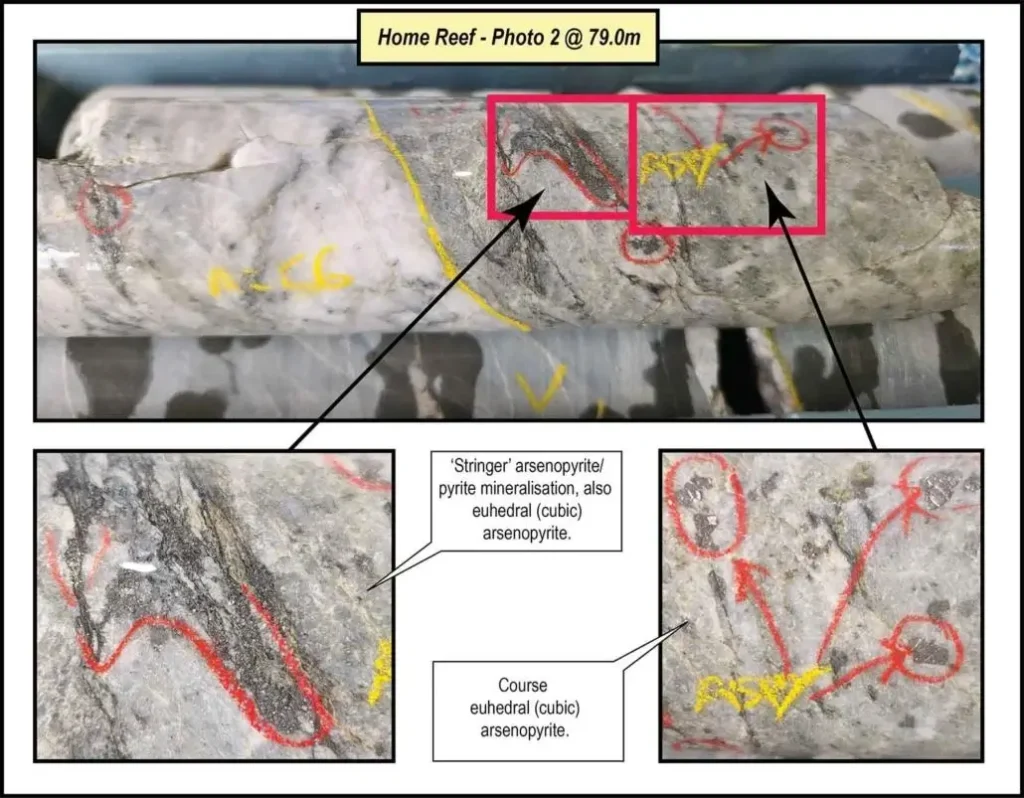
“Refractory gold ore” refers to gold ore that is difficult to recover effectively using conventional cyanide leaching.
Simply put, the gold is “locked” within other minerals, or the ore contains interfering components that reduce direct leaching recovery.
Refractory gold ore is not a single ore type. Instead, it describes a group of gold ores with higher processing difficulty. Many types of sulfide gold ore, carbonaceous gold ore, and arsenic-bearing gold ore may also be classified as refractory gold ore.
Common Causes
Refractory gold ore is difficult to process for several common reasons.
1. Gold Is Locked Within Sulfide Minerals
Gold particles may be locked within sulfide minerals such as pyrite or arsenopyrite, preventing the cyanide solution from directly contacting the gold.
Common minerals include:
- Pyrite
- Arsenopyrite
- Chalcopyrite
2. Gold Particles Are Extremely Fine
Some gold particles are extremely fine, even at the micron or submicron scale. Conventional grinding may not fully liberate them.
3. Carbonaceous Matter Is Present
If the ore contains natural carbonaceous matter, dissolved gold may be re-adsorbed, causing the preg-robbing effect.
4. Complex Elements Such as Arsenic, Antimony, or Mercury Are Present
These elements may affect leaching efficiency and increase the difficulty of environmental management.
Common Processing Flow
Refractory gold ore usually cannot be treated with a simple direct process. Pretreatment is often required.
A common process includes:
- Crushing
- Grinding
- Flotation to concentrate sulfide minerals
- Pretreatment
- Leaching
- CIL / CIP recovery
- Tailings treatment
Common pretreatment methods include:
- Roasting
- Pressure oxidation / POX
- Bio-oxidation
- Ultrafine grinding
- Chemical oxidation
Key Differences Between Free-Milling Gold Ore and Refractory Gold Ore
Item Free-Milling Gold Ore Refractory Gold Ore Classification Basis Low processing difficulty High processing difficulty Gold Occurrence Relatively easy to liberate Locked within minerals or extremely fine-grained Direct Cyanide Leaching Performance Usually good Usually poor Flowsheet Complexity Relatively simple More complex Common Processes Crushing, grinding, gravity separation, leaching Flotation, oxidation, roasting, pretreatment, leaching Cost Relatively lower Relatively higher Common Related Ore Types Quartz Gold Ore, Oxide Gold Ore Sulfide Gold Ore, Carbonaceous Gold Ore, Arsenic-Bearing Gold Ore