What Is Oxidized Gold Ore?
Oxidized gold ore is gold-bearing ore that has been altered by oxygen, water, carbon dioxide, and long-term weathering near the surface of the Earth. It usually forms when primary gold-bearing sulphide minerals are exposed to air and groundwater. During this process, sulphide minerals break down, iron oxides form, and the gold that was previously locked, enclosed, or finely distributed inside the host minerals may become exposed.
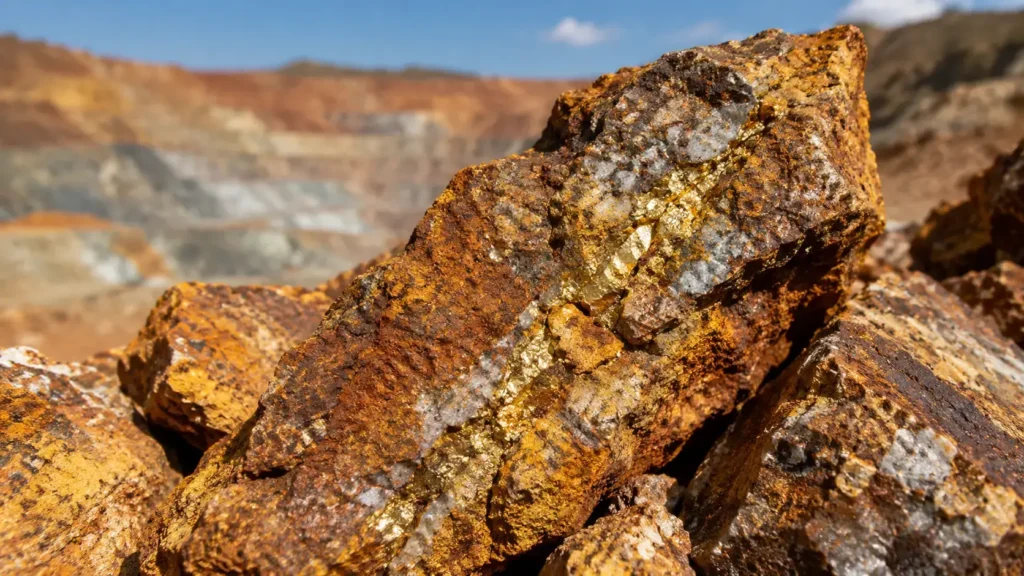
In simple terms, oxidized gold ore is often the weathered form of gold-bearing sulphide ore. It is commonly found in the upper part of a gold deposit, known as the oxidation zone. Because the original sulphide minerals have been partly or completely decomposed, oxide gold ore is often easier to process than fresh sulphide gold ore.
Oxidized gold ore may also be described by related terms such as gold oxide ore, gold ore oxide, raw oxidized gold ore, or unrefined oxidized gold ore. These terms usually refer to gold-bearing ore that has not yet been fully processed or refined.
How Does Oxidized Gold Ore Form?
Many gold deposits are originally associated with sulphide minerals such as pyrite, arsenopyrite, chalcopyrite, galena, and sphalerite. These minerals are stable underground, especially in deeper and less oxygen-rich environments. However, when the ore body is exposed near the surface, oxygen and water begin to react with the sulphide minerals.
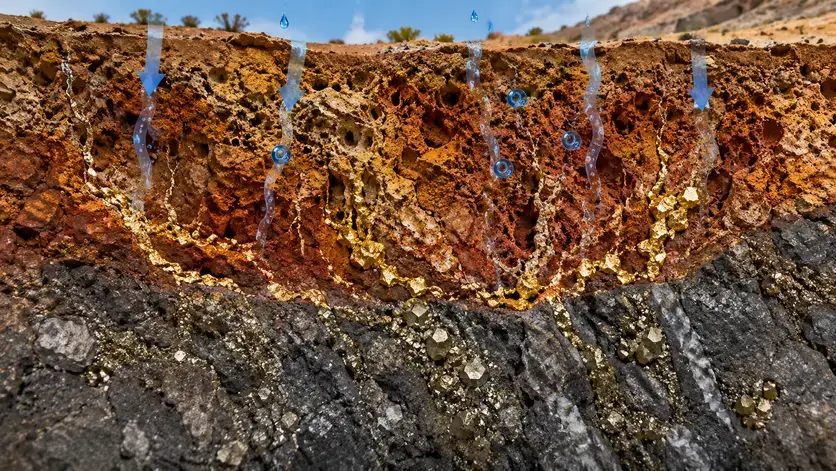
A common example is pyrite oxidation. Pyrite has the chemical formula FeS₂. When pyrite reacts with oxygen and water, it can produce iron ions, sulphate, and acid.
The simplified reaction is:
2FeS₂ + 7O₂ + 2H₂O → 2Fe²⁺ + 4SO₄²⁻ + 4H⁺
The iron can then continue to oxidize and form iron hydroxides and iron oxides such as goethite, limonite, and hematite. These minerals are the reason why many oxidized gold ores appear yellow-brown, reddish-brown, rusty, or earthy in color.
This process does not create new gold. Instead, it destroys or weakens the original host minerals and exposes the gold that was already present in the ore.
Where Was the Gold Before Oxidation?
Gold does not suddenly appear during oxidation. The gold was already present in the original gold-bearing ore, but it may have existed in several different forms.
Some gold occurs as very fine native gold particles enclosed in sulphide minerals such as pyrite or arsenopyrite. In this case, the gold is physically locked inside the mineral grains. When the sulphide minerals are oxidized and decomposed, the gold particles may become exposed.
Gold may also occur along mineral cracks, crystal boundaries, quartz vein fractures, or tiny pores within the rock. Oxidation and weathering can loosen the rock structure, enlarge cracks, and make the gold easier to recover.
In some ores, gold is extremely fine and may exist as “invisible gold” inside the crystal structure of sulphide minerals. This type of gold cannot be seen with the naked eye. When the host minerals break down, the gold may remain as residual gold or become associated with iron oxides and clay minerals.
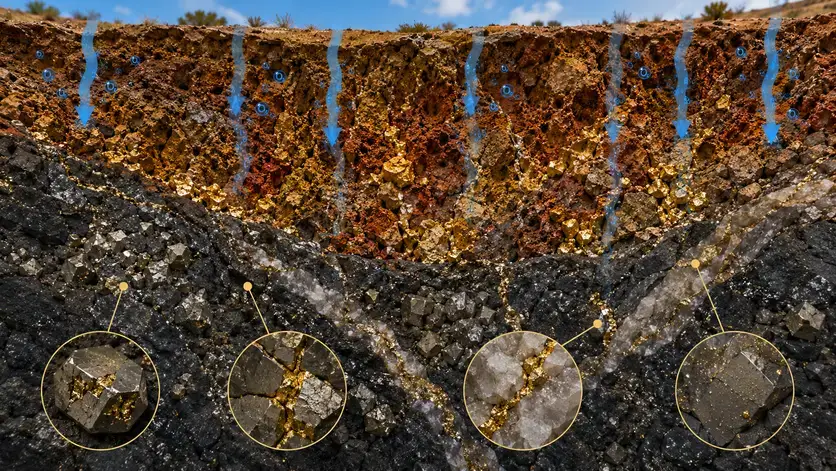
A simplified way to describe the process is:
Gold-bearing sulphide ore + oxygen + water
→ iron oxides + sulphates + acid + exposed residual gold
In this expression, the gold is not newly formed. It is the original gold that remains after the host minerals have been oxidized.
Is There Such a Thing as Pure Gold Ore?
In nature, there is almost no such thing as an entire ore body made of pure gold. However, gold can exist in its natural metallic form, known as native gold. Its chemical symbol is Au.
Native gold means that the gold already exists as metallic gold in the ore. It may occur as fine particles, flakes, visible grains, or small nuggets. However, it is usually distributed within rocks, quartz veins, alluvial gravels, or other minerals. It is not usually found as a whole mountain or large mass of pure gold.
If “pure gold ore” means ore that contains gold in its natural metallic form, then yes, this type of gold does exist. For example, gold may occur as native gold particles in quartz veins or as placer gold grains in river sediments and alluvial deposits.
A typical example may be:
- quartz vein with native gold particles
- alluvial gravel containing placer gold grains
- weathered gold ore with exposed natural gold
Gold ore is not the same as a gold nugget. Even high-grade gold ore usually contains only a small amount of gold per ton of rock. A grade of 5 g/t, 10 g/t, or 20 g/t can already be economically valuable in many mining projects. This means that one ton of ore may contain only a few grams to a few tens of grams of gold.
The rest of the ore is usually made up of quartz, feldspar, calcite, pyrite, clay minerals, iron oxides, and other gangue minerals.
Native gold is also not always 100% pure. Natural gold commonly contains silver and may also contain small amounts of copper, iron, mercury, or other elements. When gold contains a significant amount of silver, it is known as electrum, a natural gold-silver alloy.
Therefore, native gold, placer gold, quartz vein gold, and gold nuggets do exist in nature, but most gold ore is still rock that contains a recoverable amount of Au.
What Does Raw Oxidized Gold Ore Look Like?
Raw oxidized gold ore often has a weathered, rusty, earthy, or clay-rich appearance. It is commonly yellow-brown, reddish-brown, dark brown, or orange-brown because of iron oxides and hydroxides.
Common visual features include:
- rusty or iron-stained surfaces
- soft or friable texture
- clay-rich zones
- quartz vein fragments
- porous or weathered rock structure
- limonite, goethite, or hematite staining
- reduced visible sulphide content
However, visual inspection alone is not enough to confirm whether a rock contains gold. Some oxidized rocks may look promising but contain little or no gold. On the other hand, some gold-bearing oxidized ores may not show visible gold at all.
This is why oxidized gold ore pictures can be useful for basic identification, but proper sampling and laboratory assay are still required to confirm gold content.
Where Is Oxidized Gold Ore Found?
Oxidized gold ore is usually found in the weathered or near-surface zones of gold deposits. It can occur wherever gold-bearing sulphide ore has been exposed to oxygen, water, and long-term geological weathering.
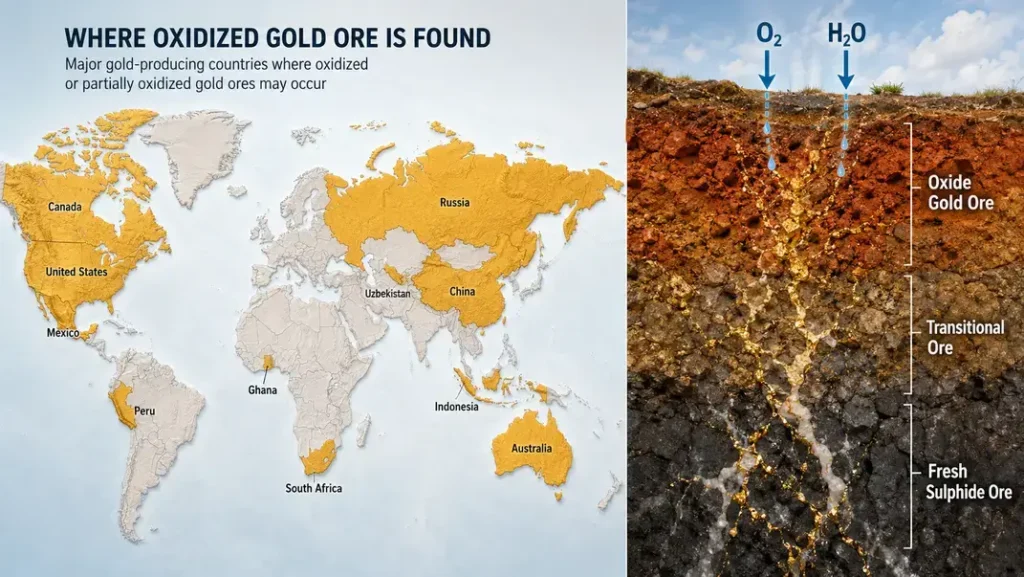
Major gold-producing countries where oxidized or partially oxidized gold ores may occur include:
- China
- Russia
- Australia
- Canada
- United States
- Ghana
- South Africa
- Peru
- Mexico
- Indonesia
- Uzbekistan
These countries are important in global gold mining, but oxidized gold ore is not limited to them. The key condition is not the country itself, but the geological environment. Oxidized gold ore is more likely to form where gold-bearing rocks are close to the surface and have experienced long-term weathering.
In many deposits, the upper zone may contain oxide gold ore, the middle zone may contain transitional ore, and the deeper zone may contain fresh sulphide gold ore.
Quartz Oxidized Gold Ore and Pyrite Oxidized Gold Ore
Quartz oxidized gold ore refers to oxidized gold-bearing ore associated with quartz veins. In many gold deposits, quartz veins act as important host structures for gold. Gold may occur as fine native gold particles, invisible gold, or gold associated with sulphide minerals inside or near the quartz vein.
Oxidized quartz gold ore may contain quartz fragments with iron oxide staining, clay alteration, and exposed gold-bearing zones. In some cases, visible gold may be present, but in many cases the gold is too fine to see.
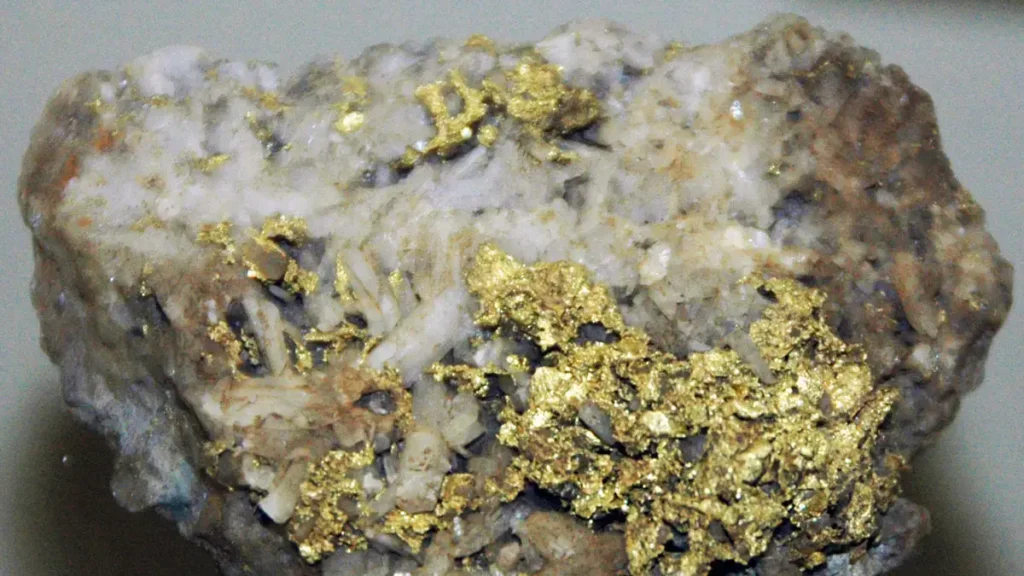
Pyrite oxidized gold ore refers to gold-bearing ore where pyrite was one of the original host minerals. Pyrite is often called “fool’s gold” because of its metallic yellow appearance, but it can also be an important carrier of real gold in many deposits.
When pyrite oxidizes, the sulphur and iron are chemically altered, while the gold may remain as residual gold or become exposed. This is one reason why some oxidized gold ores can be more suitable for leaching than fresh sulphide ores.
Oxide vs Sulphide Gold Ore
The difference between oxide and sulphide gold ore is one of the most important questions in gold mining and processing.
Oxide gold ore is usually found near the surface and has already been affected by oxidation and weathering. The sulphide minerals have been partly or mostly decomposed. As a result, the gold may be easier to expose and recover.
Sulphide gold ore is usually fresher and found deeper in the deposit. In sulphide ore, gold may be locked inside pyrite, arsenopyrite, or other sulphide minerals. This can make direct cyanide leaching less effective, especially when the gold is very fine or encapsulated.
A simple comparison is:
| Type | Main Features | Processing Difficulty |
|---|---|---|
| Oxide gold ore | Weathered, iron-stained, lower sulphide content, often near surface | Usually easier |
| Transitional gold ore | Partly oxidized and partly sulphide-bearing | Medium difficulty |
| Sulphide gold ore | Fresh sulphides, gold may be locked in pyrite or arsenopyrite | Often more difficult |
For this reason, oxide vs sulphide gold ore is not just a geological question. It directly affects mining cost, processing method, recovery rate, and project economics.
How Is Oxidized Gold Ore Mined?
Oxidized gold ore is commonly located near the surface, so open-pit mining is often used when the deposit is large enough and close enough to the surface. The typical process includes removing topsoil and waste rock, drilling, blasting, loading, and transporting the ore to the processing plant or heap leach area.
For deeper or narrow vein-type deposits, underground mining may be used. This is more common when the ore body is high-grade, steeply dipping, or located too deep for economical open-pit mining.
If the gold has been released from the original rock and concentrated in rivers, alluvial gravels, or ancient stream channels, placer mining may be used. Placer gold is often recovered by gravity separation because the gold particles are already physically liberated from the host rock.
It is important to separate mining from processing. Mining is the process of extracting the ore from the ground. Processing is the next stage, where the ore is crushed, screened, ground, leached, concentrated, or refined to recover gold.
Common Challenges in Oxidized Gold Ore Mining
Although oxidized gold ore is often easier to process than sulphide gold ore, mining it still involves several challenges.
Variable Gold Grade
Gold distribution in oxidized ore can be uneven. Two areas that look similar in color and texture may have very different gold grades. This is why systematic sampling, drilling, and assay testing are necessary before large-scale mining.
Clay and Mud Content
Oxidized zones often contain clay minerals and weathered material. High clay content can cause problems in crushing, screening, washing, conveying, and heap leaching. Clay can reduce permeability in heap leach pads and make solution flow less efficient.
Unclear Ore Boundary
The boundary between oxide ore, transitional ore, and sulphide ore is often gradual rather than sharp. If too much sulphide ore is mixed into an oxide ore processing route, gold recovery may decrease.
Water and Drainage Problems
Open-pit mines may face rainwater, groundwater, and drainage issues. This is especially important in tropical regions or areas with strong seasonal rainfall. Poor drainage can affect pit stability, haul roads, ore handling, and processing efficiency.
Low-Grade Ore Economics
Many oxidized gold deposits are low-grade. Even if the ore is easier to leach, the project must still control stripping ratio, mining cost, transport distance, crushing cost, reagent consumption, and recovery rate.
Environmental and Safety Control
Oxidized gold ore mining still requires proper control of dust, slope stability, tailings, leach solution, waste rock, and water management. Environmental compliance is especially important when heap leaching or cyanide leaching is used.
How Is Oxidized Gold Ore Processed?
The processing method depends on gold grade, particle size, mineral composition, clay content, and whether the gold is free, locked, or associated with other minerals.
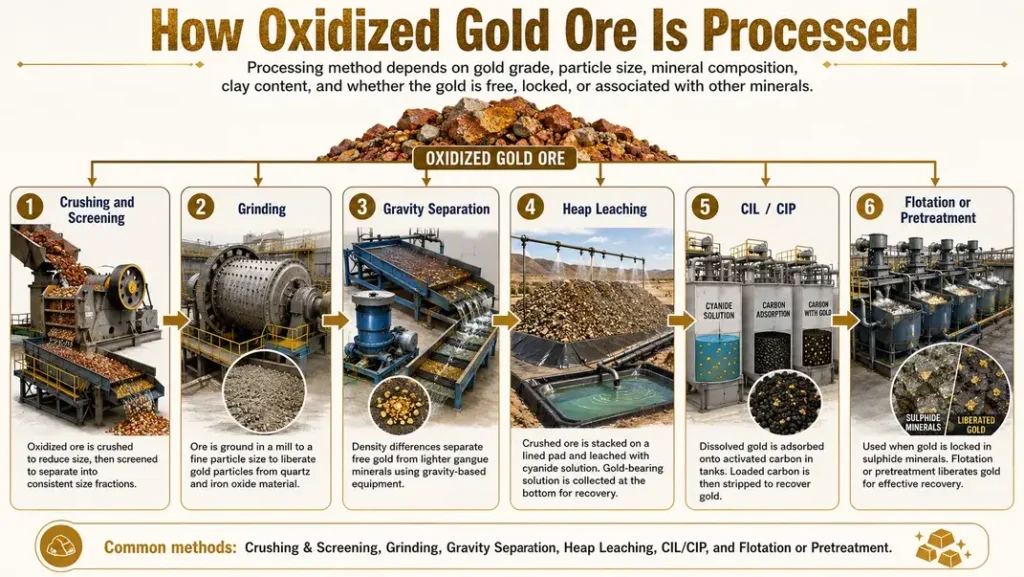
Common oxidized gold ore processing methods include:
Crushing and Screening
The ore is first reduced to a suitable size. For heap leaching, crushing may be enough. For higher-grade ore, further grinding may be required.
Grinding
Grinding helps liberate gold particles from the surrounding minerals. This is especially important when the gold is fine or still partly locked in quartz or iron oxide material.
Gravity Separation
If the ore contains coarse or free gold particles, gravity separation may be used. Equipment such as jigs, shaking tables, centrifugal concentrators, or sluice systems may help recover heavier gold particles.
Heap Leaching
Heap leaching is commonly used for low-grade oxide gold ore. The crushed ore is stacked on a lined leach pad, and a leaching solution is applied to dissolve the gold. The gold-bearing solution is then collected and treated to recover gold.
Heap leaching is attractive because it can handle large volumes of low-grade ore at relatively low cost. However, it requires good ore permeability, proper solution management, and environmental control.
CIL and CIP
For higher-grade or more finely ground oxidized gold ore, CIL or CIP processing may be used. These methods use activated carbon to adsorb dissolved gold from cyanide solution.
CIL stands for carbon-in-leach, while CIP stands for carbon-in-pulp. Both are widely used in modern gold processing plants.
Flotation or Pretreatment
If the ore is not fully oxidized and still contains significant sulphide minerals, flotation or pretreatment may be required. This is especially true for oxidized gold sulfide ore or transitional ore where part of the gold is still locked in sulphides.
Does Oxidized Gold Ore Have an Amount of Gold?
Yes, oxidized gold ore contains gold, but the amount can vary greatly. Some oxidized gold ores may contain only low gold grades, while others may be economically valuable.
The gold content cannot be accurately judged by color, weight, or appearance alone. A rock may look rusty and mineralized but contain little gold. Another sample may look ordinary but contain fine gold that is not visible to the naked eye.
The only reliable way to determine gold content is through proper sampling and laboratory assay.
FAQ
What is oxidized gold ore?
Oxidized gold ore is gold-bearing ore that has been altered by oxygen, water, and weathering near the surface. It usually forms when gold-bearing sulphide minerals break down and expose the gold inside or around them.
Is oxide gold ore easier to process than sulphide gold ore?
In many cases, yes. Oxide gold ore is often easier to process because the sulphide minerals have already been decomposed, making the gold more accessible. However, clay content, fine gold size, and low grade can still create processing challenges.
What does raw oxidized gold ore look like?
Raw oxidized gold ore often appears rusty, yellow-brown, red-brown, dark brown, or earthy. It may contain iron oxides, clay minerals, quartz fragments, and weathered rock textures.
What is the difference between oxide and sulphide gold ore?
Oxide gold ore has been weathered and oxidized near the surface, while sulphide gold ore is fresher and often found deeper underground. Sulphide ore may contain gold locked inside pyrite, arsenopyrite, or other sulphide minerals.
Can oxidized gold ore contain visible gold?
Yes, but not always. Some oxidized quartz gold ore may contain visible native gold, while many oxidized gold ores contain gold that is too fine to see without laboratory testing.
Is gold created during oxidation?
No. Oxidation does not create gold. The gold was already present in the original ore. Oxidation breaks down the host minerals and may expose or concentrate the gold.
Is there pure gold ore in nature?
There is native gold in nature, including placer gold, quartz vein gold, and gold nuggets. However, most gold ore is not pure gold. It is rock that contains a small but valuable amount of gold.
Conclusion
Oxidized gold ore is an important type of gold-bearing ore formed by the natural oxidation and weathering of primary gold deposits. It often occurs near the surface, has a rusty or iron-stained appearance, and may contain gold that has been exposed after sulphide minerals break down.
Compared with sulphide gold ore, oxide gold ore is often easier to mine and process, especially when the gold is free or partly liberated. However, successful recovery still depends on proper sampling, ore testing, mining design, and processing method selection.
Understanding oxidized gold ore, raw oxidized gold ore, quartz oxidized gold ore, pyrite oxidized gold ore, and the difference between oxide vs sulphide gold ore helps miners, investors, and equipment buyers choose the right mining and processing solution.