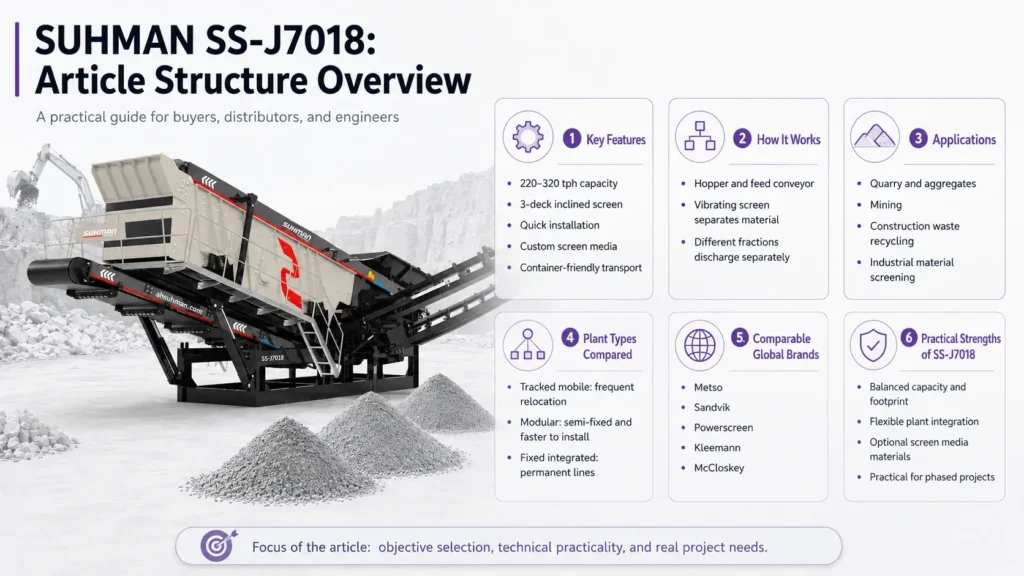
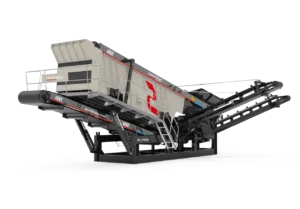
The SUHMAN SS-J7018 is a modular inclined vibrating screening plant positioned for medium-to-large aggregate and mineral screening duties in semi-fixed or fixed production lines. it is built around a 7000 × 1800 mm, 3-deck vibrating screen, with a machine processing capacity of 220–320 t/h, feed capacity of 320 t/h, maximum feed size of 100 mm, total installed power of 57 kW, machine weight of 28 t, working dimensions of 14,300 × 13,000 × 4,830 mm, and transport dimensions of 14,800 × 3,750 × 3,550 mm.
The machine is not positioned as a crawl-around contractor screen for constant site-to-site movement. Instead, it is presented as a plant-style screening module for semi-fixed and fixed production lines where integration, stable operation, and repeatable material classification matter more than self-propelled mobility.
How the machine works
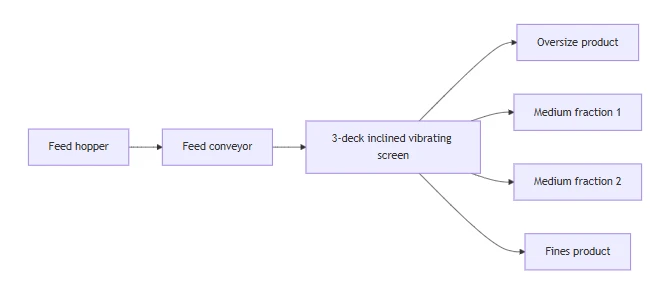
At a basic level, the SS-J7018 follows the standard logic of an inclined vibrating screening plant. Material is fed from a hopper onto a conveyor, distributed onto the upper deck of the inclined vibrating screen, and then advanced along the screening surface by a combination of vibration and gravity. Finer particles pass through the apertures of the upper deck, then continue through lower decks according to their size relative to the selected media openings. Oversize material remains on the upper deck; intermediate fractions are retained on middle decks; the smallest fraction passes to the bottom discharge. SUHMAN’s product text states that the plant can separate material into four size fractions, and standard inclined-screen references from Metso describe the same core mechanism: circular screen motion plus deck inclination move particles forward while allowing size-based separation.
That operating principle is not unique to SUHMAN. It is the standard reason inclined screens remain common in aggregates and mining. They are mechanically simple relative to more specialized sorting systems, they work well on free-flowing material, and they can generate multiple products in one pass when feed gradation and media selection are sensible. Kleemann similarly explains that triple-deck classifying screens can separate up to four fractions, while its product literature emphasizes that screen inclination and screen surface selection are central to adapting performance to the feed.
The practical implication for plant design is simple: screening performance depends as much on feed presentation and media selection as on the machine’s nameplate capacity. Metso notes that compact inclined screens are designed for fast media changes and adjustable stroke/RPM to optimize performance, and several mobile-screen manufacturers emphasize accessibility for media changes as a core selling point. That is why procurement decisions should not stop at screen size and tonnage. They should also address media type, top-deck burden, moisture, fines content, and how evenly the feed is presented onto the screen box.
Where the machine fits
SUHMAN’s published applications for the SS-J7018 include mining and quarrying, aggregate production, construction and demolition waste recycling, industrial raw-material sorting, and duty as a screening module inside a larger modular crushing and screening system. Those claims are consistent with the general application envelope for inclined multi-deck screens across the industry. Metso positions its inclined screens for quarries, gravel pits, mines, recycling, industrial materials, and slag. Powerscreen, Finlay, and Kleemann describe similar application domains for their tracked inclined and classifying screens.
For a quarry or aggregate plant, the SS-J7018 makes the most sense when the upstream crushing stages already control top size to around 100 mm or below, and when the goal is to produce multiple aggregate fractions with repeatable split quality. The 3-deck layout is well suited to common end-screening or transfer-screening duties where operators want coarse, mid-size, fine, and undersize products with one machine. In a concrete or asphalt aggregate circuit, that often means using the unit immediately downstream of secondary or tertiary crushing, or as the classifying screen inside a broader modular plant.
For recycling duties, the machine is appropriate where the feed has already been reduced to a manageable top size and the objective is fractionation, not highly aggressive scalping of dirty or oversize demolition debris. SUHMAN’s own portfolio helps make that distinction. The company positions the SZ-450D heavy-duty scalper for larger feed and coarse pre-screening, the SS-7018 for general tracked inclined screening, and the SSP-6200 horizontal screen for sticky or damp material. That product logic is consistent with wider industry practice: inclined screens are typically preferred for cleaner, freer-flowing classification duties, while horizontal or heavy-duty scalping units are often better choices for difficult moist feed or very coarse run-of-mine burdens.
A useful engineering decision rule is this: if the material is mostly dry and the main requirement is multi-size classification at moderate-to-high throughput inside a semi-fixed line, an inclined modular screen is usually a good fit. If the plant moves frequently, a tracked screen deserves first consideration. If the material is sticky, damp, or unusually difficult to stratify, a horizontal screen or a different flow arrangement may outperform an inclined unit even if the nominal capacities look similar on paper.
Screening plant types and why modular matters
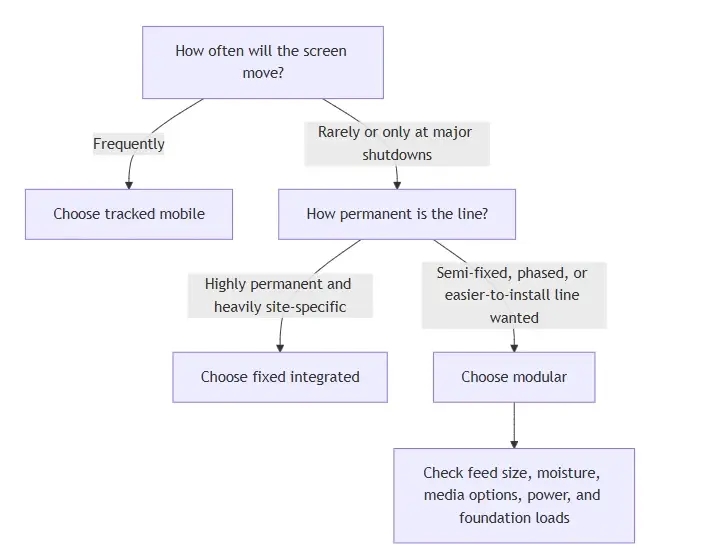
The current market for this duty can be simplified into three architectures: modular, tracked mobile, and fixed integrated. Those categories overlap, and vendors use slightly different terminology, but the distinction is still practical enough to guide specification work.
If a quarry or recycling site moves often, a tracked screen may be the right answer. If the site is permanent and the process is heavily customized, a fixed integrated station may be justified. If the goal is to combine a stable line layout with faster delivery, lower civil complexity, and straightforward integration into a broader crushing-and-conveying system, modular often becomes the practical middle path.
Manufacturer literature across the sector reflects this logic: Metso highlights fast installation and media change on compact inclined screens for stationary and portable solutions; Powerscreen, Finlay, Sandvik, Astec, and Kleemann emphasize rapid setup and mobility for tracked units; and SUHMAN places the SS-J7018 specifically in the semi-fixed/fixed category.
| Type | What it is | Strengths | Limitations | Where it fits best |
|---|---|---|---|---|
| Modular | Factory-built screening module designed to be integrated into a semi-fixed or fixed line | Faster installation than a fully civil-built station; predictable integration; easier phased expansion; often simpler power distribution; easier replacement or reconfiguration than one-off structural stations | Less mobile than tracked equipment; still requires site preparation, lifting, and line integration | Quarries, aggregate plants, and recycling lines that want plant stability without committing to a heavily bespoke fixed station |
| Tracked mobile | Self-propelled crawler screen with onboard power and folding conveyors | Fast relocation; short setup; low dependence on permanent infrastructure; good for changing faces and contract work | Higher machine complexity; more onboard systems to maintain; layout flexibility can be constrained by transport geometry; often heavier power package than a modular electric screen | Contractors, multi-site operators, temporary pads, and fast-changing quarry or recycling jobs |
| Fixed integrated | Screen installed as part of a conventional stationary plant with bespoke steelwork/civils | Can be optimized tightly to one site and one flowsheet; strong long-term productivity when feed and layout are stable | More site-specific engineering; higher civil/structural commitment; slower to modify or relocate; generally a longer project path | Long-life fixed plants with stable ore/aggregate characteristics and a strong case for customized surrounding infrastructure |
This comparison synthesizes SUHMAN’s modular-versus-tracked positioning with broader manufacturer language around stationary, portable, and tracked screens. Exact boundaries vary by vendor and by project.
Why, then, does modular matter? The short answer is that it often removes some of the friction between “too temporary” and “too permanent.” SUHMAN explicitly says the SS-J7018 offers easier installation and integration than a traditional fully civil-built screening station. Metso likewise highlights that compact inclined screens are fast to install, commission, and operate, and are designed for both stationary and portable duties. Those are not small benefits for buyers managing project schedules, civil-work risk, or phased-capex decisions.
For this article, the brief also specifies several modular advantages as part of the SS-J7018 configuration intent: quick installation, customizable screen media, module-oriented/container-transport planning, and selectable screen materials. Public manufacturer literature broadly supports that logic even where the SS-J7018 public page does not publish every detail. Metso points to quick setup and fast, efficient screening-media changes; CONSTMACH states that screen meshes can be steel or polyurethane and that its modular structure simplifies spare-part changes and maintenance; MEKA lists media options such as grizzly, perforated sheet, polyurethane, and steel meshes. What the public SUHMAN page does not publish is a module-by-module packing list or explicit container loading plan, so containerization details should be verified during the quotation stage rather than assumed from the assembled transport dimensions alone.
In practical procurement terms, modular excels when a buyer wants the discipline of a plant module rather than the improvisation of a one-off site build. That usually means faster erection planning, easier future replacement, clearer interface points with crushers and conveyors, and less exposure to custom structural redesign every time the flowsheet changes. For dealers, this also tends to mean a clearer product story. For engineers, it means a more defined package boundary. For procurement managers, it often means a more comparable bid package.
Comparable models from global brands
No two manufacturers package the screening duty in exactly the same way, so comparisons in this segment are never perfectly like-for-like. Some brands publish standalone static screens; others publish tracked classifying screens; Sandvik’s Doublescreen concept uses a different screening arrangement; and FABO’s nearest-model page in this size band includes washing. Still, the models below are the most useful mainstream reference points around the same broad duty class. Where a value is not published on the selected official page or datasheet, it is shown as not publicly stated.
| Brand | Model | Capacity range | Deck count | Screen size | Max feed | Mobility type | Typical power |
|---|---|---|---|---|---|---|---|
| SUHMAN | SS-J7018 | 220–320 t/h | 3 | 7000 × 1800 mm | 100 mm | Modular / semi-fixed | 57 kW |
| Metso | Compact CVB2060-3 | Not publicly stated on selected page | 3 | 2.0 × 6.0 m | Not publicly stated | Stationary or portable module | 22 kW / 30 hp |
| Sandvik | QA335 Doublescreen | Up to 400 mtph | 2 | 4.0 × 1.5 m | Not publicly stated | Tracked mobile | Not publicly stated on selected HTML page |
| Powerscreen | Chieftain 1700X | Up to 500 tph | 2 or 3 | 4.8 × 1.5 m | Not publicly stated | Tracked mobile | 77 / 82 / 98 kW depending emission stage |
| Kleemann | MSC 703 EVO | Up to 800 t/h on model page | 3 | 5’1″ × 14’9″ | 100 × 160 mm | Tracked mobile | 98 hp |
| McCloskey | S190 Triple Deck | Not publicly stated on selected page | 3 | Top & middle: 1.52 × 6.10 m; bottom: 1.52 × 5.49 m | Not publicly stated | Track or wheel mobile | 98 kW |
| MEKA | MS 2060X3 | Application-dependent / not publicly stated | 3 | 2000 × 6000 mm | Not publicly stated | Stationary inclined screen | 22 kW / 30 hp |
| Astec | GT205S | Not publicly stated on selected HTML case-study pages | 2 or 3 | 5′ × 20′ class | Not publicly stated on selected HTML case-study pages | Tracked mobile | Not publicly stated on selected HTML case-study pages |
| Finlay | 684 3-Deck | Up to 500 tph | 3 | 4.3 × 1.7 m | Not publicly stated | Tracked mobile | 77–82 kW depending emission stage |
| FABO | ME-2050 | 200–300 t/h | 4 | 2000 × 5000 mm | Not publicly stated | Mobile, single chassis / axle transport | 65 kW |
| CONSTMACH | CVS-2060-3 | 192–240 t/h | 3 | 2000 × 6000 mm | Not publicly stated | Stationary vibrating screen | 18.5 kW |
Sources for the table: SUHMAN SS-J7018 official product page; Metso Compact CVB specifications and inclined-screen pages; Sandvik QA335 official page; Powerscreen Chieftain 1700X official page and brochure; Kleemann MSC 703 EVO official page and datasheet; McCloskey S190 official page, screeners page, and brochure; MEKA inclined-screen references; Astec GT205S case-study pages and mobile incline screen family page; Finlay 684 3-Deck page and brochure; FABO ME-2050 page; CONSTMACH official vibrating-screen pages and catalog snippets.
The most important takeaway from that table is not that one machine is “best.” It is that the market splits into at least three comparison groups. First are modular or static 2.0 × 6.0 m-class screens such as the SS-J7018, Metso CVB2060 class, MEKA MS 2060 class, and CONSTMACH CVS-2060 class. Second are tracked compact-to-midrange mobile classifiers such as the Powerscreen Chieftain 1700X, Finlay 684 3-Deck, McCloskey S190, and Astec GT205S. Third are specialist configurations such as Sandvik’s Doublescreen architecture or washing-integrated plants such as FABO’s ME-2050, which solve adjacent rather than identical duties.
Where the SS-J7018 stands out
Viewed objectively, the SS-J7018 appears strongest in the semi-fixed line use case. That is its clearest differentiator. The public SUHMAN category page does not present it as a fully mobile contractor screen; it presents it as a modular screen plant for semi-fixed and fixed crushing-and-screening lines, with easier installation and integration than a fully civil-built screening station. For buyers who do not need tracked mobility but do want a standardized plant package, that is a real and practical advantage.
A second apparent strength is the combination of screen size and target throughput. At 7000 × 1800 mm, the SS-J7018 offers a larger nominal deck footprint than several tracked machines commonly used as references in this class, including the Finlay 684 3-Deck at 4.3 × 1.7 m and the Powerscreen Chieftain 1700X at 4.8 × 1.5 m. That does not prove higher real-world output on every material. Screening efficiency still depends on feed gradation, burden depth, moisture, and media. But it does suggest that the SS-J7018 has a sensible deck-area-to-duty ratio for its published 220–320 t/h range.
A third advantage is process simplicity inside a fixed line. Compared with a tracked mobile screen, a modular electric screen does not have to carry the design burden of propulsion, undercarriage systems, or the packaging compromises that come with fold-for-transport mobility. That can simplify power architecture, interfacing, and maintenance planning in a plant that already has crushers, conveyors, and central electrical infrastructure. This is one reason large OEMs such as Metso still maintain strong product families of compact and stationary inclined screens in parallel with mobile equipment.
A fourth advantage is configuration flexibility around media and wear parts, at least at the architectural level. The brief for this article confirms quick installation, customizable screen media, module-oriented transport planning, and selectable screen materials as intended modular benefits. Public literature from other manufacturers supports why those options matter: Metso emphasizes quick media changes and multiple panel options; CONSTMACH states that steel and polyurethane meshes are available; MEKA lists a range of mesh and panel materials. Even without a published SS-J7018 module packing diagram, the machine’s modular role in a semi-fixed line makes those forms of customization more valuable than they often are on smaller mobile screens purchased mainly for rapid relocation.
That said, a neutral comparison also requires stating where peers may be stronger. Tracked units from Powerscreen, Finlay, Sandvik, Kleemann, McCloskey, and Astec are stronger when relocation frequency is high, when setup speed on changing pads matters, or when the screen must work as an autonomous jobsite asset rather than as one module in a larger line. Large global brands may also offer broader established dealer coverage in some markets, and buyers with strict uptime requirements often weigh regional spare-parts access as heavily as machine specifications. Those are not small considerations. They are frequently decisive.
So the fairest conclusion is this: the SS-J7018 does not “beat” every peer. It appears to offer the most value when the duty is stable, the plant is semi-fixed or fixed, modular installation is preferred over a fully bespoke station, and the buyer wants a relatively large 3-deck inclined screen in a moderate throughput band without paying for crawler mobility they do not need.
Practical buying and engineering guidance
For procurement managers, the fastest way to make a mistake with a screening plant is to compare only nameplate tonnage. Screen choice is a systems decision. The following checklist is a better starting point.
| Decision point | Why it matters | Practical guidance |
|---|---|---|
| Feed top size | Determines whether the screen is being used within its intended burden range | For SS-J7018, confirm upstream crushing controls feed to 100 mm max |
| Material moisture and stickiness | Strongly affects stratification and blinding risk | If feed is sticky or damp, compare inclined options against horizontal alternatives such as SUHMAN’s SSP-6200-type concept |
| Number of saleable products | Determines deck count and conveyor layout | A 3-deck classifying screen is appropriate when up to four fractions are required |
| Mobility requirement | Often decides architecture before brand | Frequent relocation favors tracked mobile; semi-fixed production favors modular |
| Media type and change frequency | Affects both split quality and downtime | Ask for wire, polyurethane, perforated, mixed-media, and wear-life options |
| Plant interface | Defines installation time and project risk | Confirm foundations, support steel, chute interfaces, electrical load, and stockpile clearances early |
| Service access | Directly affects maintenance hours and safety | Review catwalks, deck access, tensioning systems, grease points, and change-out procedures |
| Local support | Downtime risk is commercial risk | Ask which spare parts are regional stock items and which are factory-order items |
The logic behind that table is visible across the manufacturer sources. SUHMAN publishes a 100 mm maximum feed for the SS-J7018; the SSP-6200 horizontal screen is positioned for sticky and damp materials; both SUHMAN and Kleemann present triple-deck screens as capable of producing multiple fractions; Metso, Powerscreen, Finlay, and others emphasize setup, access, and media-change features because those details directly shape uptime.
On installation, the most common buyer mistake is under-scoping the interfaces rather than the machine. For a modular screen, that means overlooking feed height, transfer chute geometry, support steel, walkway access, cable routing, stockpile clearances, and the way the plant will actually be lifted and assembled on site. A modular unit can install faster than a fully bespoke station, but only if the interfaces are frozen early enough. This is exactly why vendors emphasize installation, commissioning, and service support on their product pages.
On maintenance, the most common technical mistake is treating media as a consumable detail rather than a process variable. Media choice determines not only wear life but also split sharpness, blinding tendency, and how the machine behaves on wet, flaky, or recycled feed. Metso notes the availability of tensioned and modular snap-on panels; CONSTMACH states that screen meshes may be steel or polyurethane; MEKA lists multiple mesh options. Those details are not accessories. They are core process settings.
Three common pitfalls deserve explicit mention. The first is overrating capacity by reading brochure values without matching the material. A 300 t/h class machine can underperform badly if burden depth, top size, moisture, and media layout are wrong. The second is choosing the wrong architecture: buying tracked mobility for a plant that will barely move, or buying a fixed solution for a process that still changes every quarter. The third is underestimating service logistics. The machine itself may be technically sound, but local access to media, bearings, motors, liners, and trained technicians often determines the real cost of ownership. Manufacturer pages across brands repeatedly foreground serviceability, media access, and setup because those are the issues operators live with every day.
Before issuing a purchase order, buyers should ask vendors a small set of direct questions. What is the guaranteed duty, not just the brochure duty, on the buyer’s actual feed envelope? Which media combinations were assumed to reach that output? What are the support-steel and foundation loads? Which spare parts are stocked locally? What is the expected lead time for complete media sets, exciters or vibrators, belts, motors, and liners? What commissioning support is included? What happens if the application changes from dry aggregate to damp recycled feed? And if the vendor cites rapid installation or transport efficiency, what is the actual packing scope and lifting plan for the shipped modules? Those questions are more valuable than generic claims about “high efficiency.”
In that decision framework, the SUHMAN SS-J7018 is easiest to justify when the buyer’s priorities are stable multi-fraction screening, semi-fixed line integration, moderate civil complexity, and a modular package that can be engineered into a broader system without the additional cost and packaging compromises of a crawler machine. If those are the real project requirements, the SS-J7018 is a rational machine to shortlist. If the project instead revolves around frequent relocation, difficult sticky feed, or an unusually high need for autonomous site mobility, other architectures may be more appropriate. That is the neutral, technical conclusion the published data supports.