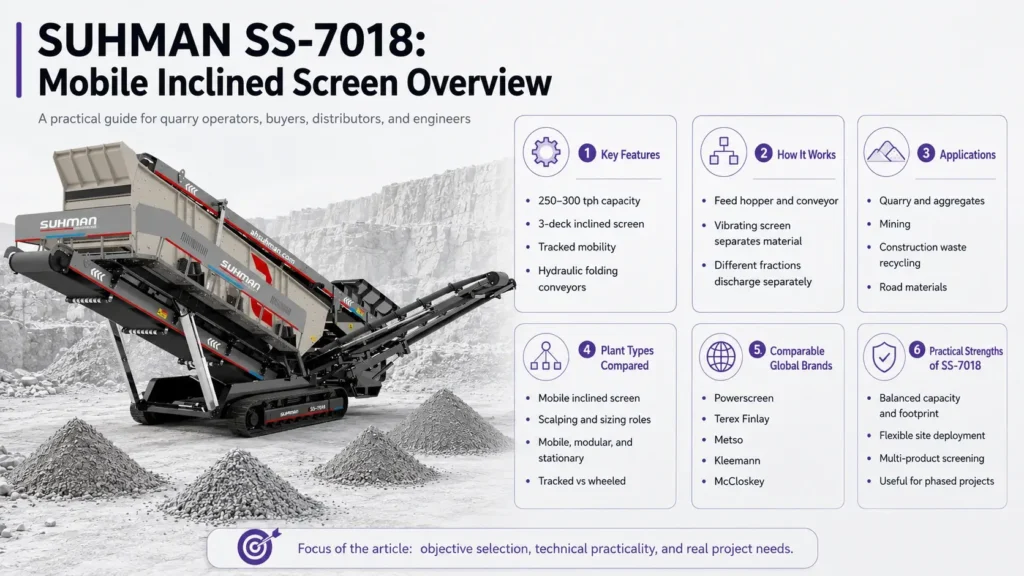
SS-7018 is a tracked mobile inclined screening plant for mining, aggregate production, and recycling: a small feed hopper with belt conveyor, a three-deck inclined vibrating screen, stockpile conveyors, a diesel generator for autonomous operation, and a crawler undercarriage for mobility on uneven ground.
The machine has a 2 m³ hopper, 2,700 mm feed height, 100 mm maximum feed size, 7,000 × 1,800 mm screen, 12.6 m² stated screening area, 250–300 t/h processing capacity, three decks for four final products, 1,200 × 10,000 mm feed conveyor, three 800 × 6,000 mm side stockpile conveyors, 1,000 × 7,000 mm main stockpile conveyor, 110 kW power, 200 L fuel tank, 37 t operating weight, 16,800 × 3,500 × 3,950 mm transport dimensions, and 16,800 × 13,000 × 5,230 mm working dimensions.
How the machine works
The SS-7018 follows the standard logic of a mobile inclined classifying screen. Material is fed into the hopper, transferred by the feed conveyor onto the inclined screen, stratified by vibration, and separated by aperture size across three decks. Finer particles pass through the upper decks first, then through lower decks as the bed becomes thinner. Oversize from each cut is discharged by the dedicated stockpile conveyors. That is why a three-deck machine can deliver four final products.
Suhman adds several machine-specific details that matter in real operation. The SS-7018 uses an elliptical vibration system driven by bolted counterweights on each side of the screen box. According to the manufacturer, vibration amplitude, forward advance, and frequency can be adjusted to suit the material. The screen media are tensioned by side-mounted bolted tensioners, and hydraulic cylinders can raise or lower the screen body to simplify access during mesh changes. The stockpile conveyors are also described as hydraulically folding, which helps during transport and setup.
That operating principle fits the broader behavior of inclined screens as described by established screen manufacturers. McLanahan notes that inclined screens rely on gravity to help move material down the deck, while MEKA describes inclined screens as circular-motion machines in which material is classified by the combined effect of gravity and vibration. In plain terms, that means an inclined screen usually offers a good balance of throughput, simplicity, and energy efficiency when the feed is already crushed to a manageable top size.
Applications of Mobile Inclined Screen
For quarry and aggregate work, the SS-7018 makes the most sense after primary crushing or after secondary crushing, where the feed is already below 100 mm and the task is to create clean commercial fractions. That aligns with Suhman’s own stated application fields of quarries, aggregates, mining, and construction and demolition waste recycling. It also aligns with Kleemann’s distinction between scalpers, which handle coarse feed before the first crusher, and classifying screens, which handle smaller, usually pre-crushed feed to produce final or intermediate products.
In practical terms, four sectors stand out as the best fit. The first is quarry aggregates, especially when the operation needs flexible production of several size fractions from one mobile setup. The second is medium-duty mineral classification, where material is already reduced before screening. The third is construction and demolition recycling, including crushed concrete and brick. The fourth is road and civil materials, where recycled concrete, crushed base, or reclaimed aggregate must be separated into usable gradations near the point of use. These are all application spaces explicitly referenced across Suhman, Metso, Kleemann, Powerscreen, and Astec screening portfolios.
Just as important is where the SS-7018 is not the best tool. The published 100 mm max feed size is far below the feed envelopes of typical heavy-duty scalpers. For example, Kleemann’s MSS 802 EVO coarse screen is published for up to 500 mm feed size, while Anaconda’s DF514 scalping screen is published for 300 mm max feed size. That comparison strongly suggests that SS-7018 should be chosen for controlled, post-crush sizing duty, not for the first pass on blasted rock, overburden, or heavily contaminated feed. That is an operational advantage when the process is set correctly, but a mismatch if the plant is expected to behave like a true pre-screen.
Screening Equipment: Market Map, Machine Types, and Selection Criteria
The simplest market map starts with five equipment families. A mobile inclined screen is the standard classifying machine for pre-crushed aggregate. A mobile scalping screen is a heavier pre-screen for coarse or dirty feed. A mobile horizontal screen is used when finer sizing accuracy, low headroom, or sticky near-size material becomes more important. A modular screen plant is a pre-engineered stationary solution assembled from modules. A stationary screen plant is the most site-specific and civil-work-dependent option, usually chosen for long-term fixed installations.
Inclined screen vs horizontal screen
The key contrast between inclined and horizontal screens is not fashion. It is process behavior. McLanahan states that inclined screens use gravity to move feed forward, while horizontal screens need more stroke and energy because they do not rely on gravity in the same way. MEKA adds that horizontal screens are preferred when fine screening, near-size material, wet screening, or low headroom are critical. In other words, an inclined screen tends to win on simplicity and throughput for routine dry sizing, while a horizontal screen tends to win when cut accuracy and difficult fines become the main problem.
Scalper vs classifying / sizing screen
The contrast between scalper and classifying screen is even more important for buyers. Kleemann describes scalpers as machines for sorting coarse feed before the first crushing stage, while classifying screens are the specialists for smaller, pre-crushed feed and qualified final products. That is exactly why the SS-7018’s place is clearer than it first appears. It belongs on the classifying side of the market. It competes less with a heavy pre-screen and more with mobile finishing or size-classification screens.
Tracked mobile vs wheeled portable
The mobility question also matters. Tracked mobile plants are designed to shift position at the face or move between jobs with limited setup. Metso describes mobile screening plants as track-mounted and easily movable on site or transportable between sites. By contrast, wheel-mounted portable plants are better for producers who stay in one location for longer periods and relocate less often. Metso says portable wheel-mounted plants can be moved to a new location within one to two years, while MEKA describes portable inclined screens as wheel-mounted, electrically powered, and suited to standalone or multistage screening of pre-crushed material. That means tracked plants favor flexibility inside dynamic quarry and contracting workflows, while wheel-mounted plants favor simpler transport economics and semi-fixed campaign work.
Mobile vs modular vs stationary
The final comparison is the plant architecture around the screen. Metso distinguishes among tailored stationary plants, pre-designed modular stationary plants, track-mounted mobile plants, and wheel-mounted portable plants. Tailored stationary plants suit long-term high-commitment sites. Modular plants reduce engineering and assembly time. Track-mounted plants cut hauling inside the quarry and reduce the need for civil works. Portable plants sit between the two. For buyers comparing SS-7018 with fixed infrastructure, that matters: a mobile classifying screen can enter production much faster than a conventional stationary screen building, but it gives up some of the permanence and system integration of a true fixed plant.
single-power vs dual-power
A short note on power concept is also useful. Suhman states that SS-7018 is available in single-power and dual-power versions: one version depends on external electricity, while the other can operate directly on diesel when stable power is unavailable. Similar logic appears in mainstream competitors such as the Finlay 694 Hybrid, McCloskey S190 Dual Power, and Kleemann MSC EVO Dual-Power concept. For operators, the choice is simple: if grid or genset power is stable and energy cost matters, dual-power or hybrid operation is valuable; if the working area changes frequently and power access is uncertain, self-contained diesel remains the safer option.
2-deck vs 3-deck vs 4-deck
Another practical comparison is the number of screen decks. A 2-deck screen separates material into three product streams. It is often enough for simple aggregate work, pre-screening after crushing, or sites that only need one oversize and two finished fractions. It is also simpler to maintain because there are fewer screen media layers.
A 3-deck screen separates material into four product streams. This is the layout used on the SS-7018. It suits quarries and aggregate producers that need several commercial sizes from one pass, such as oversize, coarse aggregate, medium aggregate, and fines. The trade-off is higher setup responsibility. The operator must select the right mesh apertures, control bed depth, and keep all decks clean. If the feed is inconsistent, the lower decks can become overloaded.
A 4-deck screen can produce five product streams. It gives more grading flexibility, but it also adds weight, height, complexity, and maintenance work. It is not always the better choice. In many quarry applications, a 3-deck machine gives a more practical balance between product range, transport size, service access, and operating cost.
For this reason, the SS-7018 should be viewed as a multi-product classifying screen rather than a simple two-product separator. Its three-deck layout is useful when the site needs several saleable aggregate fractions from pre-crushed feed. It is less suitable when the job only requires rough scalping or when the material is too coarse, sticky, or contaminated for fine classification.
Mainstream Mobile Inclined Screen models close to the SS-7018
There is no perfect one-to-one international peer for the SS-7018. Manufacturers publish screen geometry differently. Some quote single-deck box dimensions, some quote total effective screening area across decks, and some, like Sandvik’s Doublescreen, use two in-line screen boxes, which changes the comparison completely. So the clean comparison is by machine role, deck layout, feed envelope, drive concept, and overall screen size class rather than by one number alone.
The models below are the most relevant references in today’s market.
| Model | Published role | Key published facts | Relationship to SS-7018 |
|---|---|---|---|
| Powerscreen Chieftain 1700X | Track mobile inclined screen | Mid-sized tracked screen; applications include topsoil, coal, crushed stone, recycling, iron ore, sand and gravel; 4.8 × 1.5 m screenbox; 3-deck configuration available; electric/hybrid drive available. | Same general classifying role, but physically smaller in stated deck footprint. |
| Terex Finlay 694 | Portable triple-deck inclined screener | High-production producer machine; three 6.1 × 1.53 m decks; 28 m² total screening area; hybrid option available. | Same role, but typically a larger-output reference point than SS-7018. |
| McCloskey S190 3D | Mobile vibratory screening plant | Offered in dual power, double or triple deck; top deck 6,100 × 1,524 mm, bottom deck 5,490 × 1,524 mm; adjustable screenbox angle. | Same classifying duty; larger mainstream benchmark in the 20′ × 5′ family. |
| Metso Nordtrack S4.9 | Mobile three-deck aggregate/contracting screen | Track-mounted, easy to transport, aimed at sand and gravel, aggregate, and organics; three large screening decks; standard contracting-oriented configuration. | Same functional niche, especially for mobile aggregate and contractor use. |
| Astec GT205S | Track-mounted incline screen plant | Designed for sand and gravel, topsoil, slag, crushed stone, and recycled materials; 5′ × 20′ double- or triple-deck screen; low-profile layout and easy access for setup. | Comparable by application and mobility; deck footprint is smaller than SS-7018’s published 7.0 × 1.8 m. |
| Kleemann MSC 703 EVO | Triple-deck mobile classifying screen | 7 m² screen casing, up to 350 t/h, 100 × 160 mm max feed size, diesel-hydraulic, with external electric operation available through Dual-Power. | One of the more useful functional comparators because its feed envelope also places it squarely in classifying duty. |
| Sandvik QA452 | Tracked 3-deck Doublescreen | 6 × 1.5 m screen size, up to 600 mtph, two triple-deck in-line screen boxes, primary fines extraction plus secondary grading. | Not a direct peer. It is a more complex, larger-capacity reference in the same broad market. |
If the goal is to identify the closest mainstream alternatives by function, the strongest references are the Kleemann MSC 703 EVO, Astec GT205S, Metso Nordtrack S4.9, and Powerscreen Chieftain 1700X. If the goal is to benchmark against the better-known upper tier of mobile triple-deck screens, then the Finlay 694, McCloskey S190 3D, and Sandvik QA452 are more useful reference points.
Where the SS-7018 stands out
The first clear advantage of the SS-7018 is its published screen footprint. Suhman lists a 7,000 × 1,800 mm screen, which is longer and wider than the 4.8 × 1.5 m screenbox on the Chieftain 1700X and larger in stated single-deck footprint than the 6.1 × 1.53 m or 6.1 × 1.524 m deck dimensions published for machines such as the Finlay 694 and McCloskey S190 family. That does not automatically mean higher effective area than every competitor, because manufacturers quote deck geometry differently. Still, on paper, the SS-7018 sits comfortably above the smaller mid-size class.
The second advantage is clarity of duty. The SS-7018 is not pretending to be a do-everything machine. Its 100 mm max feed size, three decks, and four final products define it as a mobile classifying screen for controlled feed. That is useful because many screening problems come from choosing a machine that is too light for scalping or too coarse for finished-product classification. In that sense, SS-7018’s specification is honest. It tells the buyer what the machine is for.
The third advantage is layout simplicity relative to more complex high-end screens. A machine such as Sandvik’s QA452 uses two triple-deck in-line screen boxes and offers excellent flexibility, but it also belongs to a more complex and higher-capacity category. The SS-7018, by contrast, stays with a more conventional single-screen classifying layout. For many quarry owners and distributors, that can mean easier understanding, easier commissioning, and a lower process risk when operators want a straightforward four-product mobile screen rather than a more specialized grading platform. That is an inference from the published architectures, but it is a practical one.
The fourth advantage is maintenance-oriented hardware on the standard machine description. Suhman explicitly lists hydraulic screen lifting, side tension mesh adjustment, folding conveyors, and an adjustable elliptical vibration system. Those are not decorative details. They affect media change time, setup time, transport readiness, and the operator’s ability to tune the screen to different feed behavior. Comparable mainstream models also emphasize service access and hybrid power, but Suhman’s page makes these adjustment and service features unusually explicit for this machine size.
The fifth advantage is power flexibility. Suhman offers the SS-7018 in single-power and dual-power versions, with engine/emissions choices including Tier 3, Tier 4, and Euro 5 options. In practice, that gives the importer or end user room to match local emissions rules and site power conditions. This matters in export distribution because many otherwise suitable machines become hard to place when engine compliance or power architecture does not match the market.
The sixth advantage appears when the comparison is widened beyond other tracked screens to modular and stationary plants. Metso’s plant portfolio shows that stationary and modular solutions are still the right answer for long-term fixed installations, but they require a different level of planning, assembly, and site commitment. A tracked screen like SS-7018 avoids much of that. For quarry operators who need screening capacity now, or for contractors and distributors serving temporary or semi-mobile operations, that shorter path to production has real value.
The fair conclusion is this. SS-7018 looks strongest as a practical, mid-class tracked classifying screen for feed up to 100 mm, where four saleable products, site mobility, and simple deployment matter more than extreme throughput or highly specialized fine-screen accuracy. Its main advantages are the published 7.0 × 1.8 m screen footprint, the three-deck/four-product layout, the clear classifying-duty specification, the maintenance-oriented screen access features, and the availability of dual-power configuration. Its limitations are equally clear: it is not the right substitute for a heavy-duty scalper, and it is not the obvious choice when the site requires very high-capacity multi-box screening or the finer, more selective behavior that often pushes buyers toward horizontal or Doublescreen architectures. For the right duty, that clarity is a strength, not a weakness.