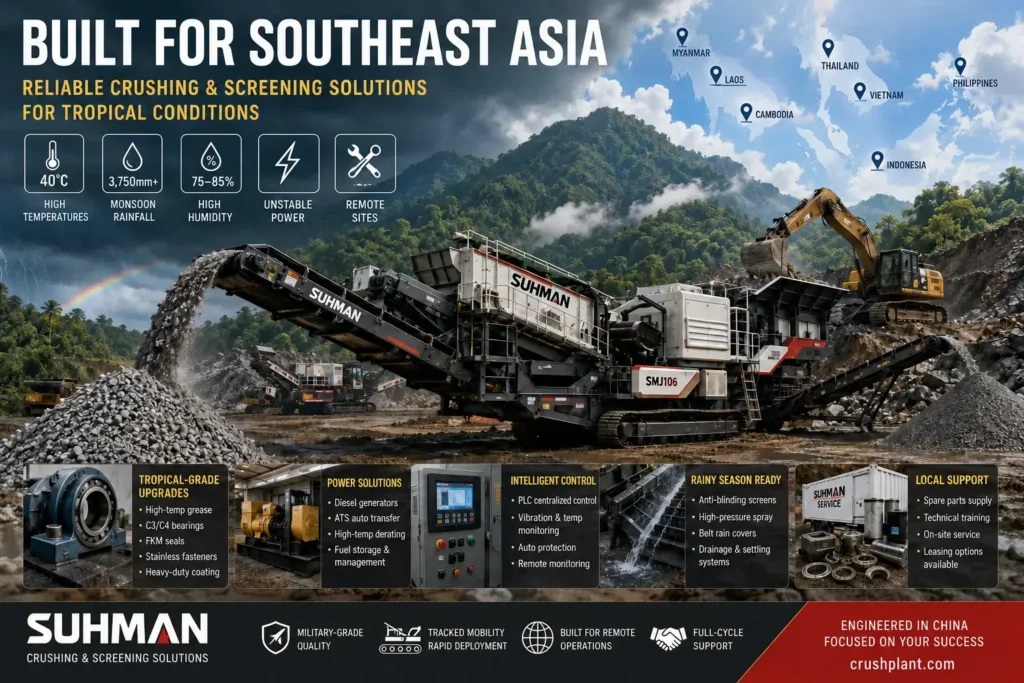
Southeast Asia is one of the world’s most active frontiers for mining and aggregate production. From the potash deposits of Laos to the nickel laterites of Indonesia, the limestone quarries of Vietnam to the copper belts of Myanmar, the region sits on extraordinary mineral wealth — and demand for processed stone, ore, and aggregate is only accelerating as infrastructure investment surges across the ASEAN bloc.
Yet for equipment buyers entering this market, the standard purchasing checklist falls dangerously short.
A crusher that performs flawlessly in northern China or central Europe can fail within a single wet season in Southeast Asia. Bearings seize. Control cabinets corrode from the inside out. Conveyor belts harden and crack. Screening efficiency collapses as feed material turns to slurry. The culprit is rarely the machine itself — it is the gap between where the equipment was designed to operate and where it is actually being asked to work.
Southeast Asia is not simply “hot.” It is a compound challenge: ambient temperatures pushing 38–40°C in the dry season, relative humidity holding at 75–85% year-round, monsoon rains delivering up to 3,750mm of annual precipitation, unstable power grids that can drop voltage without warning, remote mine sites hours from the nearest qualified technician, and supply chains that make a missing spare part a three-week problem rather than a three-day one.
This guide draws on hands-on operational experience across Southeast Asia — covering the full range of tropical climates, grid conditions, and mining environments the region presents. Whether you are setting up operations in Laos, Cambodia, Myanmar, Indonesia, or Vietnam, the fundamental questions are the same.
What needs to be upgraded before your equipment ships? How do you keep a crusher running through a monsoon? What does a realistic power supply strategy look like when the grid cannot be trusted? And which components will quietly fail first if you treat a tropical deployment like a temperate one?
The answers are neither complicated nor expensive — but they are specific. And getting them right before commissioning is far cheaper than learning them afterward.
Procuring Crushing and Screening Equipment in Southeast Asia
Purchasing equipment in Southeast Asia involves careful consideration across several dimensions. Here are the key points for each.
① Material Characteristics (Determine This First)
Start by establishing exactly what ore or rock is being crushed — granite, limestone, copper ore, potash, and similar materials vary enormously in compressive strength. Confirm the feed size (maximum raw stone dimension), required product size, moisture content, and whether the material contains clay, which significantly affects screening efficiency.
② Equipment Selection
For primary crushing, jaw crushers are the standard first choice. For secondary and tertiary stages, the choice depends on material hardness — cone crushers for hard rock, impact crushers for medium to soft rock. Vibrating screens handle most screening applications.
If work sites are dispersed or the project timeline is short, tracked mobile crushing plants are worth considering. Unit cost is higher, but civil construction costs are eliminated.
③ Local Site Conditions
Climate is a critical variable. Most of Southeast Asia has a tropical monsoon climate — dry season temperatures can exceed 40°C, and rainy season conditions create muddy ground that makes transportation significantly more difficult.
Power supply is unreliable in rural mining areas. Assess upfront whether diesel generator sets will be needed.
④ Supplier Selection
The most active equipment suppliers in Southeast Asia today are Chinese brands — Sany, XCMG (Zoomlion), Nflg, Sanme, and others. European and North American brands such as Metso and Terex offer excellent performance but carry high spare parts costs and long lead times.
The recommended approach is to prioritize brands that have established service stations either locally in Southeast Asia or in China’s Yunnan or Guangxi provinces, given their proximity to the region.
⑤ Compliance and Permitting
In several countries, the mining sector is regulated by the Ministry of Natural Resources and Environment (MONRE). Imported equipment requires proof of customs clearance, and large projects may also be subject to an Environmental Impact Assessment (EIA).
Some Southeast Asian countries have free trade agreements with China, under which Chinese equipment may qualify for partial tariff reductions — worth confirming before finalizing procurement.
⑥ Total Lifecycle Cost
Do not evaluate on purchase price alone. Crusher wear parts — jaw plates, blow bars, and liners — are consumed in large quantities. Confirm the spare parts supply chain before committing to a supplier.
A more objective way to compare options is to calculate the cost per tonne of material crushed (CNY/t), which accounts for both capital and operating expenditure.
A practical recommendation: When procuring equipment in Southeast Asia, it is strongly advisable to work with Chinese equipment suppliers that have a local office in the region. They will have direct familiarity with local permitting procedures, transport routes, and installation conditions — knowledge that is difficult to replicate from a distance.
Corrosion and Rust Prevention in Tropical High-Humidity Environments
This is a highly practical topic. In parts of Southeast Asia, annual humidity levels remain between 75–85%, causing steel equipment to corrode very quickly. Below is a comprehensive corrosion prevention plan.
1. Equipment Procurement (Control from the Start)
Material Selection
- Structural components should use Q345B low-alloy steel or higher, with noticeably better corrosion resistance than standard Q235 steel.
- Wet-contact parts such as screens and liners should preferably use stainless steel (Grade 304 or 316L).
- All fasteners (bolts and nuts) must be stainless steel or hot-dip galvanized. Standard carbon steel bolts can rust solid within six months.
- Bearing housings and gearboxes should be cast iron or cast steel — avoid thin-wall welded parts.
Protection Rating Requirements
- Electrical control cabinets: minimum IP54; for outdoor installation, IP65 is recommended.
- Motors: minimum IP54; in dust or water mist areas, IP55 or higher is required.
- All electrical junction boxes must be sealed with silicone, and terminals should be tin-plated or silver-plated.
2. Coating and Paint System (The Most Important Layer of Protection)
Tropical climates require a heavier coating system than standard domestic specifications. A three-layer composite system is recommended:
| Layer | Material | Dry Film Thickness | Function |
|---|---|---|---|
| Primer | Zinc-rich epoxy primer | 60–80 μm | Cathodic protection, rust prevention |
| Intermediate coat | Epoxy micaceous iron oxide | 80–100 μm | Blocks moisture penetration |
| Topcoat | Polyurethane topcoat | 60–80 μm | Weather resistance, UV resistance, and appearance |
Total dry film thickness must be ≥ 200 μm.
Many equipment manufacturers apply only 80–120 μm as standard, which is not enough for Southeast Asia. Specify “tropical climate coating specification” when ordering, or apply additional coats after delivery.
3. Routine Maintenance
Lubrication Management
- Use waterproof lithium-based grease with extreme pressure (EP) additives on all lubrication points. Standard general-purpose grease is not suitable.
- During the rainy season, check bearing lubrication monthly — twice as often as during the dry season.
- Gearboxes should use industrial gear oil with rust inhibitor.
Regular Inspection Priorities
- Monthly: Inspect all welds, areas around bolt holes, and cut steel edges — these are where rust typically starts.
- Quarterly: Check coating integrity. Any scratches, blistering, or rust spots should be repaired immediately — do not wait until corrosion spreads.
- After each rainy season (October): Conduct a full corrosion inspection and address any damage that accumulated during the wet months.
Keep Repair Materials On-Site
- Stock: matching topcoat paint, epoxy primer, wire brushes, sandpaper, and a small angle grinder.
- Repair procedure: grind off rust → clean dust → apply primer → apply topcoat. Do not skip any steps.
4. Equipment Layout and Site Design
- Equipment foundations should be at least 30 cm above ground level to prevent rainwater from pooling around the base structure.
- Install drainage slopes under conveyors, feeders, and other low-profile equipment—standing water must not be allowed to collect.
- Equipment that is out of service for extended periods should be covered with a rain shelter or wrapped in anti-rust film. Do not leave it exposed outdoors.
- Control cabinets and distribution panels should be installed inside a covered control room whenever possible to reduce direct exposure to the sun and rain.
5. Shutdown Period Protection
In Southeast Asian mining operations, equipment is often idle during holidays or the rainy season. Corrosion actually accelerates during shutdown—without the protective oil film that comes with normal operation:
- Shutdown exceeding 1 week: Spray rust-preventive oil on all exposed metal surfaces (jaw plates, hammer heads, screens, etc.).
- Shutdown exceeding 1 month: Repack bearings with fresh grease and manually rotate shafts periodically to prevent rust seizure.
- Hydraulic systems: Before shutdown, retract all cylinder rods to keep the polished rod surfaces unexposed and protected from oxidation.
A practical note from experience: In environments like Southeast Asia, corrosion-related failures are more common than wear-related failures. When purchasing equipment, specify “tropical climate configuration” directly with the supplier. Major brands typically offer this option. The added cost is around 5–8%, but it significantly extends equipment service life—making it a worthwhile investment overall.
Lubrication, Cooling Water, and Control System Protection in High-Temperature (40°C) Environments
When ambient temperature reaches 40°C, combined with heat generated by the equipment itself, actual temperatures at critical components can climb to 60–80°C or higher. This is one of the leading causes of early equipment failure. Below is a detailed breakdown by system.
1. Lubrication System
Why Does High Temperature Affect Lubrication the Most?
A key property of lubricating oil is its viscosity index. As the temperature rises, the oil film becomes thinner and loses its protective ability. In a 40°C environment, the actual working temperature of bearings and gearboxes is typically 20–40°C higher than ambient, meaning the actual oil temperature can reach 60–80°C or beyond.
Oil Selection
| Component | Standard (< 30°C) | High-Temp Recommendation | Key Specification |
|---|---|---|---|
| Cone/gyratory crusher gearbox | VG150 | VG220 or VG320 | Viscosity index ≥ 95 |
| Jaw crusher eccentric bearing | Lithium grease No. 3 | EP lithium grease NLGI Grade 2 | Drop point ≥ 180°C |
| Vibrating screen exciter | VG68 | VG100 anti-wear hydraulic oil | Oxidation stability ≥ 1000 h |
| Belt drive bearings | Lithium grease No. 2 | Complex lithium grease NLGI Grade 2 | Max service temp. ≥ 160°C |
| Hydraulic system | VG46 | VG68 anti-wear hydraulic oil | Pour point ≤ −15 °C |
Core principle: Choose a higher viscosity grade for high-temperature conditions—but higher is not always better. Excessively high viscosity creates greater resistance and heat during startup. VG220/320 is a reasonable upper limit for heavy-duty equipment such as cone crushers.
Adjusted Oil Change Intervals
High temperatures accelerate oil oxidation. Change intervals should be shortened by 30–40% compared to the manufacturer’s standard recommendations:
- Gearbox oil: normally every 6,000 hours → reduce to every 4,000 hours
- Bearing grease: normally replenished every 3 months → increase to monthly
- Hydraulic oil: take a sample for lab analysis every quarter; replace immediately if the oil darkens or develops an unusual odor
Temperature Monitoring
Install temperature sensors on lubrication lines and bearing housings, with the following alarm thresholds:
- Bearing temperature > 75°C: trigger alarm
- Bearing temperature > 90°C: automatic shutdown
This is the most effective way to prevent bearing burnout and shaft seizure. The cost is low, but the impact is immediate.
2. Cooling Water System (Primarily for Cone and Gyratory Crushers)
Cone and gyratory crushers are the most dependent on cooling water. In high-temperature environments, insufficient cooling is the most common cause of unplanned shutdowns.
Cooling Water Temperature Control
During the dry season, surface water temperatures can reach 30–35°C, which significantly reduces the cooling system’s ability to dissipate heat. Key requirements:
Inlet water temperature must not exceed 30°C. Above this level, cooling efficiency drops noticeably. Solutions include:
- Install a cooling tower (recommended) to bring the circulating water temperature down before it enters the equipment. Cost is approximately 30,000–50,000 RMB, with significant results.
- Use groundwater (typically 22–26°C). In mountainous areas, groundwater is considerably cooler than surface water — use it as a first option where available.
- If temperature reduction is not possible, increase circulation flow rate to compensate — though this requires a more powerful pump.
Water Quality Treatment
- Surface water is often high in hardness. Over time, scale builds up inside cooling channels, reducing heat dissipation efficiency by 30–50%.
- Add scale inhibitor and corrosion inhibitor to the circulating water system. Test water quality and flush channels every 3 months.
- Every 6 months, perform a chemical descaling flush of the cooling pipes using a dedicated descaling agent (oxalic acid solution).
Flow and Pressure Monitoring
- Trigger an alarm if cooling water flow drops more than 15% below the set value (indicating blockage or pump failure).
- Normal inlet-to-outlet temperature difference is approximately 8–15°C. A smaller difference indicates insufficient flow; a larger difference indicates inadequate cooling capacity.
Daily Cooling System Checks
Before starting up each day, confirm the following:
- Water tank level is normal
- Pump is running without unusual noise
- No leaks in inlet or outlet pipes
- Outlet water temperature does not exceed 45°C—if it does, identify the cause before starting the machine
This step seems straightforward, but it is frequently skipped on-site. It is the most common reason for heat-related equipment damage.
3. Electrical Control System Protection
In a 40°C environment, control systems face three main risks: overheating failure, accelerated component aging, and reduced insulation performance.
Control Cabinet Selection and Installation
Selection requirements:
- Cabinet enclosure rating: IP55 or higher (dust and water protection)
- Rated internal operating temperature: at least 55°C—note that many standard domestic cabinets are only rated to 40°C, meaning they are already operating at their limit in Southeast Asia
- Critical components (PLC, variable frequency drives, relays) should be industrial grade, rated for ≥ 55°C
Installation location:
- Control cabinets must be installed inside a shaded control room—outdoor installation is not acceptable
- Keep at least 5 meters away from vibration sources such as the crusher body, as vibration can cause wiring to loosen
- Orient the cabinet to avoid afternoon west-facing sunlight, which can raise internal cabinet temperature by an additional 10–15°C
Cabinet Cooling Solutions
Three options are available, ranging from light to heavy heat load:
Option 1 – Enhanced Ventilation (for cabinets with low heat output)
- Install a rooftop exhaust fan and bottom inlet louvers to create airflow through the cabinet
- Fit dust filters on the air inlets and clean them weekly (dust levels in Southeast Asia are high)
- Low cost, but limited effectiveness when outdoor temperatures are high
Option 2 – Dedicated Cabinet Air Conditioner (recommended for cabinets with VFDs or other high-heat components)
- Use a purpose-built electrical cabinet air conditioner (brands such as Phoenix Contact or Rittal) to maintain internal cabinet temperature below 35°C
- The unit is sealed directly to the cabinet, creating a closed cooling loop that keeps external dust out
- Cost: approximately 2,000–5,000 RMB per unit — the best value-for-money option
Option 3 – Remote Installation (for large centralized control systems)
- Install PLCs, supervisory computers, and other core control equipment in an air-conditioned control room
- Keep only simple local control panels on-site (basic start/stop functions) to reduce complexity in the field environment
Variable Frequency Drive (VFD) Protection
VFDs are the most sensitive—and most expensive — components in the control system, and deserve special attention:
- Most VFDs are rated for a maximum ambient temperature of 40°C. In Southeast Asia, this is already the operating limit, so derate to 80–85% of rated capacity.
- Clean the VFD heat sinks regularly — dust buildup is the leading cause of overheating.
- Ensure at least 20 cm of clearance above and below the VFD during installation. Do not mount it flush against other equipment.
- Before starting each day, check that the VFD cooling fan is running properly.
Cable and Wiring Management
High temperatures accelerate the degradation of cable insulation:
- All outdoor cables must be heat-resistant type, rated for 90°C (not standard 70°C cables).
- Run cables through conduit to shield them from direct sunlight — direct solar exposure can raise outer sheath temperature by more than 20°C.
- Retighten all terminal connections every six months. Thermal expansion and contraction cycles cause connections to loosen over time, increasing contact resistance and generating additional heat.
4. Overall Operating Strategy
Beyond equipment-level protection, scheduling work hours is the simplest and most effective way to reduce heat exposure:
- Prioritize early shifts (6:00–11:00) and evening shifts (16:00–21:00). Avoid operating during peak heat hours from 13:00 to 15:00.
- Limit continuous operation to no more than 4 hours, then allow a 30-minute cooldown stop.
- During the dry season peak in April, consider reducing daily production targets. It is better to extend the project timeline than to force full-load operation under extreme heat.
Summary recommendation: Among all the measures above, the three highest-priority actions are: upgrading to high-temperature lubricants, installing bearing temperature monitors, and fitting cabinet air conditioners on control panels. These three have the lowest cost and the highest return. Other measures can be implemented gradually over time.
If only one thing can be done, bearing temperature sensors are the most worthwhile investment — they can alert you up to 30 minutes before a bearing failure destroys the equipment.
The Impact of Rainy Season Conditions on Mine Crushing and Screening Operations, and How to Handle High-Moisture Material
The rainy season is the most challenging period for mining operations in Southeast Asia. The difficulties go far beyond simply being unable to work in the rain. Below is a systematic breakdown covering material handling, equipment performance, and safety.
1. How the Rainy Season Affects Crushing and Screening Operations
The Chain Reaction Caused by Higher Material Moisture Content
This is the central problem of the rainy season, and it triggers a series of knock-on effects.
Blockages and material sticking are the most immediate consequences. Wet material is sticky and tends to build up and cling at every stage—feeders, crushing chambers, screen decks, and chutes. Jaw crusher chambers are especially prone to “packing,” where material clumps together without being crushed and blocks the discharge opening. Each clearing event requires a shutdown of 1–2 hours. When ore contains clay and the moisture content exceeds 15%, this problem becomes severe.
A sharp drop in screening efficiency is the second direct impact. Wet material flows poorly across vibrating screen decks and tends to block screen apertures. Under normal conditions, screening efficiency runs at 85–90%. When moisture content exceeds 8%, efficiency can fall below 60%, meaning a large proportion of off-specification material ends up in the finished product, and quality control breaks down.
Belt conveyor drift and slippage are also common. Under the combined effect of wet material and rainwater, the friction coefficient of the belt surface drops, causing drive slippage. At the same time, wet material is distributed unevenly across the belt, leading to frequent tracking problems. Severe drift can cut into the belt edges and cause the belt to fail.
An overall production drop of 20–40% is the combined result. Clearing blockages, cleaning equipment, and correcting belt drift consume large amounts of time, significantly reducing effective working hours each day.
Deterioration of Equipment Operating Conditions
Reduced electrical insulation: During the Southeast Asian rainy season, relative humidity stays above 90% for extended periods. The insulation resistance of motor windings and cable terminations drops noticeably, increasing the risk of electrical leakage. Before starting any equipment, insulation resistance must be tested with a megohmmeter. Any equipment reading below 0.5 MΩ must not be started.
Accelerated corrosion: Corrosion rates during the rainy season are 3–5 times higher than in the dry season. Any coating that has already been scratched or damaged can rust through completely within a single rainy season.
Foundation settlement: Prolonged water saturation softens the ground beneath equipment foundations. Fixed equipment bases can experience uneven settlement, causing changes in equipment level and worsening abnormal vibration. Equipment levelness must be rechecked after every rainy season.
Rising Safety Risks
Landslides and mudflows are the most serious safety threats at mountain mine sites in Southeast Asia during the rainy season. Parts of Southeast Asia are particularly vulnerable to the effects of climate change and natural disasters, especially floods and droughts. After heavy rainfall, mountain mine sites must halt operations and assess slope stability before resuming work — rushing to meet schedules under these conditions is not acceptable.
Standing water on work surfaces significantly increases the risk of slips and falls, equipment exposure to flooding, and electric shock.
2. Solutions for Handling High-Moisture Material
Solution 1 — Source Control: Keep Material Dry to Begin With
This is the most fundamental approach and far less effort than dealing with wet material after the fact.
Rain shelters over ROM stockpiles: Build a steel-framed rain shelter over the run-of-mine stockpile awaiting crushing. This offers the best return on investment of any single measure. Size the covered area to hold 3–5 days of ore inventory. If a permanent shelter is not possible, at a minimum, cover the top of the stockpile with tarpaulins to reduce rainwater penetration.
Stockpile reclaim sequence: During the rainy season, always reclaim material from the bottom or inner portions of the stockpile first, where the moisture content is lower than at the surface. Excavator operators should avoid directly scooping surface material during active rainfall wherever possible.
Timing of feed: Stop feeding during heavy rain. After the rain stops, wait 30–60 minutes for surface water to drain away before resuming operations.
Solution 2 — Feed Stage: Control Moisture Content at the Inlet
Reduce feeder speed: Lower the feed rate to 60–70% of normal during wet conditions to reduce the amount of wet material entering the crushing chamber per unit of time and to lower the risk of blockages. A lower output rate is preferable to a shutdown caused by packing.
Pre-screening to remove fines and mud: Install a bar screen or fixed grizzly between the feeder and the primary crusher to remove the finest, highest-moisture fraction before it enters the crushing circuit. Fine mud typically carries 2–3 times the moisture content of coarse feed material. This step meaningfully reduces the moisture burden on all downstream processes.
Feed pre-drying (suitable for fixed plants with a reliable power supply): Install infrared heating lamps above the feeder to pre-dry wet material. This can reduce moisture content by 2–3 percentage points. The effect is noticeable, though power consumption is relatively high.
Solution 3 — Crushing Stage: Adjust Equipment Parameters
Open up the closed-side setting: Increase the crusher discharge opening by 10–15% to allow material to pass through the crushing chamber more easily. This sacrifices some particle size control in exchange for blockage prevention. Wet material packing in the chamber is the most time-consuming incident of the rainy season—prevention is far more efficient than cleanup.
Reduce speed or throughput: If the equipment has variable frequency drive control, reduce operating speed by 10–20% during the rainy season to shorten material retention time inside the crushing chamber.
Increase chamber inspection frequency: Stop and inspect the crushing chamber every 2–3 hours for wet material buildup. Clear any accumulation promptly — do not wait until the chamber is completely blocked.
Solution 4 — Screening Stage: Preventing Aperture Blinding
This is the stage most severely affected by the rainy season. Several targeted approaches are available.
Switch to anti-blinding screen media: Replace standard woven wire screens with polyurethane or rubber screen panels. Polyurethane panels have good elasticity and strong self-cleaning ability as they vibrate. In wet conditions, they resist blinding 3–5 times better than wire mesh. Although the unit cost is higher, the reduction in shutdown time for screen cleaning during the rainy season makes them worthwhile.
Increase screen aperture size: Temporarily increase aperture size by 1–2 mm during the rainy season to allow slightly larger particles to pass through and keep the apertures clear. This will affect product size specifications, but maintaining production is more important than stopping entirely—revert to the standard screen when the dry season returns.
Increase vibration excitation force: Adjust the eccentric weight angle to increase the screen excitation force by 10–20%. Stronger vibration improves material flow across the screen deck in wet conditions and reduces aperture blinding. Do not exceed the equipment’s rated excitation force limit, as doing so will accelerate bearing wear.
Install high-pressure spray bars: Mount high-pressure water pipes above the vibrating screen to wash material as it screens. This essentially converts the operation to wet screening, which actually performs better than attempting dry screening of wet material. The downside is that it generates large volumes of slurry water, which requires a settling pond and drainage system. Where water resources are available and discharge is permitted under local regulations, this is the most effective rainy-season screening method.
Solution 5 — Belt Conveyor Stage
Install rain covers: Fit full-length rain covers over all conveyors to prevent rain from falling directly onto the belt. This is a basic requirement — conveyors without rain covers are essentially unable to run reliably during the rainy season.
Re-tension the belt: Belts absorb moisture during the rainy season and stretch slightly as a result. Re-tensioning is needed to prevent slippage. Check belt tension weekly.
Upgrade belt scrapers: Wet material sticking to the underside of the belt is one of the main causes of tracking problems. During the rainy season, increase scraper blade pressure to ensure effective cleaning. Also, add a secondary water-blade scraper on the return run to remove any remaining mud and slurry.
3. Rainy Season Operating Procedures
Equipment-level measures must be supported by sound management practices.
Adjust daily production targets: Reduce the daily production target by 20–30% during the rainy season. Do not try to match dry-season output — pushing too hard increases the risk of equipment damage and safety incidents.
Heavy rainfall work stoppage criteria: Set a clear written threshold for stopping work. A recommended standard is: suspend all operations when hourly rainfall exceeds 30 mm, and evaluate site conditions before deciding whether to resume after the rain eases.
Pre-restart checklist after heavy rainfall: Before resuming operations after any significant rain event, the following must be checked and signed off item by item: slope stability, water accumulation around equipment foundations, insulation resistance of all electrical equipment, and belt tension and tracking condition. This checklist should be a formal written document with a designated person responsible for sign-off—verbal instructions alone are not sufficient.
Settling ponds and drainage systems: The rainy season generates very large volumes of runoff and slurry water, particularly if wet screening is in use. Adequate settling pond capacity must be planned into the site layout from the start. Slurry water must not be discharged directly into nearby rivers or waterways — this is explicitly regulated under environmental laws in several Southeast Asian countries.
Overall, the guiding principle for rainy season operations is: set realistic production targets, prevent blockages before they occur, maintain electrical safety, and strictly enforce work stoppages during extreme weather. Many operations attempt to maintain dry-season output levels through the rainy season, only to find that the combined cost of equipment damage and safety incidents far exceeds what would have been lost by voluntarily reducing production.
Power Supply Solutions for Mining Operations: How to Configure Diesel Generators
Understanding the Reality First
In parts of Southeast Asia, there is a fundamental power supply challenge that needs to be understood from the outset. In some countries, hydroelectric generation accounts for around 95% of the total power supply and is heavily dependent on rainfall. During the dry season, generation capacity falls short, and power must be imported from neighboring countries. Mining operations typically reach their peak demand during exactly this period — the dry season from November to April — which coincides directly with the most constrained period for power supply.
In addition, the power grid infrastructure in parts of Southeast Asia is relatively underdeveloped. Grid stability is inconsistent, long-distance cross-regional power dispatch is not reliably achievable at scale, and transmission capacity on the main network is limited. Even in countries where overall power generation is relatively adequate, transmission remains a significant bottleneck.
Starting in March 2025, Laos officially began implementing a phased industrial electricity tariff increase under its 2025–2029 policy. Rising grid power costs will need to be factored into any economic comparison with on-site generation.
1. Connecting to the Public Grid (EDL Network)
Best suited for: Mine sites located within 10–15 km of an existing grid connection, with a load demand of 500 kW or more, on projects with a lifespan of 5 years or longer.
Connection process: Submit a power application to the local national electricity utility, including the mining operating license, a load forecast, and a site location map. The utility will assess the capacity of the nearest substation and confirm the connection arrangement. Large consumers (1 MW and above) are typically required to build their own dedicated transformer and incoming switchgear.
Key contract terms to negotiate: When signing a power supply agreement, the following clauses must be explicitly included—otherwise, curtailment during the dry season becomes a real risk:
- Guaranteed monthly supply volume (minimum supply commitment)
- Advance notice period for curtailment (at least 48 hours)
- Scheduled outage windows (aim for nights or weekends)
- Voltage quality requirements (deviation not to exceed ±10%)
Realistic expectations: Even with a signed agreement, the grid’s overall capacity to manage dry-season shortfalls is limited. The utility may be forced to import more expensive power, and the domestic supply remains tight. Grid connection should therefore be treated as the primary source, but must always be backed up by on-site generation. Sole reliance on the grid is not a viable strategy.
2. Diesel Generator Configuration (The Core Solution)
Step 1 — Calculate Total Power Demand
The main power consumers in a typical crushing and screening circuit are as follows (based on a mid-scale production line):
| Equipment | Typical Power | Notes |
|---|---|---|
| Jaw crusher (600 mm feed) | 75–132 kW | Starting current is 5–7× rated current |
| Cone crusher (secondary/tertiary) | 90–160 kW | |
| Vibrating screens (×2) | 2 × 15 = 30 kW | |
| Belt conveyors (4–6 units) | 60–120 kW total | |
| Vibrating feeder | 15–22 kW | |
| Dust suppression system | 15–30 kW | |
| Lighting and auxiliary loads | 20–30 kW | |
| Total | ~300–600 kW | Varies by scale |
Key points on power calculation:
Crushers use heavy-duty induction motors, which draw 3–10 times their rated current at startup. Generator sets must be sized to handle this startup surge, not just the steady-state load. Rated generator capacity must account for the starting impact of the largest motor on the circuit.
Sizing formula:
Generator rated output = Total steady-state load × 1.25 ÷ 0.8
The factor of 1.25 accounts for the startup surge margin, and 0.8 is the assumed power factor. For a total steady-state load of 400 kW, the generator must be rated at 500 kW or above.
Step 2 — Derate for High Ambient Temperature
This is a step that many people overlook, yet it is critical. Diesel generator sets are rated at 25°C ambient temperature and 100 kPa atmospheric pressure. In the dry season, temperatures can reach 38–40°C, and output must be derated accordingly:
- For every 5°C rise above the rated baseline, output drops by approximately 2–3%
- At 40°C versus the 25°C baseline, usable output is approximately 90–92% of rated capacity
- Mine sites at higher elevations require additional derating—roughly 3% for every 300 m above sea level
If calculations indicate a need for 500 kW, the generator set should actually be rated at 560–600 kW to sustain the required output under local conditions.
Step 3 — Single Unit or Parallel Multiple Units?
| Configuration | Advantages | Disadvantages | Best Suited For |
|---|---|---|---|
| Single large unit | Simple, easy to maintain | Full shutdown on failure; poor part-load efficiency | Small temporary projects |
| Two mid-size units in parallel | One failure still allows 70% production | Parallel control is more complex | Recommended for mid-scale projects |
| Three smaller units in parallel | Flexible dispatch, fuel-efficient | Requires precise synchronization | Large permanent installations |
Recommended configuration for a mid-scale crushing plant: Two 300 kW units operating in parallel. Under normal production, both run at 70–75% load—the most fuel-efficient operating range for diesel generators (typically 70–80% of rated load offers the lowest fuel consumption and the lowest failure rate). If one unit fails, the other can continue to power critical equipment.
Step 4 — Brand and Specification Selection
Spare parts availability and local service support are critical in remote locations. Brand choice directly affects long-term reliability.
Recommended priority order:
- Cummins: The most widely used industrial generator brand globally. Service network available in Yunnan, China, with the fastest parts supply for cross-border projects.
- Perkins: A British brand with a strong market presence in Southeast Asia. Dealers are available in Vientiane.
- Shangchai / Yuchai: Chinese domestic brands, priced 30–40% lower than imported alternatives. With the completion of the China–Laos Railway, parts logistics have improved significantly—a suitable choice for budget-constrained projects.
Essential features to specify:
- Automatic Transfer Switch (ATS): Automatic switchover to generator power within 30 seconds of a grid outage
- Automatic Voltage Regulator (AVR): Stabilizes output voltage to protect VFDs and PLCs from voltage fluctuations
- Remote monitoring module: Real-time visibility of generator operating status, fuel level, and temperature
3. Diesel Fuel Storage and Logistics
This is an area that many projects underestimate, yet it is particularly important in remote mining environments.
Fuel storage planning:
- Maintain a reserve sufficient for 7–10 days of full-load operation—a 2–3 day buffer is not adequate
- A 600 kW generator set at full load consumes approximately 150–180 liters per hour. A 10-day reserve requires approximately 36,000–43,000 liters
- Storage tanks must have impermeable bases and bunded containment. Local environmental regulations carry penalties for fuel spills
Fuel quality management:
- Diesel quality in the local market is variable. Contamination with water and particulates is common.
- Freshly delivered diesel must be allowed to settle for at least 24 hours before use, allowing water and particles to sink before the fuel is transferred to the engine
- Test fuel moisture content monthly. Fuel stored during the dry season is particularly susceptible to moisture ingress due to longer storage periods
Supply chain assurance:
- Confirm the distance and road condition between the mine site and the nearest fuel station or supplier
- During the dry season, roads are generally accessible — use this period to build up fuel stocks. Before the rainy season, pre-position sufficient fuel reserves in case roads become impassable
4. Solar PV with Battery Storage — A Supplementary Option
Parts of Southeast Asia have abundant solar resources. A PV-plus-storage system can help offset dry-season power shortages and provide load flexibility. For mining operations, solar PV is best suited to supplementing non-crushing loads such as lighting, office facilities, and control systems—typically in the 50–100 kW range—which reduces generator running hours:
- During daylight hours, PV output preferentially supplies light loads such as the control room, site lighting, and battery charging
- The generator runs only during active crushing operations, and can be shut down at other times to save fuel
- A 20–50 kWh battery storage system smooths load fluctuations and reduces the number of generator start/stop cycles
For medium-to-long-term projects (3 years or more), this combination makes financial sense. PV systems typically pay back their investment in 4–6 years under these conditions.
5. Choosing the Right Power Supply Configuration
Select the most appropriate approach based on site-specific conditions:
- Close to the grid (< 5 km), long-term project → Apply for grid connection + install emergency generators sized at 30% of grid-supplied load
- Remote from the grid (> 15 km), medium-to-long-term project → Two diesel generators in parallel + PV supplementation + adequate fuel reserves
- Short-term or mobile operations → Mobile diesel generator sets that relocate with the equipment
A final practical recommendation: Regardless of which power strategy is chosen, carry out a dedicated power supply feasibility study before the project begins. This means physically visiting the nearest substation to assess its location and available capacity, speaking with operators of existing projects in the area about their real-world power experience, and confirming the diesel supply chain. This exercise takes one to two days and can prevent the need to spend hundreds of thousands later solving power problems that should have been anticipated from the start.
Key Country-by-Country Differences Across Southeast Asia
Conditions vary significantly across the region in terms of power supply, infrastructure, regulatory environment, and logistics costs. These differences have a direct bearing on procurement and operational decisions.
| Dimension | Laos | Myanmar | Cambodia | Vietnam | Thailand | Indonesia |
|---|---|---|---|---|---|---|
| Grid stability | ★★☆ Tight in dry season | ★☆☆ Worst in region | ★★☆ Below average | ★★★★ Relatively good | ★★★★★ Best in region | ★★★☆ Medium (varies widely by island) |
| Reliance on self-generated power | High | Extremely high | High | Low to medium | Low | Medium (region-dependent) |
| Infrastructure | Weak, improving with China–Laos Railway | Extremely weak, politically unstable | Moderate | Relatively good | Well-developed | Extremely variable |
| Regulatory strictness for mining | Moderate | Loose but unpredictable | Relatively relaxed | Strict | Strict | Strict |
| Access to Chinese equipment parts | Convenient (China–Laos Railway) | Difficult | Moderate | Convenient | Convenient | Moderate |
| Availability of skilled workers | Limited | Limited | Limited | Moderate | Relatively good | Moderate |
Country-Specific Points Requiring Special Attention
Myanmar
Myanmar has the weakest power infrastructure in Southeast Asia. Political instability has brought grid investment to a standstill, and many mine sites operate almost entirely on self-generated power. The regulatory environment for foreign investment has changed considerably since 2021, and compliance risk is substantially higher than in other countries in the region. Political risk assessment deserves particular care before committing to any project here.
Cambodia
Cambodia’s climate is very similar to Laos’s, so all the corrosion and moisture protection measures discussed in this series apply equally. The main difference is electricity cost — Cambodia has some of the highest industrial power tariffs in Southeast Asia, at approximately USD 0.17–0.20 per kWh, well above Laos. This makes on-site power generation even more economically attractive than it is elsewhere. Cambodia also lacks a convenient land corridor equivalent to the China–Laos Railway, so Chinese equipment parts primarily arrive by sea via Vietnam, resulting in longer lead times.
Vietnam
Vietnam has the most mature power grid in the region. Electricity supply in industrial zones approaches the reliability seen in China, making grid connection the most viable primary power option of any country in this comparison. However, Vietnam imposes strict controls on mining operations and has relatively high environmental standards. Equipment selection should account for tighter noise and dust suppression requirements than would typically apply in neighboring countries.
Thailand
Thailand offers the best overall operating environment in Southeast Asia — reliable power, efficient logistics, and a comparatively skilled workforce. That said, labor and land costs are the highest in the region, mineral resource endowment is limited, and active mining development is relatively uncommon. Thailand is rarely the target country for resource extraction projects of this type.
Indonesia
The defining characteristic of Indonesia is geographic fragmentation. Conditions in mining regions across Sumatra, Kalimantan, and Sulawesi vary enormously. The tropical rainforest climate of Kalimantan and Sumatra is more extreme than Laos’s—high humidity persists year-round with no real dry season—meaning corrosion protection requirements are actually higher than elsewhere in this comparison. Island-based logistics make spare parts replenishment complex; it is advisable to hold double the normal on-site inventory. On the positive side, Indonesia has a relatively well-developed local equipment service network, with established coverage from brands such as Caterpillar and Komatsu.
Philippines
The Philippines experiences an active typhoon season from June through November each year. Equipment anchoring systems, flood drainage design, and site layout all need to be specifically strengthened for typhoon conditions. This is the most fundamental operational difference between the Philippines and the mainland Southeast Asian countries covered in this comparison.
A Practical Decision Framework
When evaluating which Southeast Asian country to establish a mineral crushing operation in, three dimensions offer a quick initial assessment:
Operational difficulty (low to high): Thailand < Vietnam < Indonesia < Cambodia ≈ Laos < Myanmar
Mineral resource richness: Indonesia > Laos > Myanmar > Vietnam > Cambodia > Thailand
Political risk: Myanmar stands alone as a high risk; all other countries in this comparison fall in the low-to-medium range
Overall, Laos and Vietnam are currently the two countries with the highest concentration of Chinese-invested mining projects. Laos draws investment through its mineral resources and the logistical advantages of the China–Laos Railway; Vietnam attracts projects through its infrastructure quality and stable investment environment.
All the technical solutions covered in this series can be somewhat simplified for Vietnam, particularly on the power supply side. For Myanmar and remote island locations in Indonesia, the recommendations should be further reinforced — particularly around power supply reliability and spare parts inventory.
Components and Materials That Require Upgrading for Southeast Asia’s Climate and Geography
The high-temperature, high-humidity environment of Southeast Asia causes equipment to corrode and age far faster than the service life that standard Chinese-specification components are designed for. Below is a system-by-system breakdown of the parts and materials that should be upgraded.
1. Lubrication System Upgrades
Grease (Highest Priority)
Standard lithium-based grease supplied as the factory default on Chinese-built equipment degrades 2–3 times faster in Southeast Asia’s hot, humid conditions than it does in temperate climates. A full replacement is needed across all lubrication points:
| Location | Chinese Standard | Southeast Asia Upgrade | Reason |
|---|---|---|---|
| Main bearings, eccentric bearings | Standard lithium grease NLGI #2 | Complex lithium grease or polyurea grease NLGI #2 | Drop point raised from 180°C to 260°C+, preventing high-temperature runoff |
| Vibrating screen exciter bearings | Standard lithium grease | EP complex lithium grease | Contains extreme pressure additives for heavy shock loads |
| Conveyor idler bearings | Standard calcium-based grease | Waterproof lithium grease (IP-rated) | Prevents grease from being washed out when idlers are submerged during the rainy season |
| Open gearing (e.g. gyratory crusher) | Standard open gear grease | Bitumen-based open gear grease (high viscosity) | Strong adhesion; not washed away by rain |
Lubricating Oil
Base oils for gearboxes and hydraulic systems also require upgrading:
- Cone and gyratory crusher gearboxes: upgrade from VG150 to VG220 or VG320, with a high viscosity index (VI ≥ 95)
- Hydraulic systems: upgrade from standard VG46 to anti-wear VG68, formulated with rust inhibitor and antioxidant additives
- All oils should have good thermal stability and an oxidation induction period of at least 1,500 hours. Standard mineral oils made in China typically show severe oxidation at around 3,000 hours in Southeast Asia. Semi-synthetic or fully synthetic base oils are recommended.
2. Sealing System Upgrades
Seals are the components that fail fastest in Southeast Asia’s environment, yet they are among the most commonly overlooked — and cheapest — upgrade points.
Rubber Seal Material Replacements
| Sealing Location | Chinese Standard Material | Southeast Asia Upgrade | Reason |
|---|---|---|---|
| Bearing housing seals | NBR (nitrile rubber) | FKM (fluoroelastomer / Viton) | Temperature resistance raised from 120°C to 200°C; resistance to grease degradation improved 3× |
| Hydraulic cylinder rod seals | Polyurethane (PU) | PTFE composite seals | Heat-resistant, low friction, unaffected by moisture |
| Pipe fitting O-rings | NBR | EPDM or FKM | EPDM resists hot water and steam; FKM resists mineral oil and high temperatures |
| Feeder side panel seals | Standard rubber sheet | Natural rubber NR (wear-resistant grade) | Better abrasion resistance than synthetic rubber in high-dust conditions |
| Electrical junction box gaskets | Foam sponge | Silicone gasket strip | Silicone rated −60°C to 200°C; does not degrade in high humidity |
Enhanced Dust Sealing
Mine sites in Southeast Asia present a combination of dust and moisture that standard labyrinth seals cannot adequately handle:
- Cone crusher main shaft dust sealing: upgrade to a dual-lip seal combined with a labyrinth seal configuration
- Vibrating screen shaft ends: fit multi-stage V-ring seal assemblies to prevent slurry water from entering bearings
- Conveyor head and tail pulley bearings: add external retaining ring plus snap ring for double protection
3. Full Fastener System Upgrade
This is the upgrade point most frequently overlooked during procurement, yet it causes some of the largest avoidable losses. Standard carbon steel bolts can rust solid in as little as 3–6 months during the rainy season in Laos. When they shear during removal, the repair cost typically runs 20–50 times the original bolt price.
Bolts, Nuts, and Washers
| Application | Chinese Standard | Southeast Asia Upgrade |
|---|---|---|
| Exposed structural connections | Grade 4.8 galvanized carbon steel | A2-70 stainless steel (Grade 304) |
| High-strength load-bearing connections (e.g., jaw plate clamp bolts) | Grade 8.8 carbon steel, phosphate-treated | Grade 8.8 with Dacromet coating |
| Submerged or slurry-contact applications | Standard galvanized | A4-80 stainless steel (Grade 316L) |
| Foundation anchor bolts | Plain carbon steel | Hot-dip galvanized or 316 stainless steel |
Note: Dacromet coating offers 7–10 times the salt spray resistance of standard galvanizing at approximately 1.5 times the price. It delivers the best overall value and is the recommended first choice for high-strength fasteners.
Lock Washers and Anti-Loosening Solutions
Bolt loosening on high-vibration equipment (crushers, vibrating screens) becomes more problematic in high-temperature conditions.
- Replace standard spring washers with Nord-Lock double-metal wedge-locking washers, which remain secure under vibration through a mechanical wedge-locking principle
- Apply thread-locking adhesive (Loctite 243 medium-strength) to critical load-bearing bolts; a heat gun is all that is needed for disassembly
4. Coating and Corrosion Protection Materials
Primer Upgrade
Standard factory primers on Chinese-built equipment are typically alkyd-based, with salt spray resistance of around 200–500 hours. In Southeast Asia, these coatings begin to blister and peel within one to two rainy seasons. Upgrading is essential:
- Primer: alkyd primer → zinc-rich epoxy primer (dry film thickness 60–80 μm, salt spray resistance > 1,000 hours)
- Intermediate coat: upgrade to epoxy micaceous iron oxide (dry film 80–100 μm, blocks moisture penetration)
- Topcoat: upgrade to aliphatic polyurethane topcoat (UV-resistant, weather-resistant, resistant to chalking)
- Total dry film thickness: increase from the Chinese standard of 80–120 μm to ≥ 240 μm
Specialty Corrosion Protection Materials by Location
| Location | Recommended Material | Notes |
|---|---|---|
| Submerged or slurry-contact components | Coal tar epoxy (2 coats × 100 μm each) | Exceptional water resistance; designed for permanent immersion |
| Welds and cuts steel edges | Cold galvanizing spray | For touch-up repair, rapid rust prevention |
| Interior of electrical cabinet panels | Conformal coating (PCB-grade three-proof coating) | Moisture-proof, mold-proof, and salt spray-resistant |
| Structural steelwork and support frames | Hot-dip galvanizing (80–100 μm zinc layer) | More durable than paint coatings; suited to permanent fixed structures |
| Equipment base plates and ground contact areas | Epoxy glass flake coating | Abrasion and water-resistant; prevents chronic moisture corrosion at the base |
5. Bearing and Drivetrain Upgrades
Bearing Selection
Southeast Asia’s operating environment places demands on bearings far beyond what Chinese-specification temperate-climate components are designed to handle:
- Main crusher bearings: upgrade from domestic brands to SKF, FAG, NSK, or equivalent imported brands, or use ZWZ (Wafangdian) bearings with C3 internal clearance — more suitable than standard C0 clearance for the thermal expansion that occurs at elevated temperatures
- Vibrating screen exciter bearings: specify C4 extra-large clearance to prevent seizure from thermal expansion
- Conveyor idler bearings: specify double-sealed deep groove ball bearings (2RS type) with integral seals to exclude water and dust
Clearance class note: C0 is standard for normal operating conditions. At elevated temperatures, shaft expansion reduces actual bearing clearance—C3 or C4 must be specified to maintain adequate running clearance.
Conveyor Belts
Standard belt cover rubber used in China accelerates aging, hardening, and cracking when run continuously above 40°C:
- Standard cover compound (natural rubber NR) → heat-resistant cover compound (EPDM-based), continuous temperature rating raised to 80°C
- High-moisture material applications → anti-stick cover compound (special formulation reduces wet material adhesion), significantly reducing material carryback during the rainy season
- Belt splicing method: mechanical fasteners tend to loosen in high-temperature environments; hot vulcanized splices are preferred and last 3–5 times longer
6. Electrical and Control System Materials
Cables
Cables are the most seriously neglected upgrade area on Southeast Asian projects. Many installations use standard Chinese-specification cables, which develop cracked and brittle insulation within 1–2 years:
| Cable Type | Chinese Standard | Southeast Asia Upgrade |
|---|---|---|
| Power cables | PVC insulation (70°C rated) | XLPE insulation (90°C rated)— heat-resistant, slow to age |
| Control cables | PVC sheathing | Chlorosulfonated polyethylene (CSP) sheathing— oil, heat, and UV resistant |
| Instrument signal cables | Standard shielded cable | Aluminum foil + braided double-shielding— superior interference rejection in high-humidity environments |
| Flexible cables for mobile equipment | Rubber-sheathed YC type | Neoprene-sheathed YCW type (weather-resistant) |
Cable trays and conduit: All outdoor cable trays should be upgraded from painted carbon steel to hot-dip galvanized or fiberglass reinforced plastic (FRP) trays. Conduit should be upgraded from PVC to metallic flexible conduit with stainless steel clamps, preventing the softening and deformation of PVC under high temperatures.
Terminal Blocks and Connectors
- Wire terminals: tin-plated copper → silver-plated or oxygen-free copper terminals (silver oxidizes 5–10 times more slowly than tin)
- Cable joint sealing: standard self-adhesive tape → self-fusing waterproof tape (3M 23 or equivalent) to ensure fully waterproof joints
- Busbar inside control cabinets: standard copper busbar → tin-plated copper busbar to prevent oxidation-driven contact resistance buildup and heat generation
Filters and Desiccants
- Place silica gel desiccant packs inside control cabinets and replace them every quarter to prevent condensation
- Transformer breathers: standard white silica gel → color-indicating silica gel that changes color when saturated, providing a visual replacement indicator
- Hydraulic system return oil filters: upgrade to high differential pressure alarm-type filter elements and increase filtration precision from 10 μm to 6 μm—high temperatures accelerate oil oxidation, requiring finer filtration
7. Wear Parts Material Upgrades
In high-temperature, high-humidity conditions, crusher wear parts face both accelerated wear and accelerated corrosion. Material selection has a significant effect on service life:
| Wear Part | Common Chinese Material | Southeast Asia Recommendation | Improvement |
|---|---|---|---|
| Jaw plates (fixed and swing) | Mn13 high-manganese steel | Mn18Cr2 high-manganese steel | Better work-hardening at high temperatures; wear life extended by 20–30% |
| Cone crusher mantle and concave | Mn18 standard | Mn18Cr2 + chromium-molybdenum alloy | Balances wear and corrosion resistance in wet-material conditions |
| Impact crusher blow bars | High-chromium cast iron | Martensitic high-chromium cast iron (Cr26) | 15–20% improvement in wear resistance over Cr15 |
| Screen media | Low-carbon steel wire weave | 304 stainless steel woven mesh or polyurethane panels | No rusting during rainy season; polyurethane provides superior anti-blinding performance |
| Liner plates (crusher chamber walls) | Mn13 casting | Chromium carbide overlay composite liner | Service life 2–3 times longer than cast liners |
Summary: Upgrade Priority Order
If the budget is limited, invest in the following order:
Priority (must upgrade — affects basic equipment reliability): Seal materials (FKM replacing NBR), fasteners (stainless steel or Dacromet), and lubricating grease (complex lithium-based or polyurea)
Second priority (strongly recommended — affects medium-to-long-term maintenance costs): Coating system (three-layer composite ≥ 240 μm), bearing clearance class (C3 or C4), and cable insulation rating (XLPE)
Third priority (upgrade when budget allows—affects the upper limit of equipment service life): Wear part materials (high-chromium alloys), screen media replacement to polyurethane, and hot-dip galvanized structural components
The combined additional procurement cost for all of the above upgrades is approximately 8–15% above standard specification. In Southeast Asia’s operating environment, however, this investment can extend the major overhaul interval from 2–3 years to 5 years or more. The return on investment is highly favorable.
Building for Where You Actually Are
Crushing and screening equipment is a long-term capital commitment. A well-specified machine, properly protected and maintained, should deliver five to eight years of productive service in Southeast Asia. A poorly adapted one — even from a reputable brand — may not survive two wet seasons before corrosion, electrical failures, and component fatigue force a partial rebuild.
The good news is that the gap between those two outcomes is not primarily a question of budget. The most impactful upgrades — switching to composite lithium-based grease, specifying C3/C4 bearing clearances, replacing NBR seals with FKM, applying a proper three-coat paint system, and installing a cabinet-mount air conditioner on the control panel — add perhaps 8–15% to initial procurement cost. Against the total cost of ownership over five years, including downtime, emergency spare parts flown in from overseas, and the productivity lost to avoidable breakdowns, that premium pays for itself many times over.
The deeper lesson from operating in this region is that Southeast Asia rewards preparation and punishes assumptions. The assumption that standard-spec equipment will perform adequately. The assumption that grid power will be available when you need it. The assumption is that dry-season road access will still be there in August. The assumption that a local technician will know how to service your specific machine.
None of these assumptions holds reliably, and all of them can be planned for in advance.
The countries covered in this guide — Laos, Vietnam, Myanmar, Cambodia, Thailand, Indonesia, and the Philippines — each have their own specific conditions, regulatory environments, and logistical realities. But they share a common requirement: equipment that was genuinely configured for where it will work, not simply imported from a catalog designed for somewhere else.
Get the specification right. Understand your power supply before you need it. Stock the consumables that will run out first. Build in redundancy for the systems most likely to fail.
Do that, and Southeast Asia’s mining opportunity becomes exactly what it looks like on paper: vast, growing, and genuinely accessible to operators who are prepared to meet it on its own terms.
About SUHMAN Crusher
Anhui SUHMAN Engineering Machinery Co., Ltd. is a China-based manufacturer of tracked mobile crushing and screening equipment, headquartered in Hefei, Anhui Province. Built on the engineering heritage of China’s ordnance industry, SUHMAN applies military-grade quality standards to the design and production of jaw crushers, cone crushers, impact crushers, and mobile screening plants — covering the full crushing circuit from primary through tertiary stages.
SUHMAN’s equipment incorporates PLC-based centralized control, real-time bearing vibration and temperature monitoring, and automatic protective shutdown systems — features that are particularly valuable in remote deployment environments where on-site technical support is limited. The company’s tracked mobile platforms eliminate the need for fixed infrastructure, enabling rapid deployment and relocation across the kind of complex, access-constrained terrain common throughout Southeast Asia.
Beyond equipment supply, SUHMAN offers full-cycle support, including site-specific configuration, operator training, spare parts supply, and optional leasing arrangements—designed to reduce the financial and logistical barriers that often accompany first-time regional deployments.
For project inquiries, technical consultations, or factory-direct quotations, visit SUHMAN’s official website or contact SUHMAN’s international engineering team directly.