Mobile inclined screeners are widely used in quarrying, mining, aggregate production, construction waste recycling, and infrastructure projects. For contractors and quarry operators, choosing the right screening plant is not only about maximum capacity. Screen box size, machine weight, transport dimensions, power configuration, screening efficiency, and total investment cost all need to be considered.
In this article, we compare three mobile inclined screeners: SS-7018 Mobile Inclined Screener, Powerscreen Chieftain 2100X, and Terex Finlay 694. All three machines are designed for multi-size material separation, but they differ in screen box size, machine weight, transport design, and market positioning.
Overview of the Three Mobile Inclined Screeners
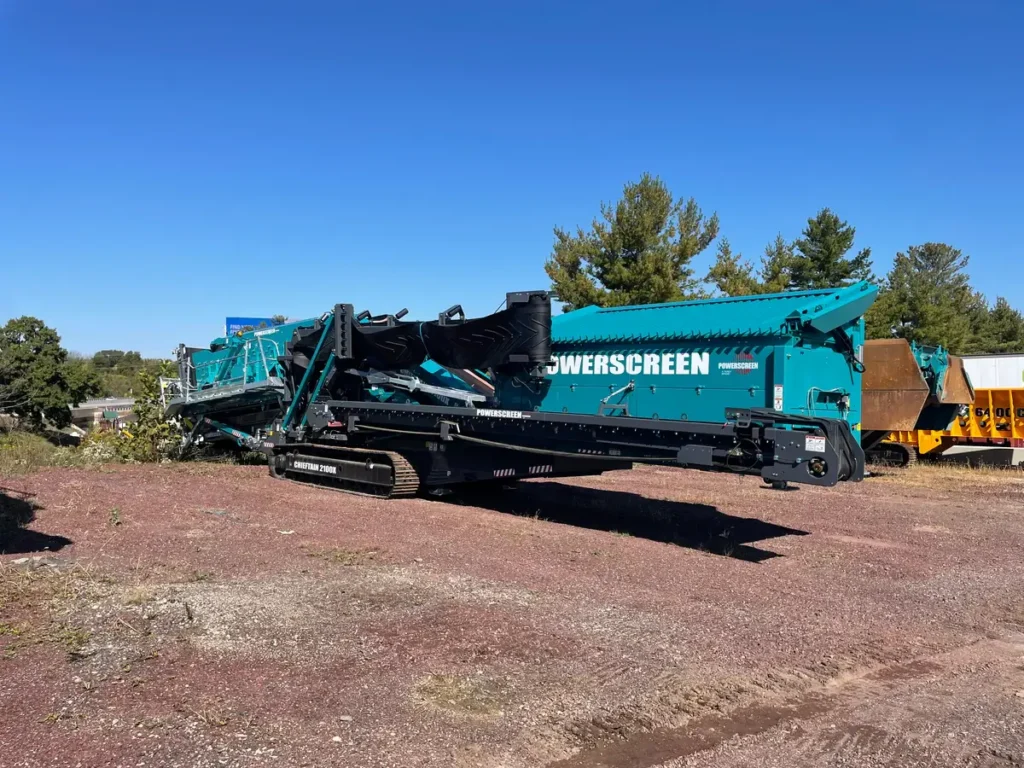
The Powerscreen Chieftain 2100X is a well-known mobile inclined screen used in high-volume screening applications. It is available in two-deck and three-deck configurations and is designed for large-scale aggregate, recycling, coal, topsoil, and sand and gravel operations, powered by a CAT C4.4 engine rated at 98 kW. Its strong brand recognition, mature design, and high output potential make it a common choice in many international markets.
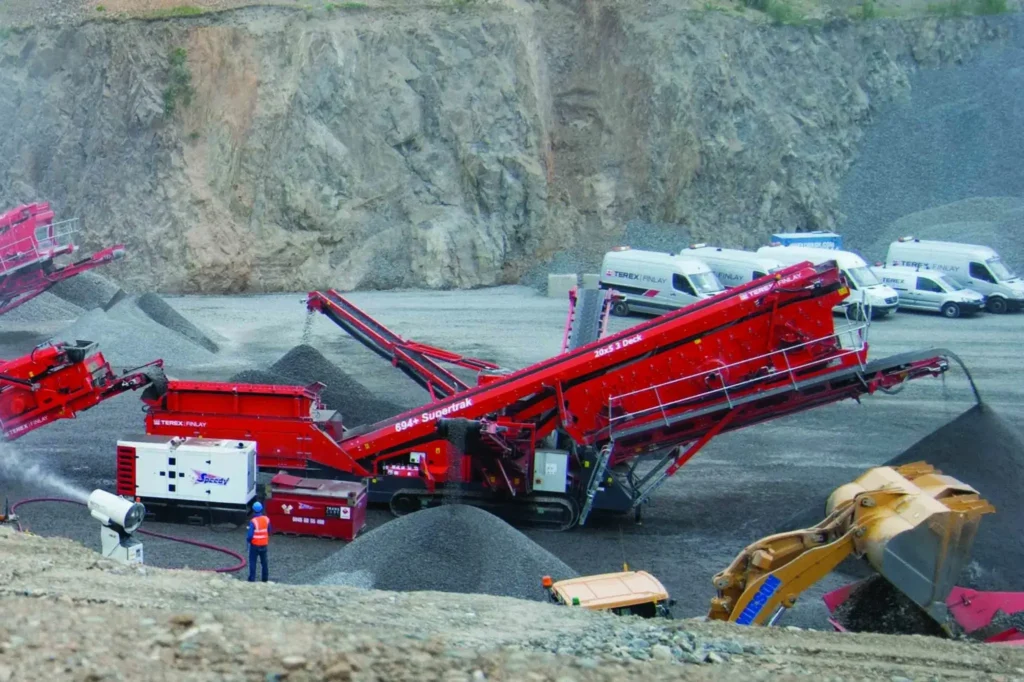
The Terex Finlay 694 / 694+ sits in a similar bracket, purpose-built for high-production quarrying, mining, and aggregate applications. It runs three full-size 6.1 m × 1.53 m decks, an 8 m³ hopper, and a hydraulic screen angle adjustment between 18° and 30°. The 694+ variant adds a hybrid dual-power option and comes with T-Link telematics fitted as standard, including a seven-year data subscription.
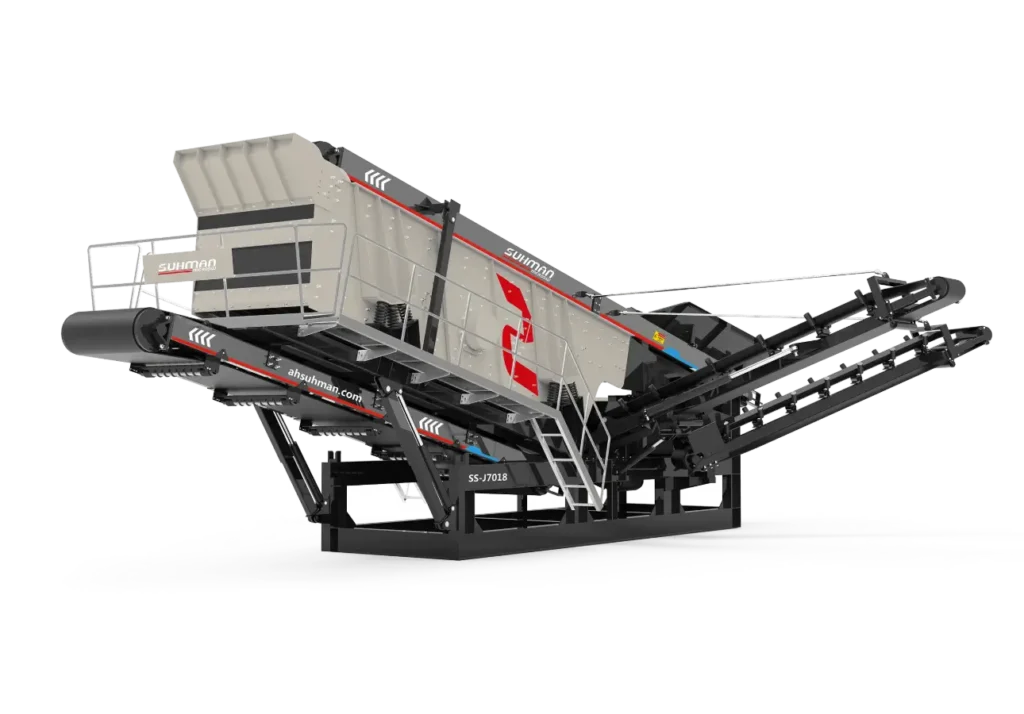
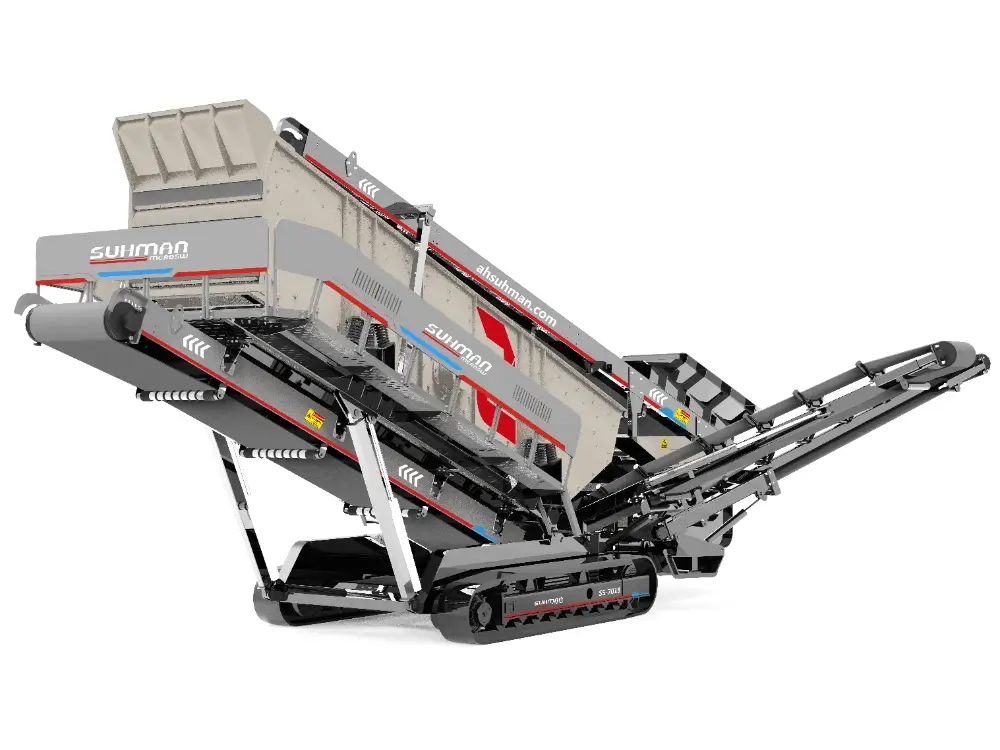
The Suhman SS-7018 Mobile Inclined Screener is a tracked mobile screening plant designed for aggregate grading, quarry screening, mining material classification, construction waste recycling, and infrastructure material processing. It features a 7000 × 1800 mm three-deck screen box, with a processing capacity of approximately 220–320 t/h. It is positioned as a practical and cost-effective screening solution for 250–300 tph class applications.
Key Specification Comparison
| Specification | SS-7018 | Powerscreen Chieftain 2100X 3 Deck | Terex Finlay 694 |
|---|---|---|---|
| Machine Type | Tracked mobile inclined screener | Tracked mobile inclined screener | Tracked mobile inclined screener |
| Screen Decks | 3 decks | 2 or 3 decks | 3 decks |
| Screen Box Size | 7000 × 1800 mm | 6100 × 1530 mm | Top / middle: 6100 × 1530 mm; bottom: 5550 × 1530 mm |
| Approx. Screening Area | 37.8 m² | Approx. 28 m² | Approx. 27 m² |
| Processing Capacity | 220–320 t/h | Up to 600 tph | Depends on material and configuration |
| Machine Weight | 32.5 t | Approx. 37.4 t | Approx. 37.4 t |
| Engine Power | 90 kW | Around 97–129.5 kW depending on engine option | Around 97–102 kW |
| Transport Length | 14.8 m | Approx. 19.06 m | Approx. 18.95 m |
| Typical Applications | Aggregates, quarrying, mining, recycling, infrastructure | Aggregates, recycling, coal, topsoil, sand and gravel | Quarrying, mining, sand and gravel, coal, topsoil |
Where SS-7018 Has Advantages
1. Larger Screen Box for Material Separation
One of the most important advantages of the SS-7018 is its larger screen box.
Both the Powerscreen 2100X and the Terex Finlay 694 use the same 6.1 × 1.53 m deck format—an industry-standard size that has remained largely unchanged for many years. Each deck provides 9.33 m² of active screening surface.
The SS-7018 uses a 7000 × 1800 mm three-deck screen box, while the Powerscreen Chieftain 2100X and Terex Finlay 694 are closer to the 6100 × 1530 mm class. This gives the SS-7018 a larger nominal screening area.
In practice, more deck area means the material bed is distributed across a wider surface. That reduces the depth of material on the screen at any given moment, which in turn reduces blinding, improves particle stratification, and allows finer material to pass through more reliably, especially when processing aggregates, crushed stone, recycled concrete, and other granular materials. For operators working with fine aggregates or processing material with higher moisture content, a larger screening surface makes a measurable difference to gradation quality and screen efficiency.
For users who need a 250–300 tph class mobile screening plant, the larger screen box is one of the strongest selling points of the SS-7018.
2. Lighter Machine Weight
The SS-7018 has an operating weight of approximately 32.5 t, while the Powerscreen Chieftain 2100X 3 Deck and Terex Finlay 694 are both around 37.4 t.
This means the SS-7018 is about 4.9 t lighter than these two international models.
A lighter machine can be beneficial for contractors who need to move equipment between different job sites. It may help reduce transport load, simplify site relocation, and improve flexibility in mobile crushing and screening projects.
This does not mean the SS-7018 is a compact, small screener. It still belongs to the heavy-duty mobile inclined screening category. However, compared with similar international models, it offers a lighter tracked chassis while maintaining a large screening area.
3. Shorter Transport Length
Another practical advantage of the SS-7018 is its shorter transport length.
The SS-7018 has a transport length of approximately 14.8 m, while the Powerscreen Chieftain 2100X and Terex Finlay 694 are close to 19 m in transport length.
This can be useful for projects where equipment needs to be transported frequently between quarries, recycling sites, infrastructure projects, or temporary crushing and screening locations.
However, transport size should always be checked based on local road regulations. Although the SS-7018 has a shorter transport length, its transport width and height also need to be considered before shipment.
4. Lower Installed Engine Power for Standard Screening Applications
The SS-7018 is equipped with a 90 kW engine, while the Powerscreen Chieftain 2100X and Terex Finlay 694 usually use higher engine power configurations depending on the model and emission standard.
For standard aggregate screening applications, a lower installed engine power can be an advantage when the target production range is around 250–300 tph.
Actual fuel consumption depends on many factors, including material type, moisture content, screen media, feeding condition, engine brand, hydraulic system, and operating load. However, from a specification perspective, the SS-7018 offers a balanced power configuration for medium- to high-capacity screening applications.
5. OEM and customisation flexibility
The SS-7018 is available with full OEM configuration. For regional equipment distributors, plant hire businesses, or operators building a branded fleet, this is a capability that neither Powerscreen nor Terex Finlay offers at this price point.
6. Price
The acquisition cost of the SS-7018 is substantially lower than a comparable European-branded machine. The gap is typically 40–60%, though actual figures vary by specification, destination market, and prevailing exchange rates.
This matters not only as a headline number but also in terms of capital efficiency across a fleet. Lower capex per unit means faster payback periods, more units deployed for the same budget, or simply more capital retained for other operational needs. It is a practical advantage, not merely a theoretical one.
7. Cost-Effective Alternative to International Brands
Powerscreen and Terex Finlay are established international brands with strong market recognition, mature product systems, and broad service networks. Their machines are widely used around the world and are often selected by customers who prioritize brand reputation and global after-sales support.
The SS-7018 should not be positioned as a machine that simply “replaces” these brands in every situation. Instead, it is better understood as a cost-effective alternative for customers who need a large three-deck mobile inclined screener but want a more practical investment.
For quarry owners, mining contractors, recycling companies, and infrastructure projects, the SS-7018 offers several clear advantages:
- Larger 7000 × 1800 mm three-deck screen box
- Lower machine weight compared with similar international models
- Shorter transport length
- Practical 250–300 tph class production capacity
- Suitable for aggregate grading, quarry screening, mining, recycling, and infrastructure material processing
- More competitive overall investment cost
Where Powerscreen 2100X and Terex Finlay 694 Still Have Strengths
Although the SS-7018 has clear advantages in screen size, machine weight, transport length, and cost-effectiveness, the Powerscreen Chieftain 2100X and Terex Finlay 694 also have their own strengths.
The Powerscreen Chieftain 2100X is designed for high-output applications and has strong market recognition in large-scale screening operations. It is suitable for users who need a proven international brand and may require higher production capacity depending on material conditions.
The Terex Finlay 694 is a mature and widely used three-deck inclined screener. It has strong application coverage in quarrying, mining, sand and gravel, coal, and recycling. For customers who already use Terex Finlay equipment, the 694 can fit well into an existing fleet.
Brand familiarity. For some operators, financiers, or end clients, the Powerscreen and Terex Finlay names carry a weight of recognition that influences purchasing decisions, resale value calculations, and financing terms. This is a real consideration, particularly in markets where asset-backed lending is common.
Therefore, the best choice depends on the customer’s project requirements, budget, local service conditions, transport regulations, and production target.
Which Machine Is More Suitable for Your Project?
If your project requires a well-known international brand, mature global service support, and very high output potential, Powerscreen Chieftain 2100X or Terex Finlay 694 may be suitable options.
If your project focuses on large screening area, practical production capacity, lower machine weight, shorter transport length, and better investment efficiency, the SS-7018 Mobile Inclined Screener is a strong option to consider.
The SS-7018 is especially suitable for:
- Quarry aggregate grading
- Crushed stone screening
- Mining material classification
- Construction waste recycling
- Concrete and asphalt recycling
- Infrastructure material screening
- Mobile crushing and screening plants
- Contractors who need frequent site relocation
Conclusion
The SS-7018, Powerscreen Chieftain 2100X, and Terex Finlay 694 all belong to the mobile inclined screener category, but their positioning is different.
The Powerscreen Chieftain 2100X and Terex Finlay 694 are established international models with strong brand recognition and proven global applications. The SS-7018, on the other hand, provides a larger 7000 × 1800 mm three-deck screen box, a lighter 32.5 t tracked chassis, and a shorter transport length of 14.8 m.
For customers looking for a practical and cost-effective 250–300 tph mobile inclined screener, the SS-7018 offers a strong balance between screening capacity, machine mobility, and overall investment value.
In short, the SS-7018 is not only an alternative to international mobile inclined screeners. It is a competitive solution for customers who need large screening area, reliable material separation, and flexible on-site operation at a more practical cost.