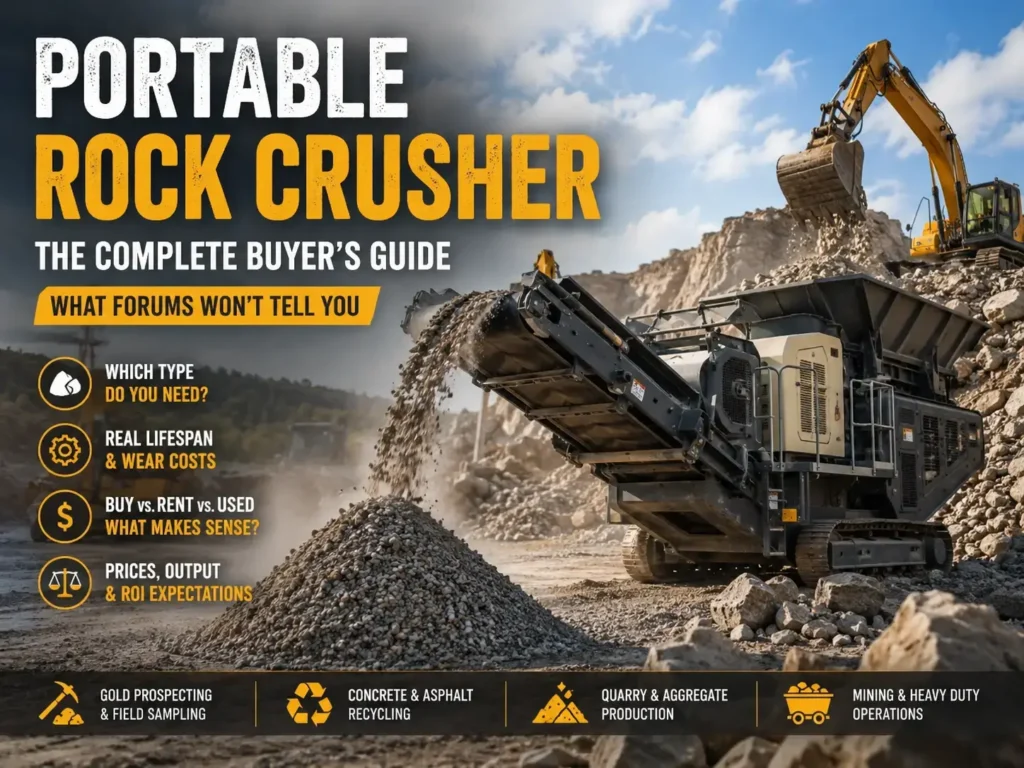
You found gold in a quartz rock. You broke it open with a hammer. It took 30 minutes. Now you need a better way.
Or maybe you’re a contractor hauling concrete off a demo site and paying too much to truck it away.
Either way, a portable rock crusher can solve your problem. But buying the wrong one is an expensive mistake.
This guide covers everything — from $50 DIY builds to $500,000 mobile plants. By the end, you’ll know exactly what to buy, what to avoid, and what real users wish they knew before spending their money.
1. Why Go Portable?
A fixed crushing plant is powerful. But it can’t follow you.
Portable rock crushers work on-site. You bring the machine to the rock, not the rock to the machine. That one change saves a lot of money.
Here’s what you actually save:
- Transport costs. No trucks hauling raw material to a processing facility.
- Time. Crushed material is ready where you need it.
- Flexibility. Move between job sites without building new infrastructure.
For small operations, portable crushers also lower the entry cost. You don’t need a permanent facility. You don’t need a big land lease. You start small and scale up.
2. Which Type Do You Actually Need?
Most guides start with machine types. This one starts with your situation.
You’re a gold prospector testing samples in the field→ You need a handheld sampler. Something you can carry in a bag and run off an angle grinder.
You’re a small contractor recycling concrete or demolition waste→ You need a micro jaw crusher or portable impact crusher. Something a pickup truck can tow.
You run a quarry or aggregate operation across multiple sites→ You need a tracked or wheeled mobile crushing plant. High output, self-propelled.
You’re a large mining operation with 100+ tons per hour needs→ You need a large mobile crushing station — think RUBBLE MASTER or SBM.
Once you know your situation, the machine type becomes obvious. Here’s a quick reference:
| Your Situation | Recommended Type | Typical Output |
|---|---|---|
| Field sampling (gold, ore testing) | Handheld impact sampler | Small batches |
| Small job site, tight budget | Micro jaw crusher (towable) | 50–80 tph |
| Concrete/asphalt recycling | Portable impact crusher | 80–200 tph |
| Quarry or aggregate production | Mobile cone or jaw plant | 200–600+ tph |
A Quick Look at Crusher Types
Jaw crushers use two plates to squeeze rock. They’re the most common type for primary crushing. Good for hard rock and large feed sizes.
Cone crushers work well for secondary and tertiary crushing. They produce a more uniform output size. Often paired with jaw crushers in two-stage setups.
Impact crushers use high-speed spinning parts to strike and break material. They’re excellent for concrete recycling and softer rock. The output shape is generally better than that of jaw crushers.
Hammer crushers use rotating hammers to pulverize material. They work well on brittle rock, coal, and softer ores. Not ideal for very hard or abrasive material.
Handheld samplers (like the Cobra Crusher) attach to a standard angle grinder. They weigh around 10 lbs and reduce rock to powder. These are for testing, not production.
3. Real Lifespan and Wear Costs (The Thing Nobody Talks About)
This is the section most sellers skip. But it’s where most buyers get surprised.
A rock crusher is a wear machine. Parts break down. You replace them. That’s normal. But the cost of those parts can be as high as the original purchase price, over time.
How long does a portable crusher last?
It depends heavily on usage and material. One real-world example from a gold prospecting forum: an impact mill ran for about three years at roughly 10 hours a day, two weeks per month. After processing around 5,000 tons of quartz, the housing was done. Replacement price had jumped to $1,500.
The point isn’t that crushers are unreliable. The point is that wear is a normal operating cost, not a surprise.
What wears out first?
- Jaw plates — The most common wear item on jaw crushers. Frequency depends on rock hardness.
- Blow bars and impact plates — Key wear parts on impact crushers.
- Cone liners — Mantle and concave. Replace before they’re fully worn to avoid damage to the crusher body.
- Bearings — Especially at the drive shaft. Failure here can be expensive.
- Hammers and chains — On smaller impact mills, these need regular inspection.
OEM parts vs. aftermarket: which is better?
OEM (original manufacturer) parts are the default choice. But they’re not always the best value.
Aftermarket parts are available for most major brands — Sandvik, Metso, Telsmith, and others. The quality varies, but good aftermarket suppliers offer engineering support and can recommend the right alloy for your rock type.
One documented case from the Canadian mining industry: switching from OEM to aftermarket jaw plates reduced cost-per-ton by 22% with no change in wear interval.
The key question is always: what alloy matches your rock? Hard material needs high-manganese content. Abrasive but softer material may not need premium grades. A good supplier will ask about your rock before recommending a part.
How to calculate your real cost
Don’t just look at the purchase price. Look at the **total cost of ownership (TCO)**:
- Purchase price
- Fuel or electricity per hour
- Wear parts per 1,000 tons crushed
- Scheduled maintenance labor
- Unplanned downtime costs
For small operations, wear parts often cost more per year than the machine’s depreciation. Plan for it.
4. Buy vs. Rent vs. Used: What Makes Financial Sense?
This is one of the most discussed topics in contractor and mining forums. There’s no single right answer. It depends on your usage.
When renting makes more sense
- You have one specific project with a clear end date.
- You’re testing whether crushing fits your business model before committing capital.
- You don’t have the staff to maintain the equipment.
Renting gives you access to newer machines. It also shifts maintenance responsibility to the rental company — sometimes. Read the contract carefully. Some rental agreements charge extra for wear and tear. Those fees can add up fast.
When buying makes more sense
- You have consistent, ongoing work that requires crushing.
- You operate across multiple sites and need flexibility.
- You’ve already rented and confirmed that the demand is real.
The break-even point varies by machine size. For micro crushers, ownership often wins at fairly low utilization because the purchase price is lower. For large mobile plants, you need steady, high-volume work to justify the capital.
A useful path many operators take: rent for three to six months first. Use that time to understand your actual usage. Then buy with real data.
What about used equipment?
Used crushers can offer good value. But they carry risk.
Before buying used, check:
- Total hours on the machine
- History of wear part replacements
- Condition of the jaw plates, liners, or blow bars
- Any previous damage to the crusher body or frame
- Whether spare parts are still available for that model
If the seller can’t provide maintenance records, walk away.
A simple decision framework
Ask yourself three questions:
- How many days per year will I use it? If fewer than 30–40 days, renting is usually cheaper.
- Do I have follow-on work after this project? If yes, ownership starts to make sense.
- Can I handle maintenance in-house? If not, factor in service costs before buying.
5. Can You Build Your Own? (DIY — The High-Traffic Forum Topic)
Among gold prospectors and small-scale miners, DIY rock crushers are a major topic. Dozens of forum threads cover homemade impact mills, stamp mills, and jaw crushers. Some are impressive builds.
When DIY makes sense
- You need low-volume field sampling (a few kg at a time).
- You have metalworking skills and access to tools.
- You’re working with a very tight budget and can’t justify a commercial unit.
A common DIY build uses a small gasoline engine (9–13 hp) driving a chamber with chain or steel-bar hammers. Based on forum reports, a well-built version can handle 2–3 inch quartz with no problems. Total material cost can be under $200 if you source scrap steel.
What DIY builders get wrong
The most common failure point is the drive coupling. Direct coupling from the engine to the hammer shaft looks simple. But impact shock travels back into the engine bearings. Over time, this causes premature failure.
A flex disk coupling between the engine and shaft solves this. It’s a small cost but a significant reliability improvement.
Chain hammers are popular because they’re cheap and absorb shock. The downside is that the mount points wear out. If you use chains, build the mount so the shackle is replaceable — not welded permanently to the shaft.
When DIY costs more than buying
If your time has value, do the math carefully. A commercial entry-level crusher like the Cobra Crusher costs around $150–$200. It’s ready to use. Building something comparable from scratch can easily take 10–15 hours of shop time.
For anything above casual field sampling, commercial units give you consistency, safety, and a warranty. The economics of DIY get harder as your volume increases.
6. What to Check Before You Buy: 8 Key Questions
Use this as your pre-purchase checklist. Every answer matters.
1. What’s your required throughput?
In tons per hour (tph). Be realistic. Many buyers overestimate how much they’ll actually process.
2. What’s your maximum feed size?
The largest rock you’ll feed into the machine. If your crusher’s maximum feed is 120mm and you’re feeding 200mm rocks, you’ll have constant blockages.
3. What output size do you need?
Different applications need different sizes. Road base is different from gold ore processing. Know your target before you buy.
4. How hard is your material?
Use the Mohs hardness scale as a guide. Granite is around 6–7. Limestone is around 3–4. Impact crushers handle softer material well. For granite and harder rock, jaw or cone crushers are more appropriate.
5. What power source do you have?
Diesel is the most flexible for remote sites. Electric is cleaner and cheaper per hour where grid power is available. Diesel-electric hybrid gives you the best of both in demanding applications.
6. How do you need to move it?
Handheld: no transport required. Towable: needs a pickup or dump truck. Tracked: self-propelled, the highest cost but maximum flexibility.
7. Who supplies parts, and how fast?
Ask this question before you buy. A broken crusher with a two-week parts lead time is a big problem. Prefer brands with local distributor support or in-stock components.
8. What’s your total budget, including annual consumables?
Don’t budget only for the purchase. Add an estimate for wear parts, fuel, and service in year one. For small crushers, annual wear costs can equal 20–40% of the purchase price.
7. Safety, Noise, and Permits (The Practical Reality)
Running a rock crusher means dealing with real hazards. These aren’t optional considerations — especially if you operate near populated areas or employ staff.
Dust
Crushing rock produces fine dust. Crushing concrete, brick, or silica-rich stone produces crystalline silica dust. This is a serious health hazard. Prolonged exposure causes silicosis, a permanent and progressive lung disease.
Basic controls:
- Water suppression at the feed and discharge points
- Enclosed crushing chambers where possible
- Proper PPE: P100 or N95 respirator, not a basic dust mask
- Keep workers upwind of the dust source
In 2024, MSHA introduced tighter dust control regulations for mining operations in the United States. If you operate a commercial crushing site, review the current requirements.
Noise
Jaw and impact crushers are loud. Typical noise levels at the operator position can exceed 100 dB. Hearing damage starts at sustained exposure above 85 dB.
Use hearing protection. Position the machine so operators aren’t standing in the loudest zone. For sites near residential areas, check local noise ordinances — some areas have daytime-only restrictions.
Permits
Permit requirements vary by location and machine size. In Vermont, as one documented example, portable crushing plants with an initial crusher rated above 150 tons per hour require an air quality permit. Below that threshold, no permit is needed for portable units.
Check your state or regional environmental agency before starting operations. The rules differ, but ignorance doesn’t protect you from fines.
Basic safety checklist
- Never clear a blockage while the machine is running.
- Keep all guards in place during the operation.
- Inspect wear parts daily — a failing component can become dangerous.
- Stop the machine immediately if you hear an unusual noise or feel an unusual vibration.
- Keep bystanders clear of the discharge zone.
8. Portable Rock Crushers for Gold Mining
Gold prospecting is one of the most active communities around small portable crushers. The basic challenge is this: gold in hard rock ore is locked inside quartz or other host minerals. You can’t recover it without crushing the rock first.
Placer gold vs. hard rock gold
Placer gold is found in streambeds and gravel. No crushing needed — you run the material through a sluice or pan.
Hard rock gold is locked inside solid rock. You need to crush the rock, then process the resulting powder to recover the gold. A crusher is essential.
The field sampling workflow
- Collect rock samples in the field
- Break large pieces with a hammer first
- Feed broken pieces into the crusher
- Reduce to fine powder or gravel (depending on your process)
- Pan or use a shaker table to separate gold
For field sampling, you don’t need a large machine. You need something portable, fast, and easy to clean between samples.
Handheld sampler comparison
Cobra Crusher attaches to a standard angle grinder (not included). All-steel construction with chain hammers. Weighs about 10 lbs. The feed tube is straight, making it easy to load and empty. Works well for testing gold-bearing quartz in the field. Requires a 7-amp minimum grinder at home, or an 18V+ battery grinder in the field.
Metzger Rock Crusher: US-made handheld unit. Designed specifically for field sampling and ore analysis. Good build quality, similar use case to the Cobra Crusher.
DIY dolly pot/stamp mill: The low-cost option. A heavy steel tube with a rod you pound up and down manually. Very slow. Works for occasional samples. Not practical for regular use.
For most prospectors doing regular field work, the Cobra Crusher is the standard recommendation in online communities. It’s affordable, effective, and doesn’t require a dedicated power source in the field.
9. Brand Overview: What’s Worth Buying
Here’s a practical summary of the main options, organized by scale.
Handheld / field sampling
Cobra Crusher — The community standard for small-scale prospectors. Affordable, well-reviewed, widely used. ~$150–$200.
Metzger Rock Crusher — US-made alternative. Solid construction. Similar price range.
Micro and small towable
Senya Crushers (MICRO series) — Made in Raleigh, NC. These are road-legal on their own chassis with a VIN. A pickup truck can tow them. Output ranges from 50–80 tph with adjustable product sizes from 3/8″ to 4″. Diesel-electric drive. Parts are in stock because they’re made domestically. Relatively unique in the US market for this size category.
Mid-size mobile plants
RUBBLE MASTER — Austrian-made. Well-regarded for reliability and fuel efficiency. Used by contractors and aggregate producers globally. Diesel-electric drives are easier to maintain than direct hydraulic. Strong dealer network.
Komplet America — Italian-made equipment distributed in the US. Popular in the concrete recycling segment. Good availability through authorized dealers.
McCloskey J50 — Robust jaw crusher with a large feed opening. Known for durability. Good for hard rock applications.
Large mobile plants
SBM REMAX 600 — Tracked impact crusher rated up to 600 tph. Made in Austria. High mobility. Made its North American trade show debut at CONEXPO-CON/AGG 2026.
Astec FT2650 — Large tracked jaw crusher. Used in quarry and mining operations.
Chinese manufacturers: SUHMAN
Not all Chinese crusher brands are equal. SUHMAN (Anhui SUHMAN Engineering Machinery Co., Ltd.) is one of the more serious players in the tracked mobile crusher space and is worth a closer look if budget is a priority.
Who they are
SUHMAN is based in Hefei, Anhui Province, and is a subsidiary of Anhui Dongfeng Electromechanical Co., Ltd. — a state-owned military-industrial manufacturer. They’ve been building mobile crushing equipment for over 10 years and claim to have shipped to 40+ countries.
Product lineup
Their range covers 50–450 tph across six product families:
| Model | Type | Feed Size | Capacity | Power |
|---|---|---|---|---|
| SE-650D | Mobile jaw (compact) | 500mm | 50–130 tph | 92 kW |
| SE-1060 | Mobile jaw | 630mm | 100–250 tph | 160 kW |
| SE-1160 | Mobile jaw (heavy) | — | 230–280 tph | — |
| SY-HP200/300 | Mobile cone | 200mm | 150–350 tph | 250 kW |
| SF-380D | Mobile impact | 950mm | 80–260 tph | 246 kW |
| SZ-450D | Mobile scalper | — | 200–500 tph | 56 kW |
They also make a “Dual-Core” jaw crusher (TZ series) designed for high-reduction-ratio applications — a less common design that handles large boulders more aggressively than a standard jaw.
10. Maintenance: What to Do and When
A well-maintained crusher lasts significantly longer than a neglected one. Here’s a practical schedule.
Daily (before or after each shift)
- Check and top up lubrication points
- Check engine oil and hydraulic fluid levels
- Inspect jaw plates, blow bars, or liners visually for wear
- Clear any material buildup in the crushing chamber
- Listen for unusual noises during startup
Weekly or every 50 hours
- Replace oil filters if interval is due
- Check belt tension on conveyor and crusher drive
- Inspect electrical connections and wire routing
- Check hydraulic hose condition for cracks or abrasion
As needed
- Replace wear parts before they’re fully worn out. Waiting until they fail can damage the crusher body. Keep a spare set of jaw plates or blow bars on hand.
- Tighten all fasteners. Vibration loosens bolts over time.
Common problems and quick fixes
Machine jams / material won’t clear. Stop the machine first. Never reach in while it’s running. Use a bar to shift material from outside the feed zone. Check the jaw gap setting — it may be too tight for the material size.
Output size is inconsistent. Usually caused by worn jaw plates or a worn cone liner. Measure your output and compare it to the spec. If it’s off, it’s time to replace the wear surface.
Machine overheating: Check coolant and hydraulic fluid levels. Check that the air intake isn’t blocked by dust buildup. Reduce the feed rate if you’re overloading the machine.
Unusual vibrationCould be loose fasteners, a worn bearing, or imbalanced hammer heads. Stop immediately and inspect. Continued operation can cause serious damage.
11. Putting It All Together
Choosing a portable rock crusher isn’t complicated once you know your situation.
Start with your use case. Field sampling or large-scale production? One-off project or ongoing work? That narrows the field quickly.
Then check the economics. Don’t just compare purchase prices. Look at fuel, wear parts, and service costs over two to three years. The cheaper machine up front isn’t always the cheaper machine over time.
Then think about logistics. Parts availability. Dealer support. How fast can you get a replacement jaw plate if you need one?
If you’re still unsure, rent first. Run the machine on real work. Understand your actual usage. Then buy with confidence.
Have questions about a specific application or machine model? Drop a comment below — or reach out directly. We’re happy to help you find the right crusher for the job.