Executive Summary
At its core, a jaw crusher is a compression-type primary crushing device: it reduces large feedstock—blasted rock, river cobbles, concrete rubble, or ore—through reciprocating compression between a fixed jaw and a swinging jaw down to sizes that can be transported, screened, or fed into secondary equipment. This is why, across quarries, mines, C&D waste recovery operations, and road aggregate systems, the jaw crusher almost always sits at the first gate of the production line. For engineers, what actually matters is not the peak tph figure in the brochure—it is stable throughput under the given material, CSS, and fines and moisture conditions. For procurement agents, what actually matters is not the unit price in isolation—it is verifiable parameters, delivery risk, emissions compliance, servicability commitments, and total cost of ownership.
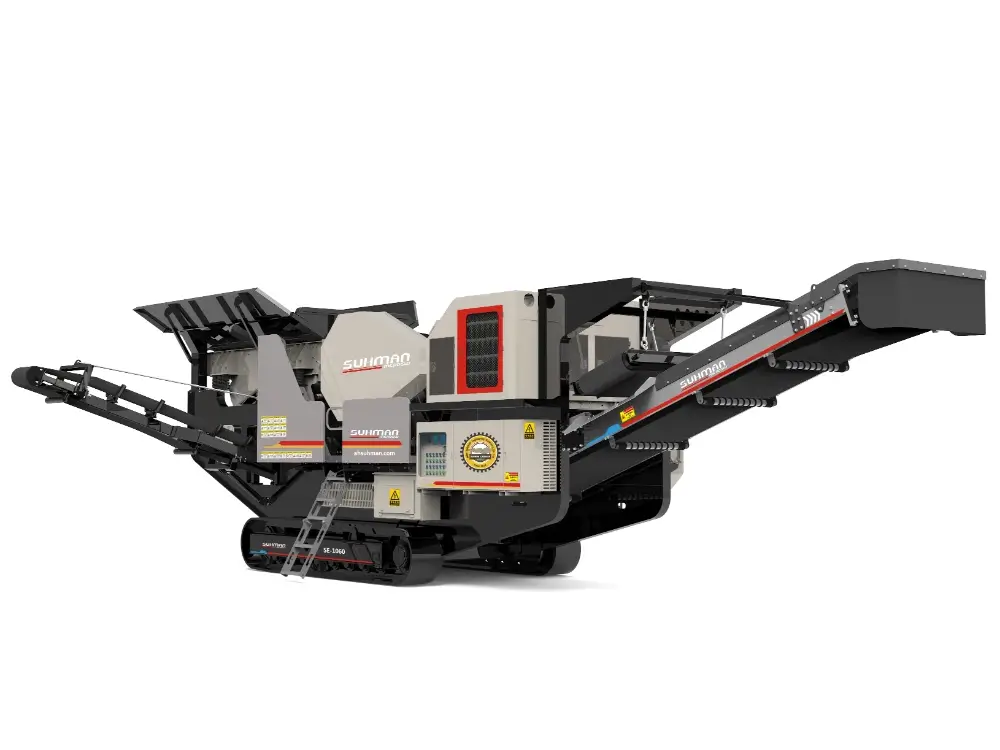
When you place the Suhman SE-1060 inside an international shortlist, it does not position itself as a machine trying to outmuscle European or North American large-frame models with a 400–450 tph headline. It reads more like a machine explicitly rated for 200–250 tph primary crushing duty in the 1060×750 mm jaw class for hard rock and mobile job site applications. The publicly available information — 700 mm maximum feed, 80–250 mm CSS, 46 t operating weight, 1060×750 mm jaw opening, single-power and dual-power configurations, hard rock suitability, manganese steel jaw plates, and upgrade paths to EPA Tier 4 / Euro V — is all laid out on the product page in one place. For anyone writing a proposal, filling out a technical deviation schedule, or building a CAPEX estimate, that kind of directness is worth a great deal.
If the actual design point of a project is 200–250 tph primary crushing, the SE-1060 — on specification transparency, power flexibility, hard rock suitability, and pricing openness — gives you more to work with from the public record than many well-known brands.
What a Jaw Crusher Is
A jaw crusher is a textbook compression crusher. Its working objective is not to produce a finished product — it is to take large blasted rock, river cobbles, concrete chunks, or ore blocks and bring them down to a size that can be transported, screened, or passed into a secondary stage. That is why the jaw crusher’s most common position is primary crushing: the very first stage of the whole processing line.
Structurally, jaw crushers divide into two main families: single-toggle and double-toggle. As Metso’s official documentation notes, the single-toggle design generates its compression action through an eccentric shaft at the top combined with a toggle plate; at comparable size classes, single-toggle machines typically deliver better throughput, which is why nearly every modern tracked mobile jaw crusher uses a single-toggle mechanism. McLanahan also provides a very practical rule of thumb for engineering selection: jaw crushers typically achieve a reduction ratio of around 6:1 to 8:1, which means they are built for coarse primary crushing—not for chasing fine product sizes out of a single stage.
Jaw opening is the entry parameter, not the whole picture. What actually determines whether a project succeeds is whether you are looking at material description, maximum feed size, target product size, target throughput, CSS adjustment method, emissions regulations, power supply conditions, transport constraints, and aftermarket terms — all together. Saying “this one has a 1060 jaw and that one has a 1100 jaw” gets you nowhere near a real answer.
How a Jaw Crusher Works
The working principle of a jaw crusher can be summarized as follows: material enters from the top of a V-shaped crushing chamber and is repeatedly compressed between the fixed jaw plate and the swing jaw; the eccentric shaft drives the swing jaw through a periodic motion, larger pieces are gripped and fractured first, and once they reach the required size at the lower opening, they discharge by gravity. The mechanism is mechanical compression, eccentric drive, and CSS-controlled output.
More importantly, CSS is not a figure you fill in casually. A smaller CSS produces finer output but typically reduces throughput; a larger CSS produces coarser output but increases throughput. The Kleemann MC 110 EVO2’s published technical page is a good illustration: it publicly states a crushing capacity of approximately 130 t/h at CSS = 60 mm and approximately 210 t/h at CSS = 100 mm. This is exactly why you cannot compare every machine in a field using only an “up to 400 t/h” figure.
For the SE-1060 specifically, the official product page walks through this logic with reasonable completeness: it features a heavy-duty eccentric shaft, hydraulic CSS adjustment, and a wide-belt discharge conveyor, and explicitly positions the machine for the primary crushing of hard rock, soft rock, and construction waste.
How to Select a Brand and Model
The first step is never to select a brand—it is to describe the material.
As McLanahan lays out, jaw crusher selection starts with material type, material physical properties, maximum feed size, target product size, and target throughput. It also makes one particularly actionable recommendation: maximum feed size should be controlled to approximately 80% of the jaw width and gape opening, which reduces the risk of bridging and unplanned downtime. In other words, the real selection logic is “size the feed first, then discuss brand preference.”
The second step is to get the throughput definitions straight.
In the publicly available literature on jaw crushers, you will encounter at least four common formulations: standard capacity, capacity, capacity up to, output potential, and, on top of those, feed capacity up to. These terms must never be treated as interchangeable in tendering or procurement. The SE-1060 uses a standard capacity of 200–250 tph. Kleemann simultaneously publishes a feed capacity of up to approx. 400 t/h and a CSS-conditioned crusher production figure. Powerscreen typically uses output potential. Lippmann writes capacities in excess of 400 TPH. If you do not specify material type, feed gradation, fines and moisture content, pre-screening configuration, CSS, and target product all in the same RFQ, then a comparison of “200 tph versus 400 tph” is almost certainly distorted.
The third step is to look at power architecture and emissions boundaries.
If the site has a stable long-term power supply, grid/hybrid/dual-power configurations typically yield better energy consumption and emissions compliance. If the application is mining, hillside stripping, or frequent relocation, diesel-direct, diesel-hydraulic, or self-generating dual-power setups give more flexibility. The SE-1060 explicitly publishes both a single-power and a dual-power version, with engine upgrade paths to China Stage IV, EPA Tier 4, and Euro V. The Powerscreen 420E is explicitly a hybrid/electric machine. The Keestrack B4 even publishes full-hybrid, plug-in, and zero-drive all-electric variants. For cross-border procurement, these are concrete, not abstract, advantages.
The fourth step — and only then — is to look at serviceability, mobility, and commercial terms.
Whether CSS adjustment is hydraulic or shim-based, whether tramp relief is available, whether central lubrication is included, whether remote monitoring is supported, and whether jaw plate profiles and tooth patterns cover different application conditions. Transport dimensions, operating weight, lead time, emissions version, warranty period, spare parts SLA, and pricing transparency. On this dimension, SE-1060 is the most transparent on price and aftermarket commitments, but established international OEMs express a more mature lifecycle ecosystem in globally visible terms—for example, Metso publishes parts and services; Kleemann provides a global sales/service/parts search, and Sandvik publishes aftermarket support, My Fleet, and Security+.
Typical Application Scenarios
In hard rock quarrying and mine primary crushing, the value of a jaw crusher comes primarily from its ability to eat large feed, absorb impact, and deliver a stable feed rate to downstream equipment. The SE-1060 covers hard rock and ore applications, including granite, basalt, andesite, iron ore, and copper ore. The Sandvik QJ341 bills itself as built for the most difficult operations and for hard rock mining and quarrying. The Metso LT106 also emphasizes, in its product documentation, the large stroke and hard-rock adaptability of the C106 chamber profile. For projects that need to take blasted feed directly into a tracked line, this kind of information matters more than brand stories.
In C&D waste processing, concrete recycling, and demolition applications, what genuinely adds value is not simply a large jaw opening, but blockage prevention, tramp iron removal, chamber clearing capability, and low infrastructure dependency. Metso positions the LT106 directly for recycled materials and concrete demolition waste. The Finlay J-1170 provides hydraulic release for demolition and recycling. The Powerscreen 420E and 450 both include C&D and recycling as standard applications. The Keestrack B4 lists concrete and landfill recycling, construction waste, and demolition waste as published applications. The SE-1060 similarly includes construction waste, concrete blocks, and urban demolition zones in its stated application range.
In road, bridge, and contract mobile crushing applications, relocation convenience, fast setup, transport dimensions, and power supply options are typically more sensitive than peak throughput limits. Metso states that the LT106’s hydraulically lockable hopper allows it to transition between crushing and transport modes in minutes. The SE-1060’s official product page emphasizes quick setup, and Suhman’s buyer guide puts the setup time at 30–60 minutes. The Powerscreen 450 and Finlay J-1170 both lead with quick setup as a selling point. For short-cycle infrastructure projects, this directly affects the number of productive shifts per month.
Comparison of Leading Manufacturers and Representative Models
The table below applies a single inclusion principle: publicly verifiable parameters only. Any field not published on an official product page or official data sheet is marked as not stated.
| Model | Jaw Opening | Max Feed | Published Throughput Basis | Operating Weight | Working / Transport Dimensions | Power & Output | CSS Range |
|---|---|---|---|---|---|---|---|
| SUHMAN SE-1060 | 1060×750 mm | 700 mm | Standard capacity: 200–250 tph | 46 t | Working 15500×4150×3900 mm; Transport 15500×3700×3900 mm | Single-power / dual-power; SE-1060-DP: crusher 110 kW, engine 200 kW, generator 200 kW | 80–250 mm |
| Metso Lokotrack LT106 | 1060×700 mm | Not stated | No TPH value on the official data page | 42 t | Transport 15300×2800×3400 mm | Hydraulic drive; CAT C9 / C7.1, 224 / 225 kW | Not stated |
| Kleemann MC 110 EVO2 | 1100×700 mm | 990×620×370 mm | Feed capacity up to 400 t/h; crushing capacity approx. 130 t/h (CSS 60) to 210 t/h (CSS 100) | 42.5 t base; 49 t max config | Transport 15010×3000×3400 mm | D-DRIVE; Scania, 248 kW | 30–180 mm |
| Terex Finlay J-1170 Direct Drive | 1100×700 mm | Not stated | High throughput, but no TPH figure on the official direct-drive page | 48 t | Working approx. 16050×4130×4360 mm; Transport approx. 16510×2900×3370 mm | Direct drive; engine output not stated | Hydraulic-assisted CSS adjustment, specific range not stated |
| Powerscreen Premiertrak 420E | 1070×760 mm | Not stated | Output potential 420 tph | Not stated | Transport approx. 14500×2900×3500 mm | Hybrid / electric; Scania DC09, 257–273 kW (depending on emissions version) | 45–145 mm |
| Powerscreen Premiertrak 450 | 1100×700 mm | Not stated | Output potential 450 tph | 49.125–49.165 t (depending on emissions version) | Working 15500×4300×4400 mm; Transport 16100×2800×3400 mm | Direct drive; CAT C9.3 230 kW or Scania DC9 202 kW | 50–150 mm |
| McCloskey J45 | 1140×688 mm | Not stated | Not stated | 43.9–46.74 t(discrepancy between website and brochure) | Transport approx. 14.48–14.6×2.50×3.40 m | 205–261 kW; feature sheet lists 261 kW CAT C9/C9.3 | Not stated |
| Keestrack B4 | 1100×700 mm | 600 mm | Capacity up to 400 t/h | 47.2 t | Transport 14054×2992×3399 mm | 202 kW @1500 rpm; or 222–260 kW @1800 rpm | 45–160 mm |
| Lippmann 1060j-t | 1060 mm wide, 42×28 in class | Not stated | Capacities in excess of 400 TPH | 48.5 t | Transport 16200×2900×3500 mm; Working length 15440 mm | Volvo D11 270 kW; or CAT C9.3B / C9.3 310 kW | 70–200 mm |
| Sandvik QJ341 | 1200×750 mm | 650 mm | Capacity: 400 mtph | 50 t | Transport 14200×2900×3400 mm | C9.3B 280 kW | Hydraulic adjustment, specific range not stated |
A critical note for readers: the “throughput” figures in the table above are not on the same statistical basis. The SE-1060 uses standard capacity. Kleemann publishes both feed capacity and CSS-conditioned crushing capacity. Powerscreen uses output potential. Lippmann uses in excess of 400 TPH. Sandvik publishes its capacity. This is precisely why you cannot rely on a single topline TPH figure in engineering work. Two machines both stating 400 tph may be describing completely different material conditions, pre-screening configurations, CSS settings, and product gradations.
The table below pulls the factors procurement cares most about — maintenance, mobility, emissions, warranty, spare parts, and pricing transparency — onto one page. The same rule applies: only published information; nothing is assumed on any manufacturer’s behalf.
Key Manufacturers and Notable Models
The jaw crusher market is served by a handful of major global manufacturers alongside numerous regional suppliers. Below are some of the most prominent players and their representative products.
Metso Outotec (Finland)
Metso’s Nordberg C Series jaw crushers are among the most recognizable in the industry, produced continuously since the 1970s and now available in over a dozen sizes. The C Series uses a steep nip angle, a long stroke, and an aggressive kinematics design to maximize throughput relative to machine size. Models range from the compact C80 (feed opening 800×500 mm) to the massive C200 (1,600×1,200 mm), with the latter capable of 1,500 t/h. Metso also integrates its crushers with its Metrics remote monitoring platform, enabling real-time performance tracking. In mobile configurations, the Lokotrack LT series packages C Series crushers on track carriers with feeders and conveyors for rapid deployment.
Sandvik (Sweden)
Sandvik’s CJ (formerly Svedala) jaw crusher range is a direct competitor to the Nordberg C Series. The CJ series features a robust one-piece, stress-relieved steel frame, a hydraulic setting adjustment system (HydroSet), and Sandvik’s signature jaw plate profiles optimized for specific rock types. The CJ815 is one of the largest models, handling feed sizes up to 1,300 mm. Sandvik also offers the QJ series of mobile jaw crushers, which include features like a built-in pre-screen and automatic CSS control via the My Sandvik digital service platform.
Terex Finlay (Ireland/UK)
Terex Finlay is particularly strong in the mobile and portable crushing segment, with the J-1175 and J-1160 jaw crushers being popular compact track-mounted units widely used in C&D recycling and small quarry operations. These machines are designed for ease of transport and rapid setup, with a hydraulic folding hopper, onboard generator, and remote-controlled CSS adjustment. Their compact size belies a high throughput capability for their class.
McLanahan (USA)
McLanahan’s Universal Jaw Crushers are engineered specifically for tough primary crushing in mining and aggregate applications. A distinctive feature is their deep, nip-friendly crushing chamber and the use of a flywheel-driven pitman to deliver high crushing forces. McLanahan also offers hybrid open-circuit and closed-circuit configurations with integrated screens, making them popular in smaller quarrying operations where simplicity and compactness are paramount.
SUHMAN
Anhui SUHMAN Engineering Machinery Co., Ltd. (China) — Based in Feixi County, Hefei, Anhui Province, SUHMAN is a specialist in tracked mobile crushing and screening plants, with a product line that spans jaw, cone, and impact crushers as well as complete mobile screening stations. The company draws on its heritage as an affiliate of Anhui Dongfeng Electromechanical (part of the China Ordnance industrial group) to embed high manufacturing standards into its equipment. SUHMAN’s mobile jaw crusher lineup includes the SE-1060 (200–250 TPH, max feed 700 mm), the heavy-duty SE-1160 (230–280 TPH), the compact SE-650D Mini (50–130 TPH), and the innovative TZ6510 Dual-Core Jaw Crusher (80–300 TPH). The Dual-Core design is a notable differentiator: by incorporating two parallel crushing chambers on a single chassis, it achieves higher throughput and more consistent particle shape than a conventional single-chamber jaw crusher of equivalent frame size. All models feature hydraulic CSS adjustment, PLC-based touchscreen control, and a remote monitoring system that tracks bearing vibration, temperature, and hydraulic pressure in real time — automatically triggering sequential shutdowns if critical thresholds are exceeded, protecting key components.
SUHMAN integrates globally sourced core components (including Austrian-technology drivetrain elements) and holds CE and ISO certification. The full range is available factory-direct, with OEM/ODM customization, a standard 2-year warranty, and lifetime technical support — positioning the brand as a competitive option for quarry, mining, and C&D recycling operations seeking European-comparable performance at a lower capital cost.
| Model | Jaw Plates / Maintenance | Mobility / Setup | Power / Emissions | Warranty / Spare Parts / Pricing Transparency | Typical Applications |
|---|---|---|---|---|---|
| SE-1060 | High-manganese jaw plates, heavy-duty eccentric shaft; manufacturer provides on-site commissioning, operator training, and remote video diagnostics | Crawler undercarriage; official page states quick setup, buyer guide states 30–60 minutes | Single-power / dual-power; China Stage III, upgradeable to China Stage IV / EPA Tier 4 / Euro V | Price published: $170k–$220k FOB China;Warranty published publicly; commits to long-term and lifetime spare parts supply | Hard rock, soft rock, construction waste, mining, road & bridge, aggregate yard |
| LT106 | Hydraulic CSS adjustment, swinging motion for chamber clearing, optional automatic lubrication and add-on service platforms; open frame for easy maintenance access | Heavy-duty crawler, 2-speed mode; hydraulically lockable hopper, official documentation states transition from crushing to transport mode in minutes | Hydraulic drive; Urban version offers optional dust suppression and noise enclosure | Parts and services published;warranty and price not stated | Concrete demolition waste, road construction, railroad ballast |
| MC 110 EVO2 | High-grade manganese jaw plates; SPECTIVE control system; visual and physical accessibility emphasized for fast maintenance | Quick Track wireless remote relocation; transport height 3400 mm | D-DRIVE diesel direct drive; emissions version varies by market | Website states “Contact us for quotes and prices”; global sales/service/parts search available; warranty period not stated | Natural stone primary crushing, recycling |
| J-1170 | Direct-drive crushing chamber with unblock feature; optional hydraulic release; hydraulic-assisted CSS adjustment | Compact footprint, quick set-up; suited for contract crushing and in-pit applications | Direct drive; engine output and emissions version not disclosed on direct-drive page | Price and warranty period not stated | Quarrying, mining, demolition, recycling |
| 420E | Centralized low-level hydraulic and electrical layout; optional jaw unblock | 500 mm track pads; hybrid power convenient for electrified sites | Optional onboard generator or direct grid connection; Scania DC09 in multiple emissions versions | Official page publishes output potential and technical data, butprice, operating weight, and warranty period not stated | Recycling, quarrying, mining |
| 450 | Low-level serviceability, direct drive, jaw level sensor, Powerscreen Pulse monitoring | 500 mm track pads; quick set-up emphasized | CAT / Scania dual power options covering different emissions versions | Website is Get a Quote / Parts Request model;price and warranty period not stated | Quarrying, demolition, recycling, mining |
| J45 | Open chassis, fast setup; multiple jaw plate / die options published (Square, Corrugated, Multitooth) | Optional Track or Track + Wheel bogie | Diesel; 205–261 kW figures vary across website and brochure versions | Price and warranty period not stated; published weight also varies by version | Type 1 crushing, quarry, recycling |
| B4 | NSS anti-blockage system; hydraulic slide frame for maintenance access beneath feeder and pre-screen; optional central lubrication, remote monitoring, and telematics | 2-speed track; can crush while tramming | Diesel-hydraulic, diesel-electric plug-in, and ZERO-drive full-electric — all three architectures publicly stated | Price and warranty period not stated | Concrete and landfill recycling, construction waste, demolition waste |
| 1060j-t | Open chassis, large discharge gap, HD crawler tracks, fast setup, quick-release jaw | Heavy-duty crawler; robustness emphasized for both relocation and maintenance | Volvo/CAT multiple engine options | Official documentation emphasizes high-quality wear parts and low downtime, but the price and warranty period are not stated | Aggregate, mining, recycling |
| QJ341 | Automated centralized lubrication, sealed-pipe-free maintenance lines, Optitooth jaw plates, My Fleet 7-year subscription, Security+ extended warranty package | Self-locking hopper, hydraulic main belt lifting, and jaw level sensor to reduce manual intervention | C9.3B 280 kW; page states emissions compliant, alternative engine options on technical page | Request a quote model; Security+ extended warranty and strong aftermarket support are standout features | Hard rock mining, quarrying, recycling, demolition |
When you put all these parameters together, one conclusion stands out clearly: the SE-1060’s strength is not in having the most impressive published peak throughput—it is that when a project’s genuine design point is 200–250 tph, its published documentation is the closest to the contractable engineering language you can actually put into an RFQ and sign on. By contrast, many international OEMs’ public-facing pages operate more as marketing entry points — strong, mature, and credible, but not necessarily structured to give you “the signable parameters under continuous operating conditions” in a single web visit.
Why the SE-1060 Deserves to Be on the Shortlist
If a project’s actual design point is 200–250 tph primary crushing, then the SE-1060’s first and most important advantage is specification fit rather than specification excess.
From the published parameters, it delivers a 1060×750 mm jaw opening, 700 mm maximum feed, 80–250 mm CSS, and a 46 t operating weight class. That means it is not pursuing headline throughput by stepping up one jaw class, one power tier, and one weight tier—instead, it defines a clear functional boundary for primary coarse crushing in mid-size quarries, mine heads, road aggregate applications, and mobile job sites. Compared to large-frame machines publicly rated at 400+ tph, this “right-sized” approach is often the more rational choice for medium-scale projects—especially when transport logistics, fuel consumption, working face dimensions, and budget are all constrained. This conclusion is an engineering inference, but it is grounded in the documented differences in operating weight, power output, and throughput basis across the machines in this comparison.
The second advantage is power flexibility.
The SE-1060 explicitly publishes both a single-power and a dual-power version: when stable grid power is available, the machine can run on external power; when it is not, the dual-power configuration with an onboard diesel generator takes over. This is not unique in the market—the Powerscreen 420E and the Keestrack B4 are both very strong on power flexibility—but within the current comparison set, the SE-1060 is one of the few machines that simultaneously publishes 200–250 tph hard rock primary crushing + dual-power options + emissions upgrade paths in a single place. For procurement agents handling frequent cross-border shipments to destinations with different emissions requirements, this is highly practical information.
The third advantage is that its hard rock positioning is explicit, and its parameters are unambiguous.
The SE-1060 explicitly states granite, basalt, andesite, iron ore, and copper ore, and publicly specifies high-manganese jaw plates and a heavy-duty eccentric shaft. This separates it from machines that read primarily as C&D recycling tools and tells buyers directly that it is not limited to soft material recovery—it can carry primary hard-rock duty. Many international brands are of course, equally capable in hard rock, but their public pages tend to emphasize broad capability. The SE-1060’s published language serves a more specific buyer intent: “I need to crush a section of hard rock.”
The fourth advantage is commercial transparency.
Among all the machines in this comparison, the SE-1060 is one of the very few with a published price range: Suhman’s official pricing guide lists the 200–250 tph standard mobile jaw crusher at $170,000–$220,000 FOB China, alongside power, weight, and capacity in the same description block. By contrast, Kleemann, Powerscreen, Sandvik, and other leading OEMs operate on a quote-driven entry model — Contact us for quotes and prices, Request a quote, Get a Quote — rather than list pricing. For procurement agents, this means the SE-1060 can reach concrete numbers faster in the early budgetary quotation and distributor engagement phase.
The fifth advantage is that its aftermarket commitments are published in more detail.
Suhman’s official pages state 24/7 technical support, remote video troubleshooting, on-site service, lifetime spare parts supply, 48-hour spare parts dispatch, and a 2-year warranty covering the main frame, engine, hydraulic system, electrical system, and crawler undercarriage. Product pages also state that a complete set of wear parts is included on delivery, along with long-term supply, on-site commissioning, and operator training. For engineers and procurement teams, this content is not window dressing — it is the basis for what can and cannot be written into a contract annex during negotiations.
In the end, if your project needs a track-mounted mobile jaw crusher rated at a 200–250 tph design point, capable of handling 700 mm-class hard rock feed, available in dual-power configuration, at approximately 46 t operating weight, and able to move into the budgeting and contracting phase faster — then the SE-1060 is a machine that very much deserves to be on your shortlist. On the other hand, if your project genuinely demands 400–450 tph peak capacity, an exceptionally dense global aftermarket network, or a more stringent worldwide lifecycle standard, then the larger-class international OEM machines will still demonstrate a more mature ecosystem in their public record. The SE-1060’s most defensible value proposition is not “biggest”—it is matched, transparent, flexible, and hard enough for the job.