
Introduction & Overview
The SF-380D-2S is a fully integrated mobile crushing and screening plant. It is an upgraded “all-in-one” machine that combines a 1214-series impact crusher with a three-layer vibrating screen on the same tracked chassis. This integration allows it to produce three different product sizes simultaneously without needing separate crushing or screening units. Typical materials include medium-hard rocks (limestone, bluestone, etc.) and construction waste (reinforced concrete, asphalt, and bricks). With a rated capacity of roughly 150–240 t/h and a 600 mm top feed, the SF-380D-2S is aimed at operators who need a compact, flexible plant that can be quickly deployed on-site. It can work off-grid (diesel) or be plugged into external power (dual-power option) to suit different environments.
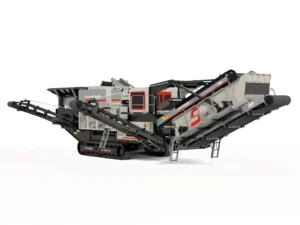
Figure: SF-380D-2S track-mounted impact crusher with integrated triple-deck screening.
Table 1 summarizes the SF-380D-2S’s main specifications. The machine uses a 250 kW crusher drive and 100 kW diesel engine, runs on a robust crawler chassis (model LDZ55-3657), and weighs about 54.3 tonnes. Its 17.8 m × 3.78 m × 3.85 m transport dimensions allow highway towing (a special permit is required for widths over 3.78 m). The triple-screen module (3 layers) is hung under the crusher: oversize material is automatically returned to the crusher for re-crushing (closed loop). This design streamlines site layout and reduces the number of separate conveyors and machines needed.
| Feature | Specification (SF-380D-2S) |
|---|---|
| Capacity (t/h) | 150–240 (typical) |
| Max. Feed Size (mm) | 600 |
| Crusher Drive Power (kW) | 250 (rotor motor) |
| Engine Power (diesel, kW) | 100 |
| Screen Decks | 3 (triple-deck) |
| Screening Outputs (sizes) | Three product fractions (fine, mid, coarse) |
| Chassis (tracked) | LDZ55-3657 crawler, 2-speed drive |
| Whole Machine Weight (t) | ~54.3 |
| Working Dimensions (L×W×H) | 17800×10800×4700 mm |
| Transport Dimensions (L×W×H) | 17800×3780×3850 mm |
| Optional Features | Dual-power (diesel+grid), various engine emissions ratings (Tier 4/V), magnetic separator, remote diagnostics, etc. |
Table 1: Key features and specifications of SF-380D-2S.
Main Features and Technical Specifications
The SF-380D-2S’s core crushing unit is a SUHMAN model 1214 horizontal-shaft impact crusher, equipped with wear-resistant blow bars and a hydraulic apron adjustment. Materials fed into the crusher are accelerated by a high-speed rotor and flung against stationary impact aprons (liners) to fracture into smaller pieces. This high-energy impact process yields a cubical aggregate shape ideal for asphalt and concrete production. The crusher’s discharge gap is hydraulically adjustable (0–150 mm range) to tune the output gradation. A twin-belt vibrating feeder (4.5 kW × 2) pre-feeds the crusher; it can handle arched or rebar-bearing feed as needed. An optional hydraulic pre-screen at the hopper can remove fines before crushing.
Downstream of the crusher is a 3-layer vibrating screening module. The crushed material from the crusher is discharged onto the vibrating screen (4600×1540 mm deck area) via the main conveyor. The screen sorts material into three fractions: undersize (“fine”), mid-size, and oversize (“coarse”). Each screened fraction exists on its own conveyor (see Figure 1). Oversized rock from the top deck is returned via a 7.3 m return conveyor back into the crusher inlet, creating a closed circuit. In this way, any material still too large after one pass through the crusher is automatically recycled for additional crushing.
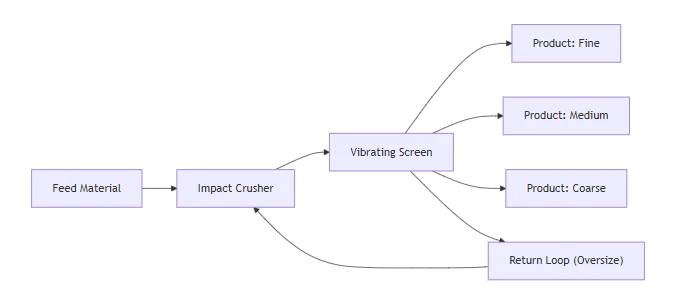
Figure: Material flow through the SF-380D-2S: feed → crusher → three-deck screen → product streams; oversized material is looped back (closed circuit) for re-crushing.
This integrated layout means one operator and one set of drivetrains can perform tasks that would normally require two machines (a crusher and a separate screen). The SF-380D-2S comes in two power versions: a single-power model (external electricity supply, typically 380 V) and a dual-power model (standard diesel engine + optional grid). All key components (crusher, conveyors, screens) are driven by electric motors (with hydraulics for adjustments). A PLC control panel (7″ touchscreen plus remote) manages sequencing (start/stop logic) and provides diagnostics. Emergency-stop buttons and door interlocks ensure operator safety around the machine. On-board magnet separators remove steel (rebar) in the feed, protecting the crusher.
Crushing and Screening Principles
The SF-380D-2S uses horizontal-shaft impact crushing (HSI). In this process, material fed into the crusher box is struck by rapidly spinning hammers (“blow bars”) on the rotor. The kinetic energy “throws” the rock against the impact aprons lining the crusher housing. These repeated impacts break the rock into smaller fragments, and it is easy to grade and compact well in pavements. The crusher’s adjustable aprons and high-inertia rotor allow operators to achieve the desired particle size by changing rotor speed or gap settings.
Behind the crusher, the screening system sorts crushed material by size. The SF-380D-2S’s three-tier screen has vibrating decks arranged in cascade. Coarser particles stay on the upper deck and continue toward the discharge as the coarse product. Finer particles drop to the middle deck (forming the mid-size product) or to the bottom deck (fine product). Crucially, any particles still above the top-deck aperture (oversize) are conveyed by the return belt back to the crusher. This closed-circuit loop guarantees that all material ultimately meets the target gradation.
This integrated flow (feed → crusher → screen → return) minimizes handling. It eliminates extra conveyors and bins that a two-machine layout would need to shuttle materials. The SF-380D-2S’s design ensures smooth, continuous operation: one continuous feed into the machine yields the full output of finished aggregate sizes. Maintenance is simplified by the machine’s tiltable chassis and ample access platforms, and all belt-conveyor drums are greased for life. Together, these features let the SF-380D-2S act as a self-contained crushing plant on a single track frame.
Integrated vs. Separate Systems
Integrating the crusher and screen onto one tracked frame has clear cost and space advantages. Compared to deploying a standalone crusher plus a separate mobile screen, the SF-380D-2S requires fewer components and less civil work. In general, such fully integrated systems have lower CAPEX and a smaller footprint. For example, one manufacturer notes that their integrated crushing-screening plant has “lower investment, a smaller footprint, and higher production capacity” compared to using multiple separate units. Operating expenses also fall: one diesel engine and one operator do the work of two machines, reducing fuel consumption and labor. Transportation is simpler too (only one machine to ship or drive to the site).
The table below qualitatively compares a fully integrated triple-deck plant (SF-380D-2S) against a non-integrated crusher+screen setup and an integrated two-deck plant (SF-380D-S).
| Aspect | Separate Crusher + Screen | SF-380D-S (2-Deck) | SF-380D-2S (3-Deck) |
|---|---|---|---|
| CAPEX | High (two machines) | Medium (one machine, two decks) | Lower (one machine, three decks) |
| Footprint | Large (two units + conveyors) | Moderate (single chassis + screening) | Smallest (all-in-one) |
| Mobility | Lower (move two units separately) | Good (one tracked unit) | Best (one tracked unit) |
| Product Flexibility | High (mix any crusher/screen) | Moderate (two fixed outputs) | High (three outputs; more gradation control) |
| Operating Cost (OPEX) | Higher (two engines, two ops) | Medium | Lower (one engine, one operator) |
| Maintenance | Higher (maintain two systems) | Easier (one unit, but fixed screen) | Easier (one unit) |
| Use Cases | Large fixed plants, mixed-use | Mid-range projects (2 products) | Small-to-medium sites needing 3 products |
Table 2: Qualitative comparison of crushing solutions. Integrated designs like SF-380D-2S reduce equipment count and footprint, at the cost of fixed screen configurations.
As shown, integrated systems reduce project cost (CAPEX/OPEX) and site logistics. Integrated plants are ideal for fast setup or recycling jobs, whereas separate systems (crushers and independent screens) can offer more flexibility in mixing and matching equipment for very large-scale stationary plants. Between the 2-deck and 3-deck variants, the SF-380D-2S’s extra screen layer gives additional throughput and product grading options, which can justify the slight increase in machine size when three product fractions are required.
Typical Application Fields
The SF-380D-2S suits a wide range of crushing scenarios. Key applications (with examples) include the following:
- Construction & Demolition (C&D) Waste Recycling: On building demolition sites or urban construction projects, this unit can crush concrete slabs, bricks, and asphalt. Its impact crusher can even separate rebar, producing clean aggregates. For example, demolished concrete can be fed directly into the SF-380D-2S to generate recycled sand and gravel for reuse in foundations or road subbases.
- Aggregate Production (Quarrying): In quarries and gravel pits, the SF-380D-2S processes medium-hard stones like limestone, bluestone, or dolomite. Its high reduction ratio often means secondary crushing is unnecessary. Mines have used similar impact crushers for limestone, coal and other ores, producing high-quality cubical aggregate with minimal fines.
- Infrastructure Projects (Road/Rail): For road or railway construction, a variety of aggregate grades are needed on short notice. The SF-380D-2S can be deployed on-site to produce multiple size fractions (e.g. 0–5 mm, 5–20 mm, 20–40 mm) to spec.
- Sand and Gravel Production Lines: In sand/gravel pits, this mobile plant can replace or augment fixed crushing lines. The triple-screen output is especially useful when multiple end products (e.g. coarse gravel, fine gravel, and manufactured sand) are desired.
- Other Uses: The machine also finds roles in coal and metallurgical plants for raw material crushing, as well as in general recycling where diverse materials need processing. In all these cases, the SF-380D-2S’s portable design means it can be brought directly to the working face, minimizing material hauling.
Market Positioning and Model Comparison
The SF-380D-2S sits between SUHMAN’s lighter 2-deck model and heavier 3-deck models, and also competes with other brands’ mobile impact crushers. Table 3 compares SF-380D-2S with SF-380D-S, SF-580D-S, and representative competitors (Keestrack R3/R5, Rubble Master RM100GO). The figures below are drawn from official datasheets.
| Model | Capacity (tph) | Max Feed (mm) | Screens | Weight (t) | Engine (kW) | Notes |
|---|---|---|---|---|---|---|
| SF-380D-2S | 150–240 | 600 | 3 sizes | 54.3 | 100 (diesel) | Hybrid power; triple-deck (3 products); 150–240 tph |
| SF-380D-S | 150–180 | 600 | 2 sizes | 51.4 | 100 | Dual-deck (2 products); similar machine |
| SF-580D-S | 150–350 | >700 | 2 sizes | 59.5 | 100 | Larger impact (1315) for high throughput |
| Keestrack R3 | ~250 | 770×960 | 1–2 decks | 27.5 | 202 | Compact, ~30 t, up to 250 tph |
| Keestrack R5 | up to 400 | 800×1050 | 2 decks | 45.5 | 352 | Heavy-duty ~45 t, up to 400 tph |
| RM 100GO! | up to 250 | 950×700 | 1 deck | 34.8 | (diesel-elec) | Lightweight (~35 t) tracked crusher up to 250 tph |
Table 3: Comparison of SF-380D-2S with related models (specs from manufacturers).
SUHMAN’s own 2S, 2S (3-deck), and heavy-duty models are designed as a family. The SF-380D-S is effectively a 2-deck version of the same concept, with an identical crusher but only dual screening. It is rated 150–180 tph and weighs ~51 t. The SF-580D-S is the “big brother,” using a larger 1315 crusher for up to 350 tph (Table 3). In SUHMAN’s FAQ, they note the SF-580D-S offers higher capacity (150–350 tph vs 150–240) for large-scale projects. Thus SF-380D-2S is positioned for medium-scale work where three product grades are needed, whereas SF-580D-S targets heavy-duty quarry or waste applications, and SF-380D-S suits simpler jobs requiring only two grades.
Competitors like Keestrack and Rubble Master occupy similar market segments. The Keestrack R3 is a very compact 27.5 t machine (~250 tph) with optional single- or double-deck screening, ideal for contractors needing easy transport. The Keestrack R5 is much larger (45.5 t, up to 400 tph), comparable in power to SF-580D-S but with dual decks. The RM 100GO! by Rubble Master is a direct competitor in the 250 tph class; it’s lighter (~34.8 t) and features a diesel-electric drive for fuel efficiency. Compared to these, the SF-380D-2S is heavier but offers triple outputs and a standard diesel drive. Its 250 kW crusher motor and 100 kW engine put it roughly on par with the RM100GO’s throughput, but with the advantage of on-board screening built in.
In summary, the SF-380D-2S sits between compact recyclers and large quarry crushers. It matches the mid-range capacity of machines like the Keestrack R3 or RM100GO (~250 tph) but provides up to three finished products at once. It offers higher mobility than heavier units like the Keestrack R5 while delivering more grading flexibility than simpler 2-deck plants.
Engineering Integration Considerations
When installing the SF-380D-2S on a site, several engineering factors should be addressed:
- Site Layout: The machine requires clearance for the feeding hopper and three discharge conveyors (fine, medium, coarse) plus space for a skip or stockpile area for each product. Being a tracked unit, it can position itself without foundations, but ground should be firm. Noise and dust buffers may be needed if working near residences or sensitive areas. The compact footprint of a single mobile plant means fewer access roads are needed compared to a multi-machine plant.
- Power Supply: The dual-power version allows either an external power connection (often used at mines or construction sites with available grid) or use of the onboard diesel engine. If using plug-in power, ensure a stable 380 V (or local equivalent) supply and proper cabling. The system’s total electric power draw is about 320–330 kW for crushing and conveyors, so the supply must handle this load. If on diesel only, the 100 kW engine is typically sufficient for continuous operation. Operators should plan fuel or electricity logistics accordingly.
- Transport and Mobility: The SF-380D-2S can move on its crawler tracks at ~1–2 km/h, but long-distance transport (between sites or internationally) requires disassembly of the screen or using a lowboy trailer. Its transport width (3.78 m) often needs an oversized permit. SUHMAN offers an optional wheeled dolly for road hauling. The machine’s tilt-up deck conveyors and foldable panels facilitate compact travel dimensions.
- Maintenance Access: A tilting chassis and removable guards give good access to the crusher chamber and motors. All wear parts (blow bars, liners, screen panels) can be changed from ground level or via provided ladders/platforms. SUHMAN notes that all conveyor drums are “greased for life,” minimizing daily lubing. A central greasing system is optional for other bearings. The engine and electronics are housed in weatherproof compartments with service panels on multiple sides.
- Dust and Noise Control: Impact crushing is noisy, and fines dust is generated at multiple points (inlet, discharge). Best practice is to use water-spray dust suppression. For example, vendors like Rubble Master equip crushers with water nozzles at the feed and main discharge to “ensure that the dust is contained within the crusher box”. On the SF-380D-2S, optional dust suppression modules (spray bars on the hopper and conveyors) are recommended if regulations require it. Noise can be mitigated by strategic positioning (e.g. facing the main discharge away from neighbors) and by using the engine’s low-idle when possible. Since silica dust is a health hazard, maintaining moisture on screens and conveyors is advised during operation.
- Safety and Training: Standard safety features include emergency-stop controls and guards on all conveyors and the crusher feed. Operators should maintain safe distances from moving belts and wear PPE (hard hats, hearing protection, dust masks). SUHMAN provides on-site commissioning and operator training with each machine. Their engineers train the customer’s staff on startup/shutdown procedures, crusher adjustment, screen panel change-out, and routine checks. After-sale support is available via phone or video call if needed. Before starting, teams should review local safety regulations (e.g. OSHA, MSHA) and ensure all guards are in place and training is complete.
Conclusion
The SF-380D-2S delivers the practicality of a compact crushing plant with the versatility of on-board triple screening. By integrating a large 1214 impact crusher with a three-deck screen, it provides up to three product sizes in one pass, reducing the need for multiple machines. This yields significant time and cost savings on-site: one SD-380D-2S can accomplish what would otherwise require two or more tracked units. The result is a highly flexible production line that is ready for demolition, recycling and aggregate projects.
Importantly, SUHMAN backs this performance with robust engineering and service. The SF-380D-2S is built “to military-grade quality” standards, and comes with features like an onboard magnet, upgraded engines, and full remote monitoring. SUHMAN promises on-site installation, commissioning and hands-on operator training, plus a 12‑month warranty and spare-parts support. These measures ensure that customers can trust the machine to run smoothly and profitably.
In summary, for operators needing a full-spectrum mobile crushing solution, the SF-380D-2S offers proven impact-crushing mechanics and triple-output capability in a single mobile package. It meets the needs of modern construction and recycling projects with high throughput and product quality, while reducing logistical complexity. When properly integrated into a worksite (accounting for power, access and safety), it becomes a turnkey crushing plant that builds trust through reliability and support.