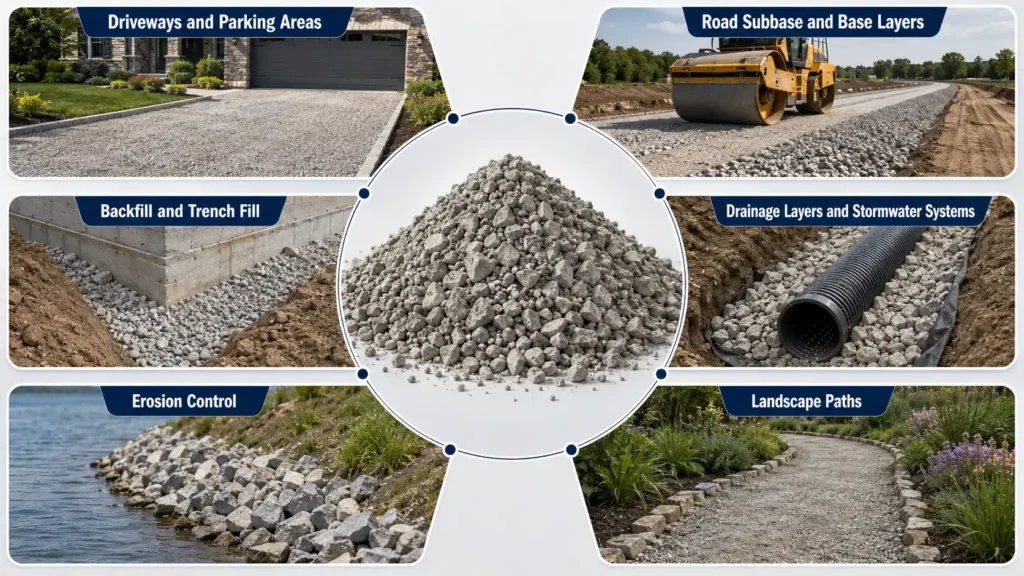
You have a driveway to repave, a parking lot base to build, or a pile of demolished concrete sitting on your job site. Someone tells you crushed concrete is the move. But is it really the right call for your project?
The answer depends on what you’re building, who’s using it, and how much control you have over material quality. This guide covers the full picture — what crushed concrete actually is, where it performs well, where it falls short, and how to get the most out of it whether you’re a homeowner or a contractor running multiple job sites.
What Is Crushed Concrete?
Crushed concrete, also called Recycled Concrete Aggregate (RCA), comes from demolished structures — old roads, building foundations, parking lots, sidewalks, and curbs. Instead of hauling that material to a landfill, contractors run it through an industrial crusher to break it into smaller, reusable pieces.
The result is a recycled aggregate that behaves much like natural gravel or stone — but costs significantly less and keeps demolition waste out of the ground.
The process typically involves three steps:
- Crushing—jaw or impact crushers reduce large slabs into manageable pieces
- Magnetic separation — removes rebar, wire, and steel ties
- Screening—sorts the output into size grades (typically ¾” minus, 1.5″ minus, or 3″ and larger)
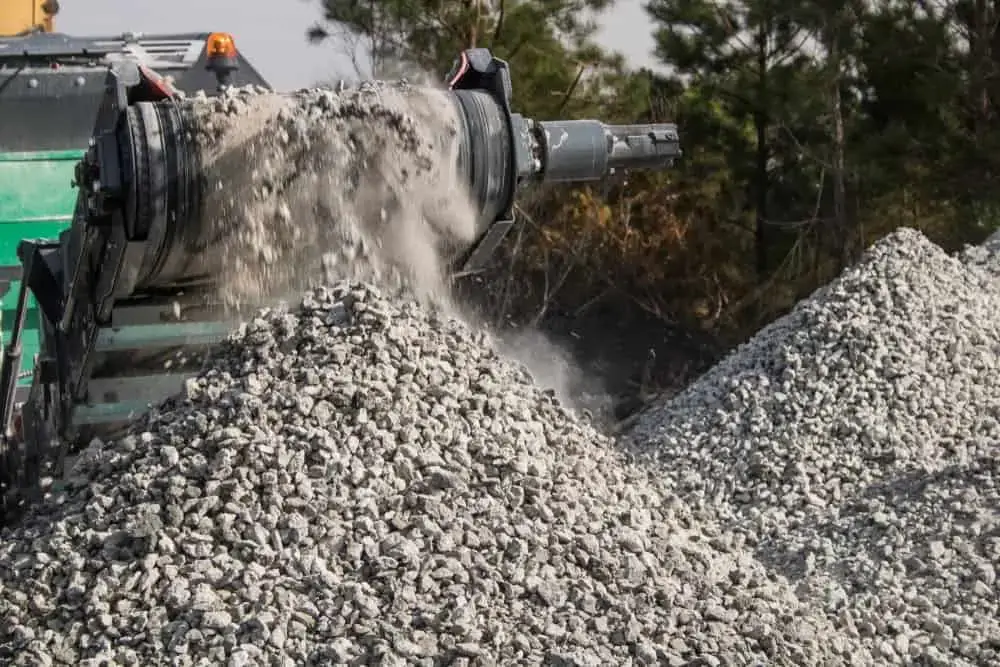
Common size grades and what they’re used for:
| Grade | Typical Use |
|---|---|
| ¾” minus | Driveway surface, compacted base layers |
| 1.5″ minus | Road subbase, parking lot base, backfill |
| 3″–6″ | Drainage layers, erosion control (riprap) |
| Fines | Pipe bedding, blending into new concrete mixes |
One important distinction: crushed concrete is not the same as fresh concrete. It starts life as something else, gets crushed down, and carries some of the characteristics of its source. That matters for both its strengths and its limitations.
Pros of Using Crushed Concrete
1. It Costs Significantly Less Than Natural Aggregate
Cost is the most immediate reason contractors and homeowners reach for crushed concrete. According to 2026 pricing data from HomeGuide, crushed concrete runs $11–$53 per ton, with most projects falling in the $15–$25 per ton range. Standard gravel, by comparison, costs $30–$75 per ton—making crushed concrete 20–60% cheaper depending on grade and location.
For larger projects, that gap adds up fast. A 15-ton load of crushed concrete saves you roughly $1,275–$2,025 compared to equivalent gravel—before you even factor in delivery.
For contractors who generate waste concrete on-site, the savings go even further. Instead of paying tipping fees (which typically run $50–$100 per ton at landfills) plus transportation, you can crush that material on-site and immediately put it to work. No hauling. No disposal cost. No reorder.
2. It Compacts Tightly and Stays Stable
Crushed concrete has a natural advantage over rounded gravel: its angular, broken edges interlock when compacted. That interlocking action creates a stable, load-bearing surface that resists shifting under vehicle weight and repeated use.
Over time, the material actually continues to harden. Residual cement paste in the aggregate undergoes a secondary hydration reaction when exposed to moisture—essentially re-bonding the particles together. This means a well-installed crushed concrete base often gets firmer over its first few months, not looser.
For driveways, parking areas, and road subbase applications, that behavior is a genuine performance advantage.
3. It Drains Well
Unlike dense, impermeable surfaces, crushed concrete allows water to move through it. The gap-graded particle sizes create natural drainage channels that redirect stormwater down and away rather than letting it pool on the surface.
This drainage performance makes crushed concrete a smart choice for:
- Driveways and parking pads in areas with heavy rainfall
- French drains and trench backfill
- Stormwater management systems and infiltration beds
- Slope erosion control (when used as riprap)
In fact, its permeability is one reason many municipalities specify RCA for road subbase work — it handles freeze-thaw cycles better than materials that trap and hold water.
4. It Keeps Concrete Waste Out of Landfills
According to the U.S. EPA, the United States generated approximately 600 million tons of construction and demolition debris in 2018 — more than twice the amount of municipal solid waste generated that same year. Concrete alone accounted for 353.6 million tons of demolition debris. Using crushed concrete directly addresses that problem.
By choosing RCA over quarried stone, you divert material from landfills, reduce the need for new mining, and cut the heavy truck traffic that moves raw aggregate from quarries to job sites. On multi-project operations, that reduction in hauling also means lower fuel costs and less equipment wear.
For contractors pursuing LEED-certified projects, this is a practical advantage: many green building frameworks credit the use of recycled materials, and some municipalities now require RCA as a substitute for virgin aggregate in public infrastructure work.
5. It Works Across a Wide Range of Applications
Crushed concrete handles more project types than most people expect. Contractors use it for:
- Road and driveway subbase
- Parking lot base layers
- Foundation backfill and trench fill
- Retaining wall fill
- Pipe bedding
- Drainage ditches and stormwater channels
- Riprap for erosion control along slopes and waterways
- Landscape pathways (with caveats — more on this below)
Some contractors also blend crushed concrete with crushed asphalt to create hybrid base materials that combine the stability of RCA with the slight flexibility of asphalt—particularly useful for driveways and parking pads subject to temperature swings.
That versatility means leftover RCA from one phase of a project often finds a use somewhere else on the same site.
Cons of Using Crushed Concrete
1. It’s Not as Strong as Fresh Concrete or Virgin Stone
For base layer and fill applications, the strength of crushed concrete is more than adequate. But for structural use — load-bearing elements, high-traffic commercial surfaces, or situations where strength specs are fixed — RCA has real limitations.
A 2025 review published in the journal Buildings (MDPI) found that a full 100% replacement of virgin aggregate with RCA results in concrete with roughly 79% of the compressive strength of standard concrete. The reduction happens because adhered mortar on RCA particles increases porosity and weakens the bond between aggregate and fresh cement paste.
The practical implication: crushed concrete works well as a base, backfill, or loose-surface material. It is not a direct substitute for virgin aggregate in high-strength structural concrete without careful mix design and testing.
2. Quality Varies Depending on the Source
Fresh crushed stone comes from a controlled quarrying process. Crushed concrete comes from whatever was on that demolition site — and that introduces variability.
Contamination is the biggest concern. RCA can contain remnants of the following:
- Asphalt (if the original structure mixed pavement and concrete)
- Gypsum from drywall or plaster
- Soil, clay, or organic material
- Chemical residues from industrial or treated concrete
These contaminants affect compaction performance, long-term durability, and — in some cases — environmental compliance. A reputable supplier will screen and inspect material before sale, but not all suppliers do. As a contractor, it pays to ask about source tracking and quality testing before you buy in bulk.
If you’re crushing your own on-site, you control the source—which is one reason many contractors prefer that approach.
3. Dust Can Be a Problem
Crushed concrete, especially finer grades, generates significant dust during dry conditions. Fine particles become airborne when vehicles drive over loose material, creating visibility hazards on job sites and nuisance issues in residential areas.
In dry climates, or during summer months, dust control becomes an active maintenance task—water suppression, dust binders, or a surface layer of larger aggregate can all help, but they add to the management burden.
4. The Material Can Spread and Shift Without Proper Edging
Unlike a poured slab or compacted asphalt, crushed concrete is a loose aggregate. Without physical containment—edging, curbing, or a landscape border—it migrates over time. Vehicles track it outward. Rain washes fines toward the edges. The surface thins in high-traffic areas and thickens elsewhere.
For driveways and parking areas, installing landscape curbing or steel edging around the perimeter is a straightforward fix. The cost is real (landscape curbing typically runs $15–$20 per linear foot installed), but it extends the life of the surface and reduces maintenance.
5. Weeds Can Push Through
The gap-graded particle structure that makes crushed concrete drain well also gives weed seeds room to establish. Without a weed barrier beneath the material, persistent weeds can break through—and over time, root growth can disrupt surface stability.
A heavy-duty permeable weed fabric installed before laying the crushed concrete significantly reduces this issue without blocking drainage.
6. It Looks Rough
Crushed concrete has an industrial appearance. Colors vary from pale gray to tan to off-white depending on the source, and the texture is irregular. For purely functional applications—road subbase, backfill, industrial driveways—that’s irrelevant. But for visible residential surfaces like front driveways or garden paths, the aesthetic is a limitation.
Newer screening and washing processes can produce cleaner, more uniform RCA, and some suppliers offer blended products that look more consistent. But if appearance matters, gravel or decorative stone typically offers more options.
7. It Can Raise Soil pH Near Planting Areas
This is the con that most content skips—and the one that catches homeowners off guard.
Crushed concrete contains residual calcium hydroxide from the cement paste. When water passes through the material, it leaches alkaline compounds into the surrounding soil. According to research cited by Hello Gravel, this can raise soil pH by 0.5 to 1.5 points depending on the quantity used and original concrete composition—and the University of Florida notes that elevated pH from concrete debris is a well-documented consequence in garden settings.
Most plants prefer a soil pH between 6.0 and 7.0. A shift into the 7.5–8.5 range limits the availability of nutrients like iron, manganese, and phosphorus. Acid-loving plants—blueberries, azaleas, rhododendrons, potatoes, and tomatoes—are particularly vulnerable. Symptoms show up as yellowing leaves and poor growth.
The practical rule: keep crushed concrete away from planting beds and tree root zones. For landscape paths or decorative areas near vegetation, test soil pH regularly, and amend with sulfur or acidic compost if alkalinity creeps up.
Best Uses for Crushed Concrete by Project Type
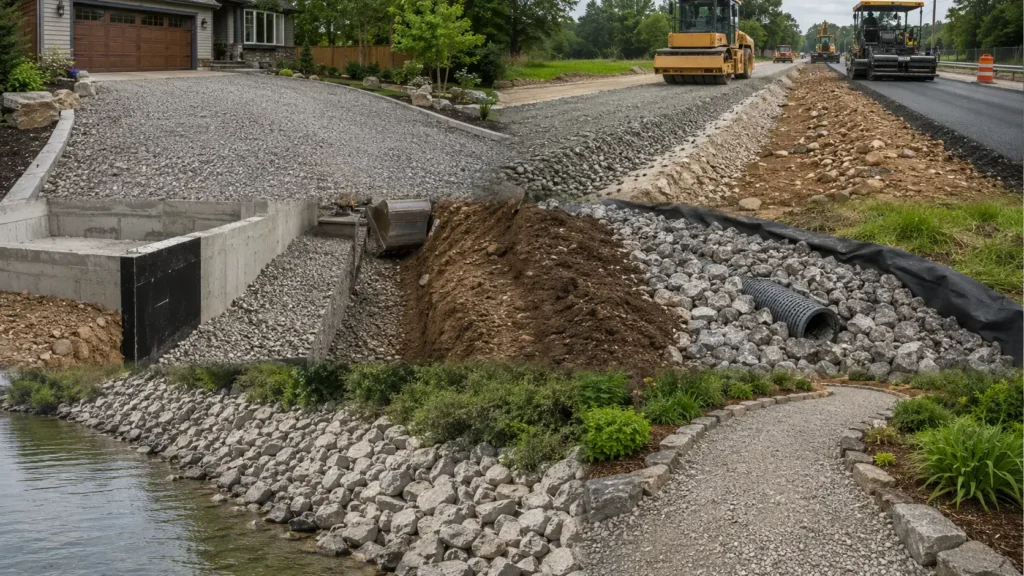
Knowing the pros and cons tells you what crushed concrete can do. Matching it to the right application tells you where it actually earns its keep.
Driveways and Parking Areas
This is crushed concrete’s sweet spot. The 1.5″ minus or ¾” minus grades compact well, drain efficiently, and handle vehicle loads without shifting. A 4–6 inch compacted layer over a prepared subgrade gives most residential driveways 10–20 years of serviceable life with minimal maintenance. Install edging, add a weed barrier underneath, and top up with fresh material every few years as needed.
Road Subbase and Base Layers
Crushed concrete performs reliably as a subbase beneath asphalt or concrete roads. Its interlocking particle shape creates stable load distribution, and its permeability handles subsurface drainage. Many state DOTs specify RCA for this application.
Backfill and Trench Fill
For foundation backfill, utility trench fill, and retaining wall backing, crushed concrete—especially 1.5″ minus to 3″ material—provides structural support and drainage simultaneously. It compacts readily and doesn’t settle the way soil-heavy fill does.
Drainage Layers and Stormwater Systems
The 3″–6″ grade works well as drainage aggregate in French drains, infiltration beds, and around perforated pipe. Water moves through freely, and the weight and mass of the material stabilize the system.
Erosion Control
Larger pieces (3″–6″ and above) placed along slopes, stream edges, and embankments act as effective riprap—absorbing energy from flowing water and protecting underlying soil from erosion.
Landscape Paths (with caution)
Crushed concrete can work for informal garden paths and utility walkways. Keep it away from plant beds, install weed fabric underneath, and monitor pH in adjacent soil if you’re growing acid-sensitive plants.
What to avoid
Direct use as the aggregate in high-strength structural concrete without testing; finished surface material for upscale residential or commercial applications where aesthetics matter; areas adjacent to acid-loving plants without soil monitoring.
How to Get Quality Crushed Concrete — or Make Your Own
Buying from a supplier
Not all crushed concrete is the same quality. When sourcing from a supplier, ask:
- What structures did this material come from? (Demolition debris from commercial concrete is generally cleaner than mixed-source rubble.)
- Has the material been magnetically separated to remove rebar?
- What size grades are available, and has the material been screened?
- Does the supplier offer any contamination testing or certification?
Price alone is a poor guide. Cheap RCA with high contamination causes problems later—poor compaction, surface instability, and potential environmental issues.
Making your own on-site
For contractors who regularly generate waste concrete, on-site crushing is often the smarter financial decision. The equipment required:
- A jaw crusher or impact crusher for primary reduction (jaw crushers handle large, hard concrete slabs well; impact crushers produce a more uniform output)
- A magnetic separator to pull rebar and steel from the output stream
- A screening plant to sort output into usable size grades
Mobile crushing and screening units make it practical to process material directly on demolition sites. You eliminate tipping fees, eliminate the cost of buying aggregate, and maintain full control over material quality because you know exactly what went into it.
Whether purchasing a mobile crusher makes sense depends on your project volume. Contractors running consistent demolition and construction work typically see a return on investment within a year or two. For lower-volume operations, renting equipment per project is a practical alternative.
Conclusion
Crushed concrete earns its reputation as a cost-effective, durable, and genuinely sustainable base material. For contractors, the ability to generate it on-site from demolition waste turns a disposal problem into a free supply of aggregate. For homeowners, it delivers driveway and base layer performance at a fraction of the cost of quarried stone or fresh concrete.
Its limits are real but manageable. Structural applications need virgin aggregate or carefully engineered RCA mixes. Aesthetic projects need something with more visual appeal. Planting areas need monitoring.
Used in the right places, crushed concrete performs and saves money in the process.
Thinking about crushing your own concrete on-site? Talk to our team about mobile jaw crushers and screening equipment sized for your project volume.
FAQ about crushed concrete
How much does a cubic yard of crushed concrete weigh?
A cubic yard of crushed concrete weighs approximately 1.4 to 1.6 tons (2,800–3,200 lbs). It runs slightly lighter than virgin gravel because residual mortar in RCA lowers its overall density.
How much crushed concrete do I need?
Multiply your area’s length × width × depth (all in feet), then divide by 27 to get cubic yards. Multiply that by 1.5 to convert to tons. Always order 10–15% extra to account for compaction loss.
What size crushed concrete should I use under a concrete slab?
Use ¾” minus or 1.5″ minus as your base layer, compacted to 4–6 inches. The angular particles lock together tightly under the slab and handle drainage well.
How much is crushed concrete per ton?
Crushed concrete typically costs $15–$25 per ton in 2026, depending on quality grade and location. Premium screened material runs toward the higher end, while basic RCA with some debris costs less. Delivery adds another $10–$25 per ton.
Can you rent a concrete crusher?
Yes. Most equipment rental companies offer mobile jaw crushers and impact crushers by the day or week. Renting makes sense for one-off projects. If you’re regularly processing demolition concrete across multiple job sites, buying a mobile crusher usually pays for itself within one to two years.
Is crushed concrete toxic?
Generally no. Crushed concrete is not classified as hazardous waste. The main concern is its alkaline pH—residual calcium hydroxide can leach into the surrounding soil and raise pH levels, which affects plant growth nearby. For structural and base layer applications away from vegetation, it poses no health or safety risk.
Can crushed concrete be used as aggregate?
Yes, but with limits. As a base layer aggregate for driveways, roads, and backfill, it performs reliably. As a direct replacement for virgin aggregate in structural concrete mixes, research shows it reduces compressive strength by roughly 20% at full replacement — so high-load structural applications require careful mix design and testing.