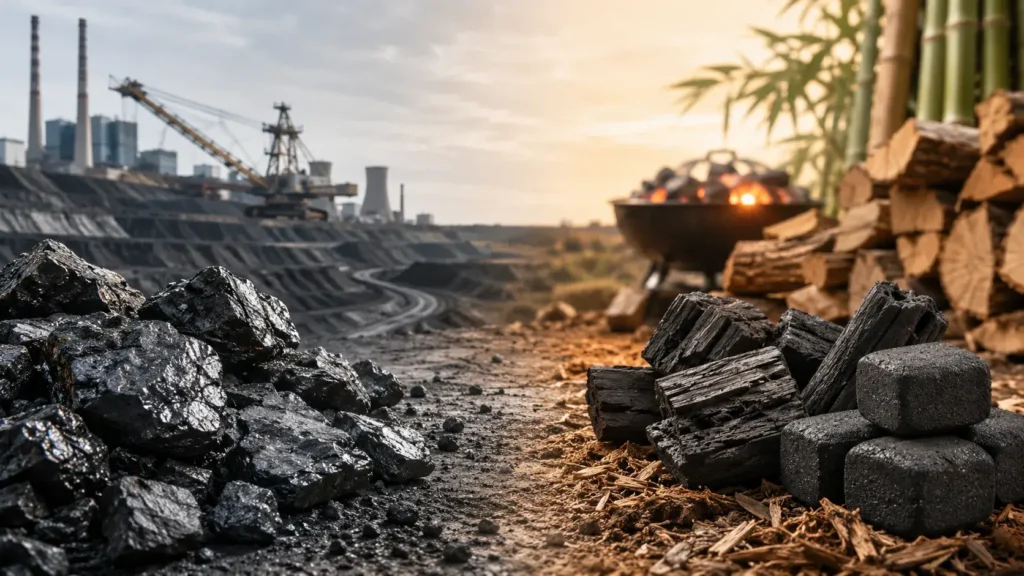
Coal and charcoal are both carbon-rich materials. They are often used as fuels, and their names may sound similar. However, they come from different sources and are produced in very different ways.
Simply put, coal is an ancient fossil “mined” from underground, while charcoal is made by “burning” modern plant materials.
This article explains what coal and charcoal are, how they are obtained, their main types, their applications, and the important differences between them.
| Comparison | Coal | Charcoal |
|---|---|---|
| Source and Formation | A natural fossil fuel formed from ancient plants through geological processes; non-renewable | A manufactured product made by carbonizing modern wood or bamboo at high temperatures; renewable when sustainably sourced |
| Composition and Impurities | Mainly carbon, mixed with mineral impurities such as sulfur, phosphorus, soil, and rock | A relatively clean,carbon-rich material produced through high-temperature carbonization |
| Burning Characteristics | Produces intense heat but may releasepungent and harmful gases, leaving behind hardcoal clinker and ash | Provides steady heat withless smoke and odour, leaving behind lightwood ash |
| Main Applications | Large-scale industrial energy, including thermal power generation, steelmaking, and industrial boilers | Everyday and commercial uses, including barbecuing, tea brewing, heating, and activated carbon production |
What Is Coal?
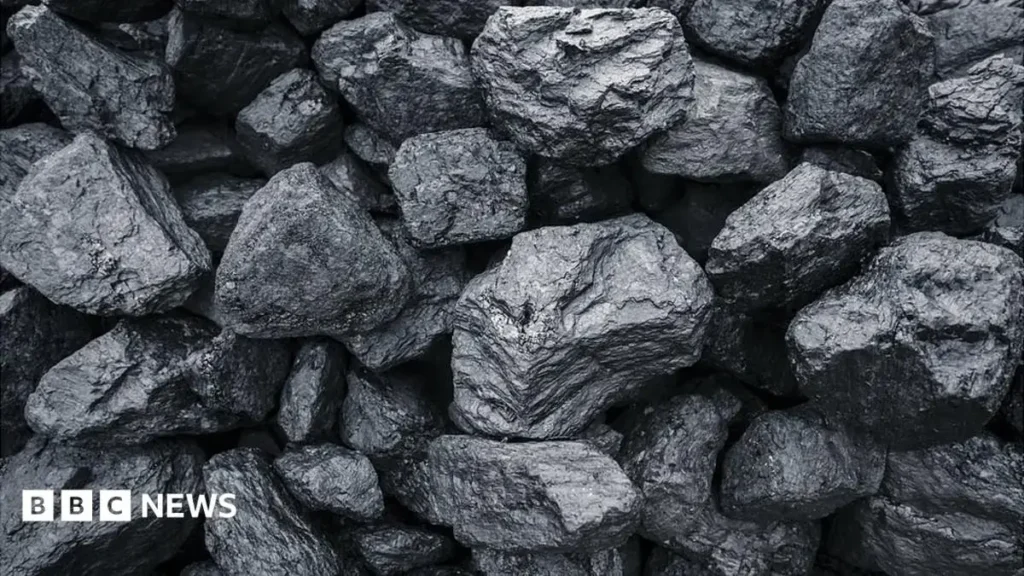
Coal is a naturally occurring sedimentary rock. It contains a high percentage of carbon, along with hydrogen, oxygen, sulfur, nitrogen, and mineral matter.
Coal began as plant material in ancient forests and wetlands. When plants died, they collected in waterlogged environments. Mud and water protected some of this material from complete decay.
Over millions of years, new layers of sediment covered the plant remains. Pressure and heat gradually changed the material into coal. This slow process is called coalification.
The amount of heat, pressure, and time involved determines the rank of the coal. Lower-rank coal contains more moisture and less carbon. Higher-rank coal is generally harder, richer in carbon, and able to release more energy.
Coal is a non-renewable energy source. Once it is extracted and burned, it cannot be replaced within a human timescale.
Applications of Coal
Coal has supported industrial development for centuries. Although many countries are reducing their dependence on it, coal remains important in electricity generation, steelmaking, cement production, and chemical manufacturing.
1. Electricity Generation
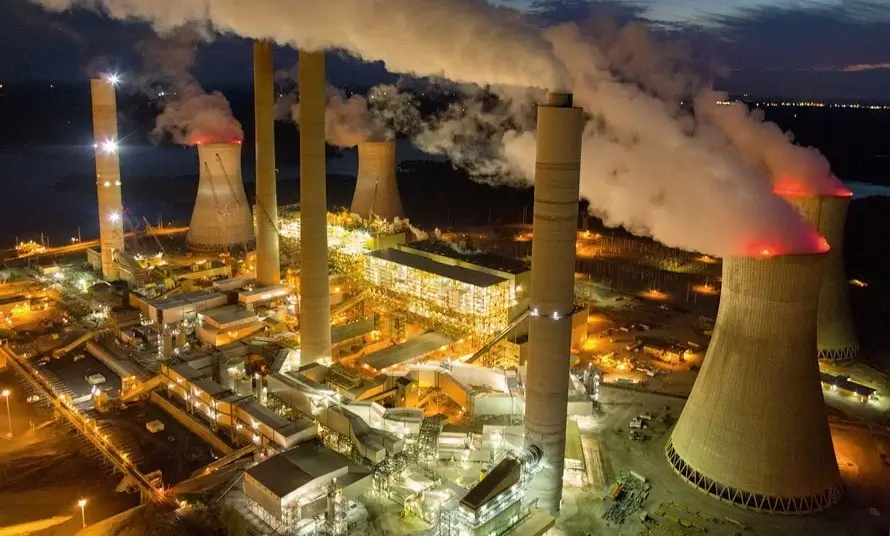
One of the largest uses of coal is power generation.
In a coal-fired power plant, coal is burned to heat water. The water becomes high-pressure steam. This steam drives a turbine, which powers a generator and produces electricity.
Thermal coal is normally used for this purpose. It is also called steam coal.
Coal-fired power plants can provide stable electricity for long periods. However, burning coal releases carbon dioxide, sulfur compounds, nitrogen oxides, fine particles, and other pollutants. Modern plants may use filters, scrubbers, and other systems to reduce these emissions.
2. Steel Production
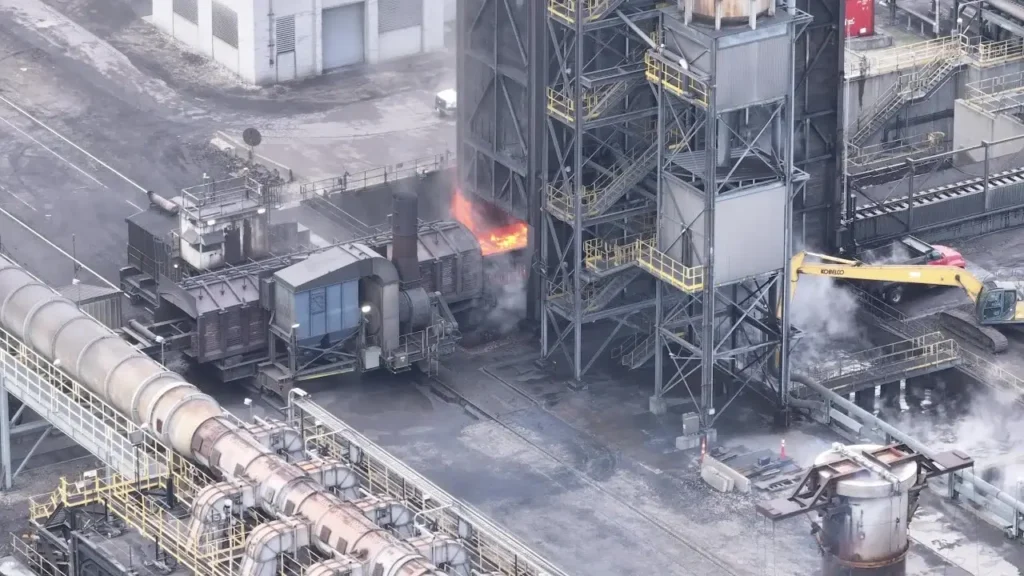
Coal plays an important role in steelmaking.
Certain grades of bituminous coal can be converted into coke. Coke is a hard, porous, carbon-rich material. It is produced by heating coal at high temperatures without enough oxygen for normal combustion.
In a blast furnace, coke performs several functions:
- It provides heat.
- It helps remove oxygen from iron ore.
- It supports the materials inside the furnace.
- It supplies carbon to the ironmaking process.
Not all coal is suitable for coke production. Coal used for this purpose is known as coking coal or metallurgical coal.
3. Cement Manufacturing
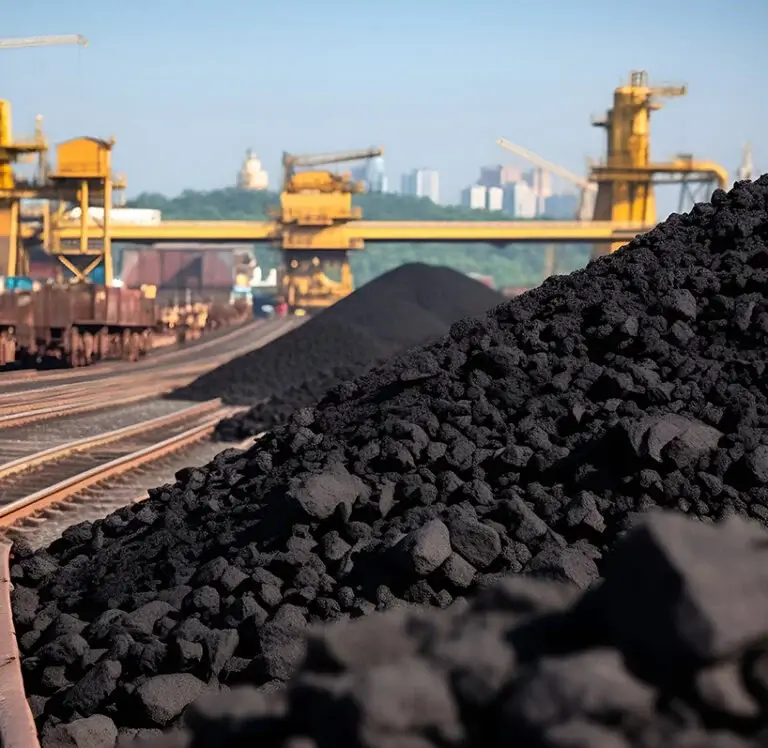
Cement plants require very high temperatures to process limestone and other raw materials.
Coal and petroleum coke are often used as kiln fuels. The heat allows chemical reactions to take place and produces clinker, the main ingredient in cement.
The cement industry is developing alternative fuels, but coal is still used in many production plants.
4. Industrial Heating
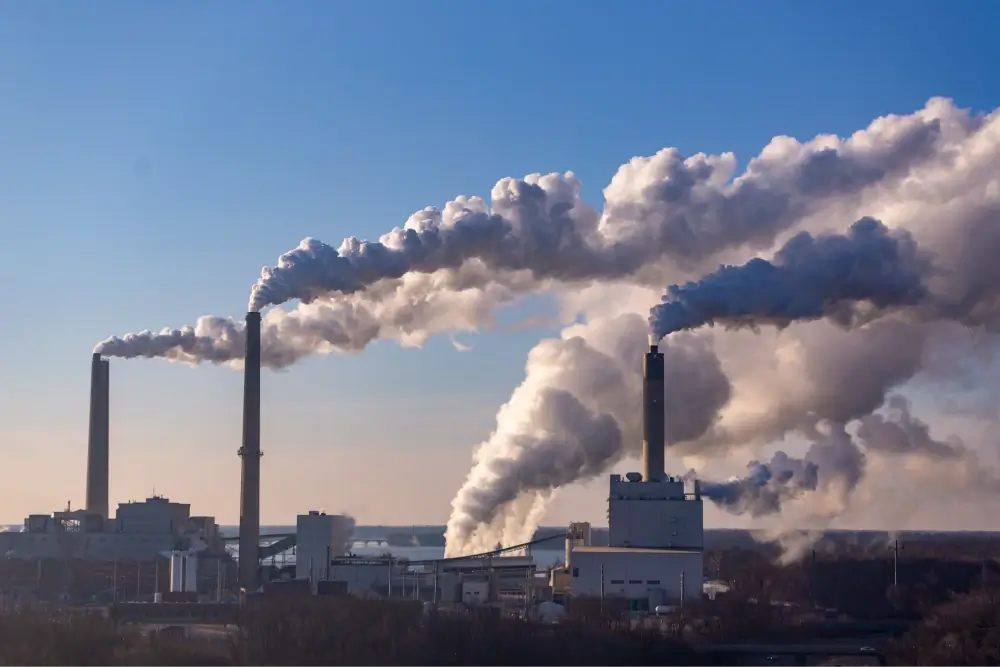
Coal is used in boilers, furnaces, kilns, and other industrial heating systems.
Industries may use coal to produce steam or process heat. Common users include brick factories, paper mills, chemical plants, food-processing facilities, and mineral-processing plants.
The exact coal grade depends on the equipment, required temperature, fuel cost, and local availability.
5. Chemical Production
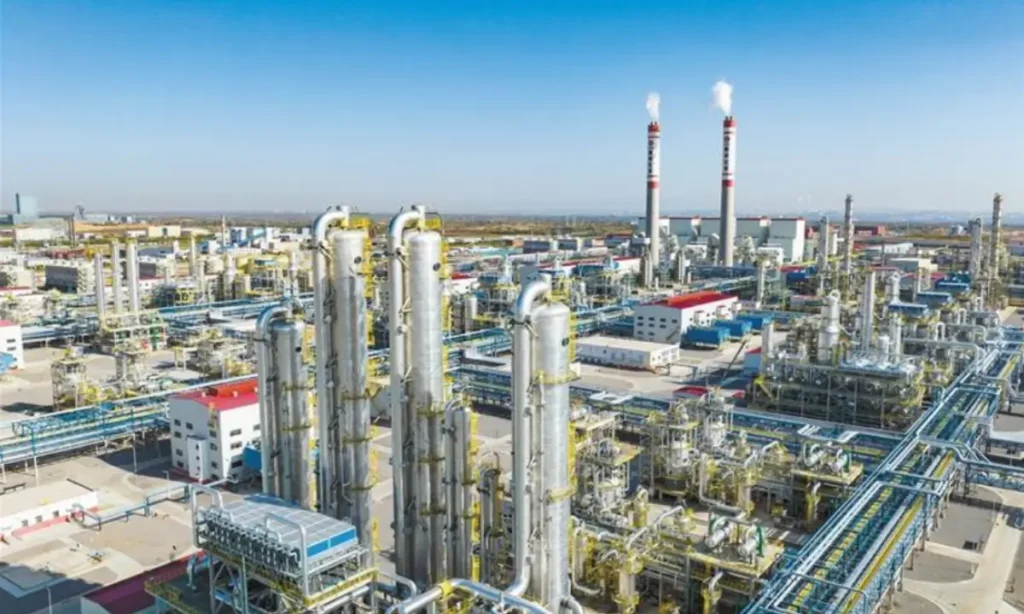
World’s largest coal chemical project starts in Shaanxi – Global Times
Coal is not only a fuel. It can also serve as an industrial raw material.
Through gasification, coal can be converted into synthesis gas, commonly called syngas. Syngas mainly contains carbon monoxide and hydrogen. It can be further processed to produce:
- Methanol
- Ammonia
- Hydrogen
- Synthetic natural gas
- Liquid fuels
- Other industrial chemicals
Coal tar and other by-products from coke production can also be used in chemical manufacturing.
6. Domestic Heating and Cooking
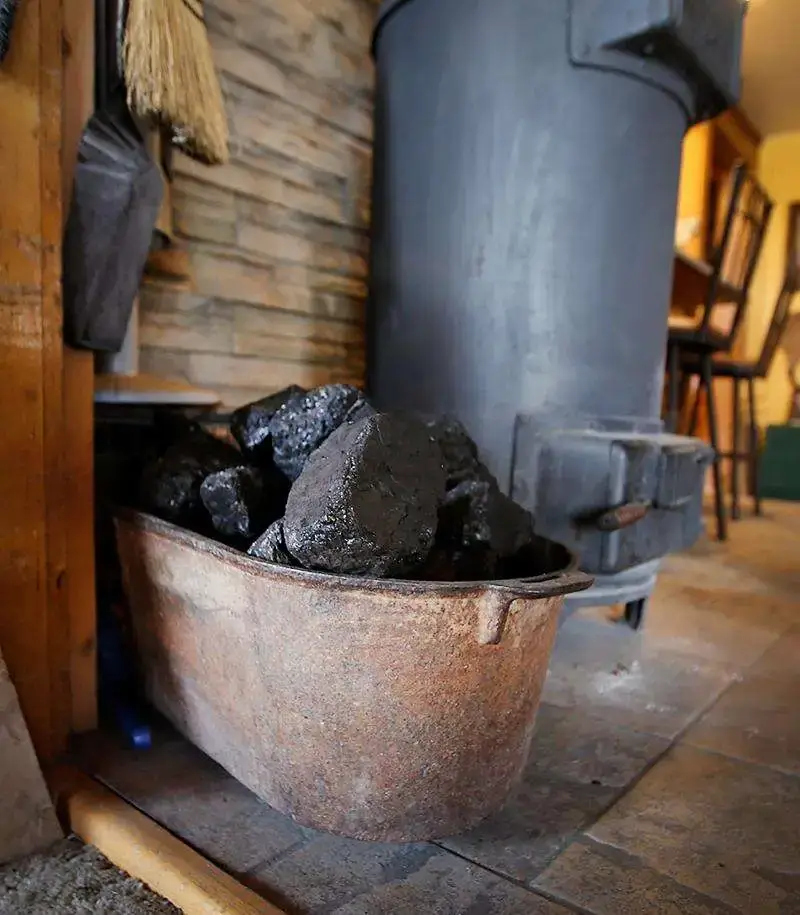
Coal is still used for home heating and cooking in some regions. It may be burned in household stoves, fireplaces, or small boilers.
However, indoor coal burning can create serious health and safety risks. Poor ventilation may lead to smoke exposure or carbon monoxide poisoning. For this reason, many areas have restricted domestic coal use.
Main Types of Coal
Coal is usually classified by rank. Rank describes the degree of coalification and reflects the coal’s carbon content, moisture level, hardness, and heating value.
The four major coal ranks are lignite, sub-bituminous coal, bituminous coal, and anthracite.
1. Lignite
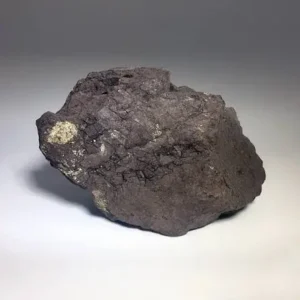
Lignite is the lowest-rankank coal. It is also called brown coal because it often has a brown or dark-brown appearance.
It contains a large amount of moisture and has a relatively low carbon content. Its heating value is lower than that of higher-rank coal.
Lignite is soft and may break easily. Because its high moisture content makes long-distance transport less economical, it is often used in power stations located near the mine.
Main characteristics include:
- Brown to dark-brown colour
- High moisture content
- Low heating value
- Soft and fragile structure
- Mainly used for electricity generation
2. Sub-Bituminous Coal
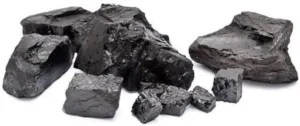
Sub-bituminous coal ranks above lignite and below bituminous coal.
It is usually darker and contains less moisture than lignite. It also has a higher heating value. Many power plants use sub-bituminous coal because it can offer a useful balance between energy output and sulfur content.
Main characteristics include:
- Dark brown to black colour
- Moderate moisture content
- Higher heating value than lignite
- Often lower in sulfur than some bituminous coal
- Mainly used in power generation
3. Bituminous Coal
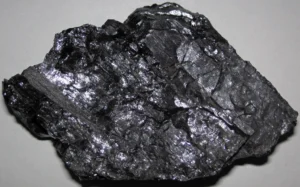
Bituminous coal is one of the most widely used coal types. It is black, relatively dense, and contains more carbon than lignite or sub-bituminous coal.
This coal has a medium-to-high heating value. It is commonly used for electricity generation, industrial heating, cement production, and steelmaking.
Some bituminous coal has the right properties for making coke. These properties include suitable fluidity, strength, and chemical composition.
Main characteristics include:
- Black colour
- Medium-to-high carbon content
- Good heating value
- Wide range of industrial applications
- Certain grades can produce metallurgical coke
4. Anthracite
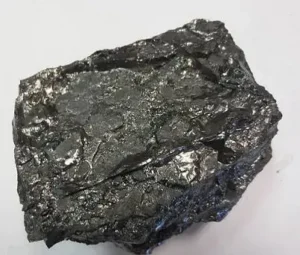
Anthracite is the highest-rank coal. It is hard, shiny, and rich in carbon.
It contains less moisture and volatile matter than other coal ranks. Anthracite burns with a hot flame and produces less smoke than many lower-rank coals. However, it can be more difficult to ignite.
Anthracite is used for heating, selected industrial processes, filtration media, and some metallurgical applications.
Main characteristics include:
- Hard and glossy appearance
- High fixed-carbon content
- Low volatile matter
- High heating value
- Cleaner-burning than many other coal types
Other Ways to Classify Coal
Coal can also be classified according to its intended use.
Thermal Coal
Thermal coal is burned to generate heat or electricity. Sub-bituminous and bituminous coal are commonly used as thermal coal.
Coking Coal
Coking coal is processed into coke for steel production. It must have specific physical and chemical properties. Ordinary thermal coal cannot always be used as a replacement.
Pulverized Coal Injection Coal
Pulverized coal injection, or PCI, coal is finely ground and injected into a blast furnace. It can replace part of the coke required during iron production.
How Is Coal Mined?
Coal mining is the process of extracting coal from underground deposits. The mining method depends on the depth, thickness, shape, location, and geology of the coal seam.
The two main approaches are surface mining and underground mining.
Surface Coal Mining
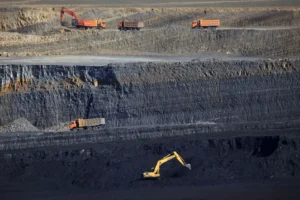
Surface mining is used when coal seams are relatively close to the ground.
Before the coal can be removed, workers clear the site and remove the upper layers of soil and rock. This covering material is known as overburden.
After the coal seam is exposed, excavators, draglines, loaders, and trucks remove and transport the coal.
Common Surface-Mining Methods
Open-Pit Mining
Open-pit mining creates a large excavation with a series of benches or steps. It is suitable for wide coal deposits near the surface.
Strip Mining
In strip mining, long strips of soil and rock are removed to expose the coal seam. After one strip has been mined, material from the next strip may be used to fill the previous excavation.
Mountaintop Removal
This method removes rock from the top of a mountain or ridge to reach coal seams underneath. It can produce major changes to the landscape and is highly controversial because of its environmental impact.
Advantages of Surface Mining
Surface mining usually offers several operational advantages:
- Higher coal recovery
- Lower production costs
- Easier use of large machinery
- Simpler access to the coal seam
- Lower underground safety risks
However, it can disturb large areas of land. Dust, noise, water pollution, soil loss, and habitat damage must be carefully managed.
Underground Coal Mining
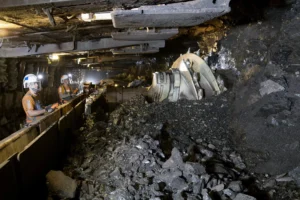
Underground mining is used when coal deposits are too deep for economical surface extraction.
Workers and equipment reach the coal through shafts, slopes, or tunnels. Ventilation systems supply fresh air and remove methane, coal dust, heat, and exhaust gases.
Underground mining is more complex than surface mining. It also presents risks such as roof collapse, fire, explosion, flooding, dust exposure, and equipment accidents.
Common Underground-Mining Methods
Room-and-Pillar Mining
In room-and-pillar mining, miners extract coal from a network of underground rooms. Sections of coal are left in place as pillars to support the mine roof.
Some pillars may later be removed during retreat mining. This allows more coal to be recovered, but it requires strict control of roof stability.
Longwall Mining
Longwall mining uses powered cutting equipment to remove coal along a long working face.
Hydraulic supports hold up the roof near the cutting machine. As the equipment moves forward, the roof behind the supports is allowed to collapse in a controlled way.
Longwall mining can achieve high production rates. It also requires large investments and careful geological planning.
Coal Processing After Mining
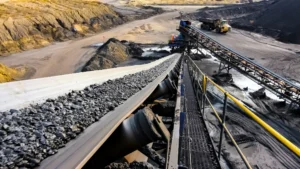
Freshly mined coal often contains rock, soil, sulfur-bearing minerals, and other impurities. It may need to be processed before being sold.
Typical processing steps include:
- Crushing: Large pieces are reduced to a suitable size.
- Screening: Coal is separated into different size ranges.
- Washing: Differences in density are used to remove rock and mineral matter.
- Dewatering: Excess water is removed after washing.
- Blending: Different coal grades are mixed to meet customer requirements.
- Storage and transport: The finished coal is stored and then moved by truck, railway, barge, or ship.
Coal preparation can improve fuel quality and reduce ash. It cannot remove every pollutant, but it may make the coal more suitable for a particular application.
What Is Charcoal?
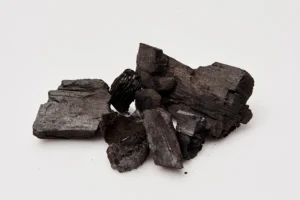
Charcoal is a lightweight, carbon-rich material made from biomass.
Wood is the most common raw material. Bamboo, coconut shells, nut shells, agricultural waste, and other plant materials can also be used.
Charcoal does not form naturally underground like coal. It is produced by heating biomass in an environment with little or no oxygen. This process removes much of the water and volatile matter from the raw material.
The remaining solid contains a high proportion of carbon. It is easier to transport than fresh wood and can burn at a higher, more stable temperature.
Charcoal production can take a few hours or several days. The time depends on the raw material, equipment, temperature, and required product quality.
Applications of Charcoal
Charcoal has many household, commercial, industrial, and environmental uses.
1. Cooking and Barbecuing
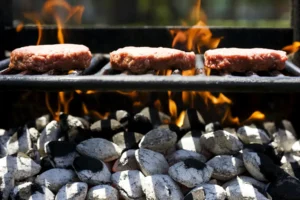
Cooking is one of the best-known applications of charcoal.
Lump charcoal and charcoal briquettes are commonly used in grills, ovens, and traditional cooking stoves. Once they are fully lit, they can provide steady heat for a long period.
Lump charcoal can reach high temperatures quickly. Briquettes usually offer a more even shape and a predictable burn.
Only charcoal made and approved for cooking should be used with food. Treated wood, painted wood, or charcoal containing unsuitable additives may release harmful substances.
2. Household Heating
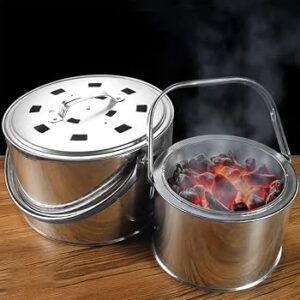
Charcoal is used for heating in homes, workshops, restaurants, and small businesses.
It is compact and easy to store. It also produces less visible smoke than raw firewood when properly carbonized.
However, burning charcoal indoors is dangerous without suitable ventilation. Charcoal produces carbon monoxide, which has no colour or smell. Exposure can cause severe poisoning or death.
3. Metallurgy and Metalworking
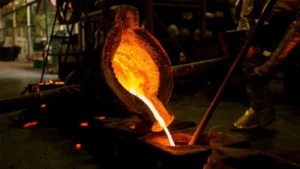
Charcoal has a long history in metal production.
Before coke became widely available, charcoal was a major fuel for smelting iron. It provided both heat and carbon. Blacksmiths also used it in forges.
Today, charcoal is still used in selected metallurgical operations. In some countries, renewable charcoal is used in pig iron, silicon, and ferroalloy production.
4. Activated Carbon Production
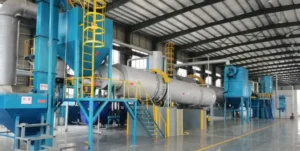
Activated Carbon Production Line
Charcoal can be processed further to make activated carbon, also called activated charcoal.
toDuring activation, the charcoal develops a large internal surface area and a network of tiny pores. These pores can trap certain gases, odours, colours, and dissolved substances through adsorption.
Activated carbon is used in:
- Drinking-water filters
- Wastewater treatment
- Air-purification systems
- Industrial gas treatment
- Food and beverage processing
- Gold recovery
- Chemical purification
- Certain medical treatments
Activated carbon is not the same as ordinary barbecue charcoal. The two products are manufactured and tested for different purposes.
5. Agriculture and Soil Improvement
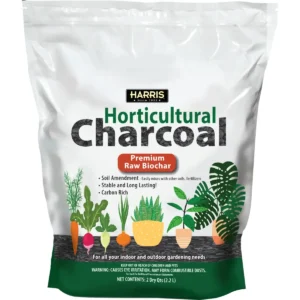
A specially produced form of charcoal called biochar can be added to soil.
Biochar may help improve soil structure, water retention, and nutrient management. Its effect depends on the feedstock, production temperature, soil conditions, climate, and application method.
Biochar can also store stable carbon in the soil. For this reason, it is being studied as a tool for carbon management and sustainable agriculture.
6. Art and Drawing
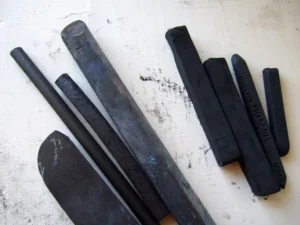
Artists use charcoal to create sketches and finished drawings.
Drawing charcoal may be made from willow, vine, or compressed charcoal powder. It creates deep black marks and can produce both soft shading and strong lines.
Artist charcoal is different from fuel charcoal. It is manufactured to provide a consistent texture and drawing quality.
7. Odour and Moisture Control

Some charcoal products are used to absorb odours or help manage moisture in enclosed spaces.
They may be placed in wardrobes, shoes, vehicles, refrigerators, or rooms. Bamboo charcoal is commonly marketed for this purpose.
Actual performance depends on the charcoal’s pore structure, surface area, quantity, and exposure conditions.
Main Types of Charcoal
Charcoal can be classified by its raw material, shape, manufacturing method, and final application.
1. Lump Charcoal
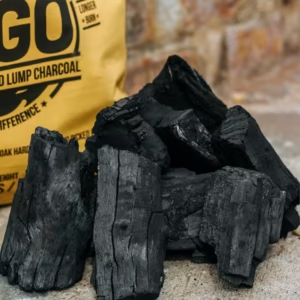
Lump charcoal is made by carbonizing pieces of natural wood.
It retains much of the original shape and grain of the wood. The pieces are irregular in size and may burn at different rates.
Lump charcoal usually lights quickly and reaches a high temperature. It also contains fewer binders than most briquettes.
Common uses include:
- Barbecue cooking
- Restaurant grilling
- Traditional ovens
- Blacksmithing
- Small-scale industrial heating
2. Charcoal Briquettes
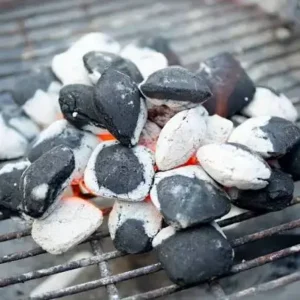
Charcoal briquettes are manufactured from charcoal powder or small charcoal particles.
The material is mixed with a binder and compressed into uniform shapes. Depending on the product, other ingredients may be added to control ignition, ash formation, or burning speed.
Briquettes normally burn more evenly than lump charcoal. Their regular size also makes them easier to package, store, and transport.
Common shapes include:
- Pillow-shaped briquettes
- Hexagonal briquettes
- Cube briquettes
- Round briquettes
- Rod-shaped briquettes
3. Hardwood Charcoal
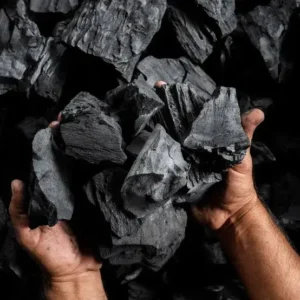
Hardwood charcoal is made from dense wood species such as oak, beech, maple, or fruitwood.
It is often valued for its long burn time and high temperature. It is widely used for grilling, restaurants, and selected industrial processes.
Its exact performance depends on the wood species and the carbonization process.
4. Bamboo Charcoal

Bamboo charcoal is produced from bamboo stems, branches, or processing waste.
Bamboo grows quickly, which makes it an attractive charcoal feedstock in suitable regions. The finished material can be used as fuel or processed into products for filtration, odour control, humidity management, and soil improvement.
5. Coconut-Shell Charcoal
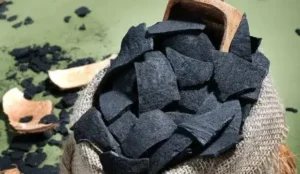
Coconut-shell charcoal is produced from discarded coconut shells.
It is hard, dense, and usually has a low ash content. It can burn for a long time. Coconut-shell charcoal is commonly used to make barbecue briquettes, hookah charcoal, and activated carbon.
Its use also creates value from an agricultural by-product.
6. Activated Charcoal
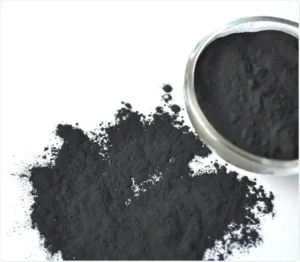
Activated charcoal has been treated to create a highly porous structure.
It may be produced from wood, coconut shells, coal, peat, or other carbon-rich materials. Activation is usually carried out with steam, carbon dioxide, or selected chemicals.
Activated charcoal is mainly used for adsorption and purification. It is not normally intended as a cooking fuel.
7. Biochar
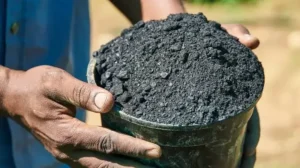
Biochar is charcoal produced mainly for soil application and environmental management.
The manufacturing process is controlled to create a stable carbon-rich material. Good-quality biochar should also be tested for unwanted contaminants before agricultural use.
8. Extruded Charcoal
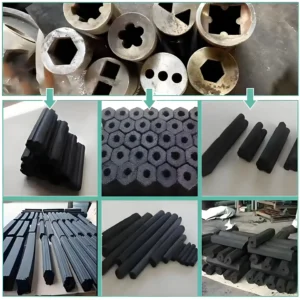
Extruded charcoal is made by compressing ground biomass or charcoal powder into logs, rods, or hexagonal shapes.
Some products are formed from raw biomass and then carbonized. Others are made by compressing material that has already been carbonized.
Extruded charcoal often has a central hole. This improves airflow and helps the product burn evenly.
How Is Charcoal Produced?
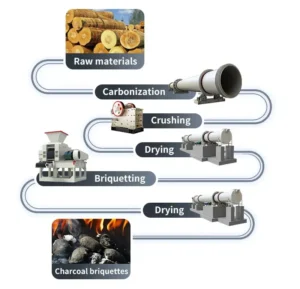
Charcoal is made through carbonization, which is a form of pyrolysis.
During this process, biomass is heated with a limited supply of oxygen. The material does not burn completely. Instead, heat breaks it down into charcoal, gases, vapours, tar, and other liquids.
The basic production process includes several stages.
1. Raw Material Selection
The producer selects a suitable feedstock.
Common options include:
- Hardwood
- Softwood
- Bamboo
- Coconut shells
- Nut shells
- Sawdust
- Wood chips
- Agricultural residues
The feedstock affects the charcoal’s density, ash content, strength, pore structure, burning time, and final use.
Clean raw material is essential. Painted, chemically treated, or contaminated wood should not be used for cooking charcoal.
2. Drying
Fresh biomass contains water. Too much moisture slows the process and increases energy consumption.
The raw material is therefore air-dried or mechanically dried before carbonization. A consistent moisture level can improve production efficiency and product quality.
3. Heating
The dried material is placed in a kiln, retort, furnace, or carbonization chamber.
It is then heated while oxygen is restricted. Some systems burn part of the wood to supply heat. Modern systems may collect and reuse the gases released during carbonization.
4. Carbonization
As the temperature rises, water and volatile compounds leave the biomass.
The material gradually becomes darker and richer in carbon. Process temperature has a strong effect on the final product. Higher temperatures generally reduce volatile matter and increase fixed-carbon content.
Careful temperature control is important. If too much oxygen enters the chamber, the material may burn into ash instead of becoming charcoal.
5. Cooling
Fresh charcoal remains extremely hot and may ignite when exposed to air.
It must be cooled in a sealed or controlled environment. This stage cannot be rushed. Improper cooling may cause fires and reduce the final yield.
6. Crushing, Screening, and Shaping
Lump charcoal may be screened and divided into different sizes.
To produce briquettes, smaller charcoal pieces and powder are crushed, mixed with a binder, and compressed. The formed briquettes are then dried before packaging.
7. Quality Inspection and Packaging
Finished charcoal may be tested for:
- Moisture
- Fixed carbon
- Volatile matter
- Ash content
- Calorific value
- Density
- Mechanical strength
- Burning time
- Size distribution
The required specifications depend on whether the charcoal will be used for cooking, heating, metallurgy, filtration, or agriculture.
Common Charcoal-Production Systems
Different technologies offer different levels of control, efficiency, and environmental performance.
Traditional Earth Kilns
Wood is stacked and covered with soil before being slowly carbonized.
This method requires little equipment, but it is difficult to control. It may produce heavy smoke, uneven charcoal, and a low product yield.
Brick Kilns
Brick kilns offer better control and can be used repeatedly. They are common in commercial charcoal production.
Their efficiency depends on the kiln design, operator experience, airflow, and heat management.
Metal Kilns
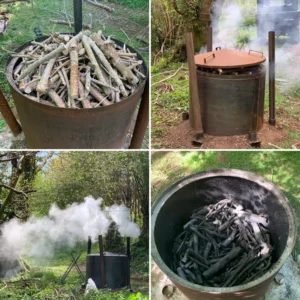
Portable metal kilns can be moved close to the raw-material source. They are faster than many traditional systems and provide better control.
Their capacity may be lower than that of large fixed installations.
Retort Systems
Retorts heat the biomass inside a controlled chamber.
Modern retorts can recover or burn the released gases to supply part of the required heat. This can improve efficiency and reduce smoke. They also provide more consistent charcoal quality.
Coal vs. Charcoal: What Is the Difference?
Coal and charcoal are both rich in carbon, but they should not be treated as the same material. Their key differences can be explained through the following points.
1. Source
Coal comes from ancient plant matter buried underground.
Charcoal comes from modern biomass such as wood, bamboo, coconut shells, or agricultural residues.
Coal is mined. Charcoal is manufactured.
2. Formation Process
Coal forms naturally through heat, pressure, and geological change. The process takes millions of years.
Charcoal is produced by heating biomass in a low-oxygen environment. Depending on the equipment, production may take a few hours or several days.
3. Renewability
Coal is a non-renewable fossil resource. Its reserves are limited.
Charcoal can be renewable when it is made from responsibly managed forests, fast-growing bamboo, or agricultural waste. It is not automatically sustainable. Charcoal production can still contribute to deforestation if the raw material is poorly sourced.
4. Physical Appearance
Coal is usually a dense rock. Its colour may range from brown to glossy black.
Charcoal is generally lighter and more porous. Wood charcoal often retains the visible structure of the original wood.
5. Carbon and Moisture Content
Coal quality varies greatly by rank. Lignite contains high moisture, while anthracite contains more fixed carbon.
Properly produced charcoal has much less moisture and volatile matter than raw wood. Its exact carbon content depends on the feedstock and carbonization temperature.
There is no single rule stating that all charcoal contains more carbon than all coal. The result depends on the specific coal rank and charcoal grade.
6. Ignition and Burning Behaviour
Charcoal is usually easier to ignite than anthracite and some other high-rank coals. It can provide a clean, steady heat once fully lit.
Coal-burning behaviour varies by type. Some coal produces more smoke, sulfur emissions, ash, and soot. Higher-rank coal generally burns differently from lignite or sub-bituminous coal.
Both fuels can produce carbon monoxide. Neither should be burned in an enclosed space without proper ventilation.
7. Ash and Sulfur
Coal often contains more mineral matter and sulfur than wood charcoal. These materials remain as ash or form emissions during combustion.
High-quality charcoal can have relatively low ash and sulfur levels. The actual result depends on the feedstock, soil contamination, additives, and production process.
Charcoal briquettes may produce more ash than natural lump charcoal if mineral fillers are added.
8. Main Applications
Coal is mainly used for:
- Electricity generation
- Steel production
- Cement manufacturing
- Industrial boilers
- Chemical production
Charcoal is mainly used for:
- Barbecuing and cooking
- Small-scale heating
- Metalworking
- Activated carbon production
- Soil improvement
- Art materials
Their applications may overlap, but they are not always interchangeable.
9. Environmental Impact
Coal mining can disturb land, affect water systems, create dust, and release methane. Burning coal also produces substantial carbon dioxide and air pollutants.
Charcoal can have a smaller fossil-carbon impact when it comes from sustainable biomass. However, inefficient kilns may release smoke, methane, carbon monoxide, and other gases. Unsustainable harvesting can also damage forests and local ecosystems.
The environmental performance of charcoal depends heavily on where the biomass comes from and how it is produced.
10. Storage and Safety
Coal piles can generate dust and may heat up through oxidation. Large stockpiles require careful temperature, moisture, and fire management.
Charcoal is also capable of self-heating, especially when it is fresh, warm, or poorly ventilated. It must be fully cooled before storage and transport.
Both materials should be kept dry and away from ignition sources.
Quick Comparison Table
| Feature | Coal | Charcoal |
|---|---|---|
| Basic material | Natural carbon-rich rock | Carbonized biomass |
| Main source | Ancient buried vegetation | Wood, bamboo, shells, or plant waste |
| How it is obtained | Extracted by mining | Produced through carbonization |
| Formation time | Millions of years | Hours or days |
| Renewability | Non-renewable | Potentially renewable |
| Weight and structure | Usually dense and rock-like | Usually light and porous |
| Main types | Lignite, sub-bituminous, bituminous, anthracite | Lump, briquette, bamboo, coconut-shell, activated charcoal, biochar |
| Major uses | Power, steel, cement, chemicals | Cooking, heating, purification, agriculture, metalworking |
| Common concern | Mining damage and fossil carbon emissions | Deforestation and inefficient production |
| Indoor safety | Can produce carbon monoxide | Can produce carbon monoxide |
Conclusion
Coal and charcoal share one important feature: both contain a large amount of carbon. Beyond that, they are very different materials.
Coal is a fossil fuel formed underground over millions of years. It is extracted through surface or underground mining. Its major applications include power generation, steelmaking, cement production, and industrial heating.
Charcoal is manufactured from wood and other plant materials. It is produced by carbonization under limited oxygen. Its uses range from cooking and metalworking to water treatment and soil improvement.
The choice between coal and charcoal depends on the application. Fuel quality, cost, availability, emissions, safety, and raw-material sourcing must all be considered. Most importantly, the words should not be used as if they describe the same product.