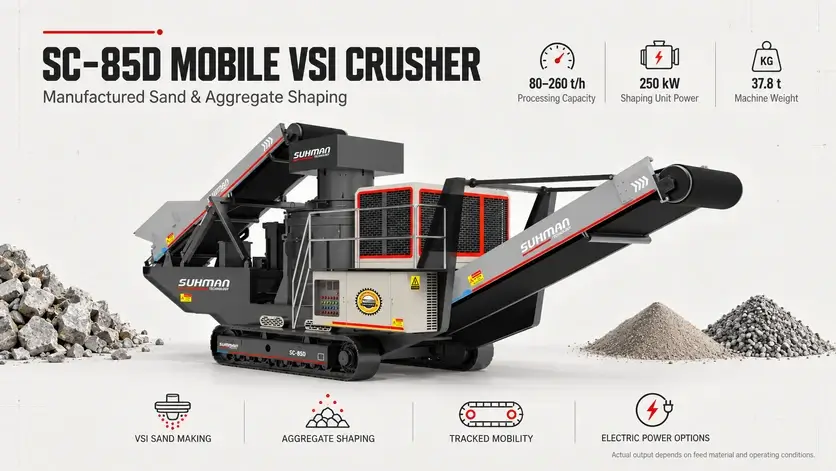
SC-85D is a crawler-mounted mobile VSI sand-making machine with 80–260 t/h capacity.
What Is a Mobile VSI Crusher?
A mobile VSI crusher combines a vertical shaft impact crusher with a tracked or wheeled platform. It is commonly used in the final stages of aggregate processing to improve particle shape and produce manufactured sand. Its mobile configuration allows the crushing stage to be repositioned as site requirements change. Metso LT7150 overview
How Does a Mobile VSI Crusher Work?
Material enters a rapidly rotating rotor, accelerates outward and strikes a surrounding material bed or impact surfaces. These impacts break and shape the particles. Depending on the machine configuration, rotor speed and the distribution of material through or around the rotor help control the resulting product. Metso Barmac VSI operating principle
What Are the Main Applications?
Mobile VSI crushers are commonly used for:
- Producing manufactured sand from previously crushed rock.
- Improving aggregate shape for concrete and asphalt.
- Further processing selected quarry fractions into finer products.
They generally operate as part of a crushing and screening circuit, with the configuration selected around the feed material and required finished product. SUHMAN VSI applications
SC-85D: Technical Configuration and Processing Capability
O Máquina móvel de fabricação de areia SC-85D com injeção vertical combines a crawler-mounted platform with a dedicated VSI processing unit. SUHMAN lists a processing capacity of 80–260 t/h, a 250 kW shaping unit, and a total machine weight of 37.8 tonnes. These specifications position it as a candidate for mobile aggregate-shaping and sand-production projects within its published operating range. SC-85D product specifications
Its practical value lies in adding a finishing stage to an existing operation. Producers can evaluate the machine for improving aggregate shape, generating manufactured sand or combining both objectives within a planned production circuit.
The published description identifies rock-on-rock and rock-on-steel arrangements, together with central and peripheral feeding options. These provide relevant configuration choices when matching the equipment to different materials and processing requirements. SC-85D working principle
In VSI processing, the selected operating conditions influence the balance between shaping, size reduction, and fines generation. Metso’s application guidance notes that lower rotor speed and increased cascade feeding generally produce a coarser product. Closed-circuit operation can provide additional reduction, while increasing circulating load and potentially generating more ultrafines. These relationships offer a useful framework for configuring and testing an SC-85D production circuit. Metso manufactured-sand application guide
Crawler Mobility and Flexible Site Deployment
One of the SC-85D’s strongest practical attributes is its crawler-mounted configuration. For a quarry with changing stockpile locations or temporary processing areas, a mobile finishing stage offers greater freedom in arranging the production site.
From a site-planning perspective, repositioning the machine closer to a suitable feed stockpile may reduce loader travel. It also allows operators to adapt the relationship between crushing equipment, screening units and finished-product stockpiles as production requirements change.
This configuration is particularly relevant to operations already using mobile primary and secondary crushers. A tracked VSI can extend the process to include shaping and sand making while preserving flexibility in plant layout. SUHMAN identifies the SC-85D for this final-stage role alongside other crushing equipment. SUHMAN mobile VSI integration
The benefit depends on the overall site arrangement, including conveyor connections and power supply, but crawler mobility gives operators an additional option when planning the finishing stage.
Electric Power Options and Operational Flexibility
SUHMAN lists external electric supply and a diesel-generator option for the SC-85D. This allows buyers to evaluate grid-powered operation where electricity is available or generator supply for projects with limited grid access. Automatic starting and remote-control functions are also described. SC-85D power and control options
The practical advantage is adaptability across different working environments. An established quarry can assess the machine against its electrical infrastructure, while a temporary project can specify a suitable generator package.
Power-source selection also creates an opportunity to match the operating arrangement to local energy costs. Actual savings depend on electricity tariffs, fuel prices, generator efficiency, and production load. The equipment’s power options support that evaluation without requiring every project to use the same supply arrangement.
Comparison with Metso LT7150 and Sandvik UV312
O Metso Lokotrack LT7150 e Sandvik UV312 provide useful technical reference points. The LT7150 shares the tracked VSI concept, while the UV312 offers a similar published upper capacity in a wheeled crushing-and-screening configuration.
| Parâmetro | SUHMAN SC-85D | Metso Lokotrack LT7150 | Sandvik UV312 |
|---|---|---|---|
| Mobile platform | Crawler-mounted | Tracked | Wheeled trailer |
| Crushing unit | SK2400-D-SS | Barmac B7150M | CV218 VSI |
| Published processing capacity | 80–260 t/h | Not stated in the cited leaflet | Up to 250 metric t/h |
| Crusher-unit power or drive | 250 kW listed | Hydraulic drive; separate crusher power not stated | 220 kW electric motor |
| Power arrangement | External electricity or diesel-generator option | Diesel engine with hydraulic crusher drive | Elétrico |
| Published machine weight | 37,8 t | 30.0 t | 31.5 t |
| Screening arrangement | Can be paired with mobile screening equipment | Separate mobile screens shown as compatible equipment | Integrated screening |
The comparison uses the SC-85D specifications, Metso’s 2023 LT7150 leaflet e Sandvik’s 2022 UV312 technical sheet. Figures describe published configurations, not results from a common performance test.
The SC-85D offers a useful combination of tracked mobility, electric supply options and dedicated VSI processing. Its published capacity range overlaps the upper production range represented by the UV312, while its mobile-platform arrangement is closer to the LT7150.
The comparison also reveals different configuration priorities. Metso documents adjustable rotor speed and integrated process controls for the LT7150. Sandvik combines VSI crushing and screening on the UV312’s trailer frame. These features make both machines useful references when assessing the equipment and controls required for a particular production duty. Metso LT7150 controls, Sandvik UV312 configuration
For the SC-85D, the opportunity to pair the crusher with separate mobile screening equipment allows the screening stage to be selected around the wider circuit. This can be valuable where a producer already owns suitable screening equipment or requires a particular product-separation arrangement.
The small difference between the published maximum capacities of 260 and 250 t/h should not be treated as a performance ranking. Feed conditions, product requirements and circuit configuration determine the meaningful comparison.
Integrating the SC-85D into a Sand-Production Circuit
A practical application places the SC-85D after an existing crushing stage, followed by screening to separate the required products. Where further reduction is necessary, oversize material can be returned for additional processing.
Classification may also be appropriate when the finished sand requires tighter control of fine particles. Metso’s sand-production guidance illustrates how VSI crushing, screening and classification can work together to achieve the required product characteristics. Manufactured-sand processing technologies
For an existing aggregate producer, this creates several possible uses: improving the shape of a selected aggregate fraction, developing a manufactured-sand product or combining the two within one circuit. The appropriate arrangement depends on the material available and the products the operation intends to sell.
Evaluating Production Performance
The most useful performance indicators are saleable output, product quality and operating cost under representative conditions. For electrically powered production:
Specific energy consumption = measured electricity use ÷ tonnes of saleable product
This connects energy use directly to production value and provides a more useful comparison than motor ratings alone. Product grading, particle shape, wear-part consumption and maintenance time should be evaluated over the same operating period.
A few specification details should be confirmed during selection. SUHMAN publishes both 50 mm and 100 mm feed-size figures, so the applicable limit should be established for the supplied configuration. Published throughput should also be distinguished from the yield of a particular finished-sand fraction. SUHMAN specification comparison
For projects requiring an adaptable finishing stage, the SC-85D deserves consideration for its combination of crawler mobility, electric power choices and VSI shaping capability. Matching those features to the actual feed material, required grading and site layout provides a practical basis for developing a mobile sand-production system.