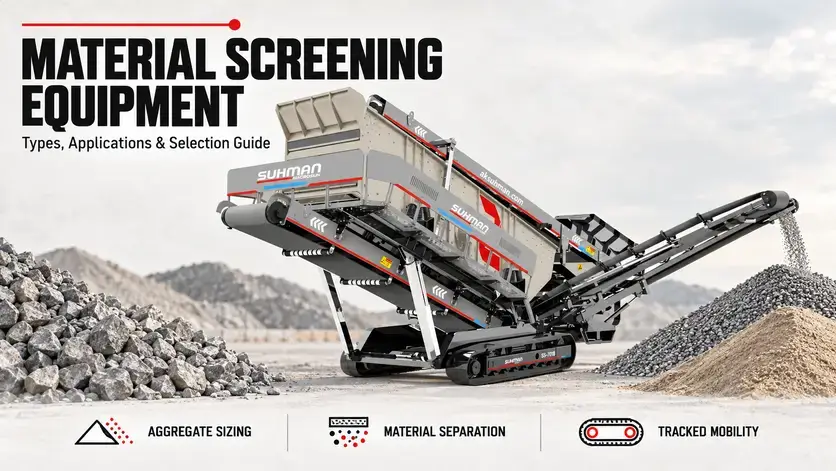
A screening plant can move plenty of material and still leave you with stockpiles that fail the customer’s specification. Before comparing machines, define the material going in, the products you need, and the quantity of each product you expect to sell.
This guide explains how to choose material screening equipment for aggregate production and recycling. It covers the main machine types, common screening duties, operating conditions, and the information needed for a useful supplier proposal.
The starting point is simple: choose equipment around a defined separation task, then assess its capacity under those conditions.
What Is Material Screening Equipment?
Material screening equipment separates bulk material into size fractions. Smaller particles pass through openings in a screening surface, while larger particles continue toward a separate discharge. Vibration or rotation helps expose the material to those openings. McLanahan’s screening and sizing overview explains this basic process.
A crusher reduces particle size. A screen sorts the resulting material, or separates an incoming feed before it reaches the crusher. Both machines can work together in the same production line.
Screening also has a role in recycling, where separating a mixed feed into size bands can support later sorting stages. Metals, wood, and plastic may still require dedicated separation equipment. AEI describes these combined processes in its mechanical screening guide.
When comparing options, distinguish three things: the screening mechanism, the job it performs, and how the plant is installed. A vibrating screen, for example, can perform product sizing on a mobile or stationary plant.
Main Types of Material Screening Equipment
Cribas vibratorias
Vibrating screens move material across one or more decks. Inclined designs combine deck slope with vibration; horizontal designs use their motion to move material along a flatter screening surface. Both deserve consideration for aggregate sizing, with the final choice depending on the application and installation.
Trommel and disc screens use different mechanisms, summarized below. For a broader comparison of these operating principles, see AEI’s screening equipment guide.
| Equipment type | How it separates material | What to investigate before buying |
|---|---|---|
| Criba vibratoria | Material travels over vibrating screen decks | Required cuts, feed distribution, usable deck area, and media access |
| criba rotativa | Material tumbles through a rotating drum with openings | Whether a drum trial achieves the required separation with the actual feed |
| Disc screen | Rotating discs move material across gaps in the screening surface | Suitability for the feed’s shape, size range, and contaminants |
| Flexible-mat screen | Screen mats flex during operation to help keep openings clear | Performance with the site’s wet, sticky, or difficult fine material |
Flexible-mat screens for difficult material
Specialist flexible-mat designs can be worth investigating when a conventional screen struggles with sticky feed. For example, AEI’s BIVITEC system uses dual vibration to flex polyurethane mats. The supplier also identifies material testing as part of machine selection.
Treat this as a candidate technology to test. Ask for results using representative moisture levels and the intended separation size before choosing a machine.
Fine powders and specialist industrial products may need other screening systems. This guide focuses on aggregate and recycling plants; that scope does not cover every process screen used in manufacturing.
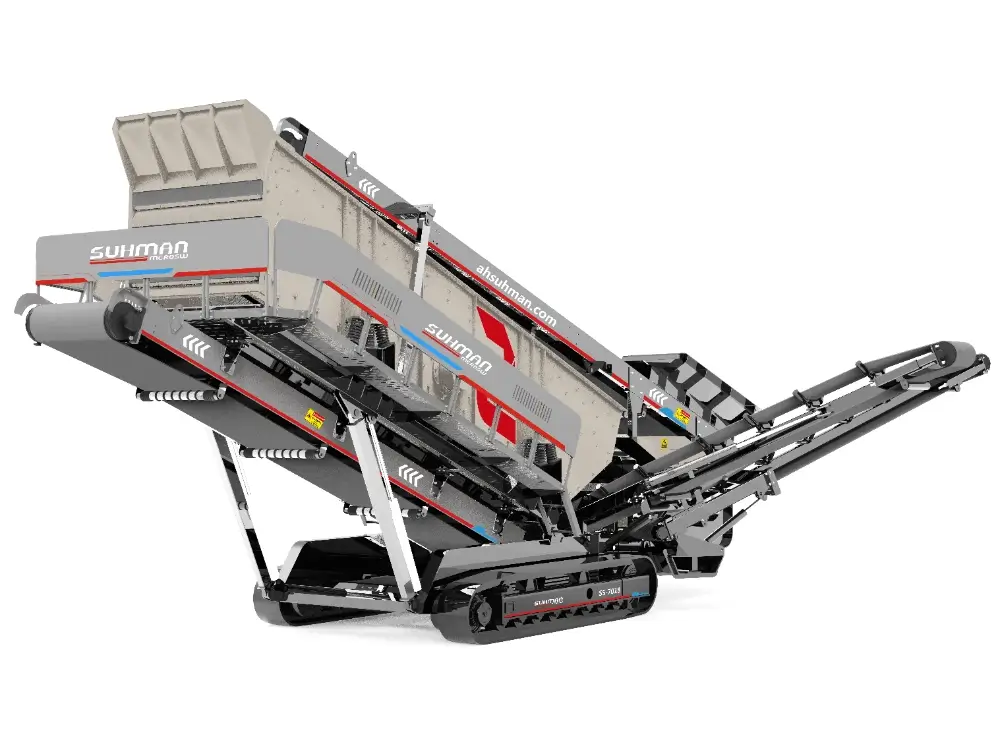
The SUHMAN SS-7018 is an example of a tracked inclined screening plant. Its three-deck configuration can produce up to four size fractions. Source: SS-7018 product page.
Match the Equipment to Your Material
Use the following table to build a shortlist for supplier discussions. Each entry is a starting point; feed samples and product requirements should determine the final configuration.
| Material de alimentación | Main task to define | Equipment or process to investigate | Key verification |
|---|---|---|---|
| Piedra triturada | Split crusher discharge into saleable grades | Inclined or horizontal vibrating screen | Grading of each product at the required feed rate |
| Arena y grava | Separate size fractions and assess cleaning needs | Sizing screen; washing and dewatering stages where required | Fines, clay, moisture, and the customer’s product specification |
| Hormigón reciclado | Remove unwanted fractions and grade usable aggregate | Scalping followed by product sizing, with contaminant separation as needed | Reinforcement, mixed debris, and product consistency |
| Reclaimed asphalt pavement (RAP) | Separate usable fractions and manage oversize lumps | A coordinated screening and crushing circuit | Feed condition, moisture, and the destination of oversize |
| Wet or sticky mixed material | Achieve separation without persistent blocked openings | Suitable media, flexible-mat screening, or a wet process to test | Performance on the most difficult representative feed |
| Soil and organic mixtures | Recover a specified size fraction from variable feed | Trommel, disc, or other suitable screening technology | Wrapping, contamination, and the quality of the recovered fraction |
For a concrete recycling project, review the whole processing line when comparing concrete recycling equipment. Include how unwanted material will leave the plant.
RAP also illustrates the value of checking the conditions behind a capacity figure. NFLG’s RAP plant specifications state a feed-moisture condition alongside rated capacity and list a separate crusher capacity. Ask suppliers to define the same boundaries in their proposals.
Scalping, Product Sizing, and Dewatering
Scalping: prepare the feed
Scalping makes an initial separation before further processing. Depending on the circuit, it can remove fines that do not need crushing or separate material that requires different handling. Removing already sized material ahead of a crusher can reduce unnecessary wear and power use. McLanahan describes this prescreening role.
For a project involving coarse, mixed feed, our guía de pantalla para scalping provides further context. Specify what should pass, what should remain on the deck, and where both streams will go.
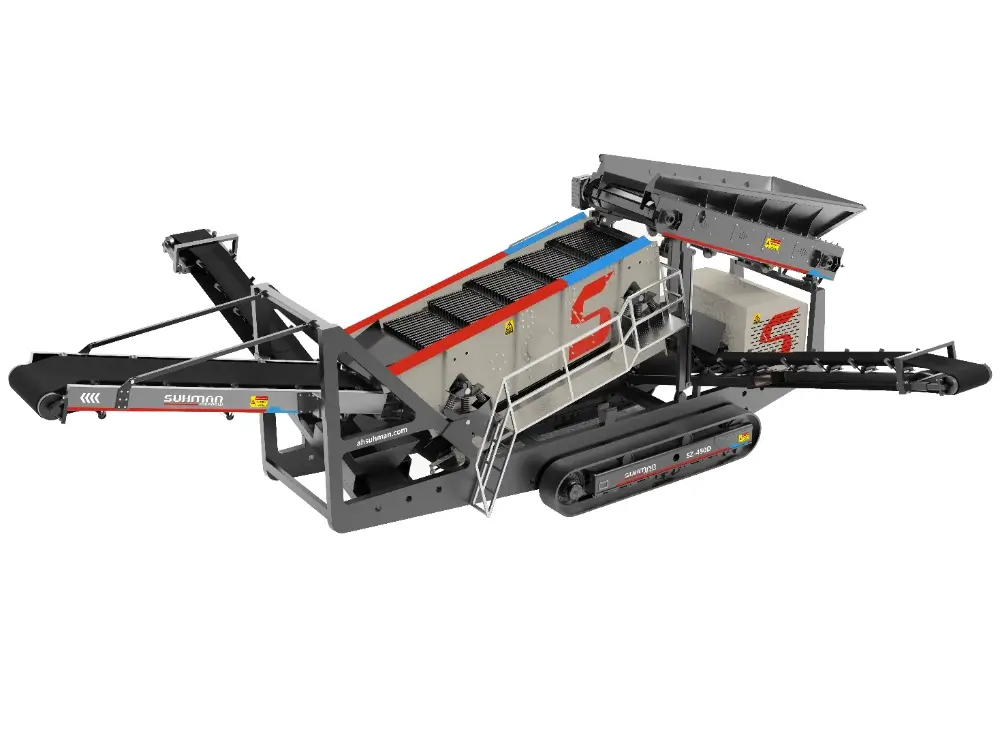
The SUHMAN SZ-450D is a heavy-duty mobile screening option for applications that require an initial separation. Confirm the deck configuration and feed limits for the project. Source: SZ-450D product page.
Product sizing: make the specified grades
Product sizing divides material into the fractions required by the customer. Write those requirements as grading limits, including any allowable oversize or undersize, so the supplier has a clear acceptance target.
Our guide to aggregate sizes and grading introduces common product descriptions. Confirm the actual specification for your market and project before selecting screen openings.
Dewatering: reduce retained water
A dewatering screen removes water from wet material to improve handling and stockpiling. Final moisture depends on the feed and operating conditions. It should be evaluated against its moisture-removal duty; a separate sizing stage may still be needed for precise product grades. McLanahan’s dewatering screen guide explains these operating considerations.
Key Factors That Affect Screening Performance
Feed size, moisture, and near-size particles
Two feeds with the same maximum lump size can behave differently. Their full particle-size distributions, shapes, and surface moisture matter. Particles close to the chosen opening size are harder to separate than much smaller particles. These relationships are described in AEI’s mechanical screening guide.
Send the supplier a sieve analysis if one is available. Also describe normal feed conditions and the difficult periods: after rain, during a change of source, or when recycled material contains more fines.
Feed distribution and bed depth
A steady feed and an appropriate material bed help the screen perform its separation. Excessive bed depth makes it harder for fine particles to reach the screening surface. AEI identifies both feed regularity and bed depth as operating factors.
During a trial, check how the feed spreads across the deck. Record the feeder setting and loading method so the conditions can be reproduced after installation.
Screen media and openings
Screening surfaces are available in wire, polyurethane, rubber, and combinations of these materials. McLanahan lists these media options as part of screen selection.
Ask the supplier to explain the proposed opening shape, panel arrangement, wear protection, and replacement method. Include the availability of spare panels in your comparison. The purchasing question is practical: can the proposed media maintain the agreed product quality over an acceptable service interval?
Screen area and plant layout
Request the usable dimensions of every deck, then ask how the supplier sized each separation stage. A long screen box alone does not establish what the complete plant will deliver.
Check discharge arrangements too. Can the conveyors move and stockpile each fraction at its expected rate? Is there room to reach the media for inspection? Can a loader remove finished material without interrupting feed?
Mobile, Modular, or Stationary Screening Plants?
Choose the installation format around the site’s operating plan. Compare transport, setup, access, power supply, and the expected time at each location.
| Plant format | A useful starting point when… | Preguntas por resolver |
|---|---|---|
| Mobile | The plant needs to move between work areas or projects | Transport dimensions, setup procedure, ground conditions, and stockpile access |
| Modular | The project benefits from a defined arrangement of separate plant sections | Foundations, assembly, interconnections, and future changes |
| Stationary | The operation has a long-term layout and dedicated infrastructure | Civil works, maintenance access, conveyor routes, and expansion space |
Nuestro mobile inclined screen overview y modular screening plant guide provide examples of different layouts.
Apply the same product-quality targets to every proposal. Mobility and installation format should sit alongside the screening specification in the comparison.
How to Compare Capacity and Product Quality
Start by asking what the quoted tonnes per hour actually measures. For a fair comparison, request three separate figures where applicable:
- Fresh feed: new material entering the overall process.
- Screen feed: all material reaching the screen, including any circulating load.
- Accepted product: material leaving in the required grades and meeting the agreed specification.
Consider an illustrative, once-through trial. A screen receives 200 metric tonnes per hour and discharges 65 tonnes of one saleable grade, 70 tonnes of another, 45 tonnes of a third, and 20 tonnes of oversize. If all three saleable fractions pass inspection, accepted output totals 180 tonnes per hour.
That is a 90% saleable mass yield for this example. Screening accuracy still requires particle-size checks on the output streams. A large stockpile can contain misplaced material, and valuable fines can remain in the oversize stream.
The figures above are arithmetic examples, with no losses assumed. They are not a capacity claim for any particular machine.
Account for recirculation
When oversize returns for further crushing and screening, it adds load inside the circuit. Ask the supplier to show fresh feed and returning material separately in the proposed flow sheet. Our impact crusher design guide discusses the crusher’s role in this arrangement.
Agree on a measurable acceptance test
Define the material, moisture range, screen settings, and trial duration in advance. Measure product quantities over the same period, and take representative samples from every output stream.
Ask the supplier to explain how separation performance will be calculated. Useful measures include the recovery of material into its intended product and the amount of misplaced material in each fraction.
Also agree whether tonnage means metric tonnes or US short tons, whether measurements use wet or dry mass, and whether the reported hourly rate includes operating interruptions.
These definitions give you a practical basis for comparing both performance and operating cost per accepted tonne.
What to Send a Screening Equipment Supplier
A useful enquiry gives the supplier enough information to propose a complete duty. Use this checklist before requesting a machine recommendation.
| Información | What to include |
|---|---|
| Material de alimentación | Source, material type, maximum lump size, and sieve analysis if available |
| Variable conditions | Typical and difficult moisture conditions, sticky fines, and seasonal changes |
| Contaminants | Metal, wood, plastic, clay, or other unwanted material present in the feed |
| Required products | Target fractions, grading limits, tolerances, and intended use |
| Objetivo de producción | Required accepted output by fraction, plus the available operating hours |
| Existing process | Crushers, feeders, conveyors, wash equipment, and any return circuit |
| Site constraints | Available space, access, power, water, drainage, and relocation needs |
| Acceptance method | Trial material, sampling procedure, measurement basis, and product-quality checks |
For difficult material, ask whether a representative sample test or site trial is available. Manufacturer testing can help establish suitable settings and expected separation results; Rotex describes a material-testing approach for its own equipment.
Make sure the sample represents routine production and the harder conditions you expect. Record where it came from and how it was stored, particularly when moisture affects the proposed process.
De SUHMAN screening plant range includes inclined, horizontal, heavy-duty, and modular options. To discuss a suitable arrangement, send us your material details and required product grades. Include your accepted output target so the discussion starts with a clearly defined production requirement.
Preguntas frecuentes
What is the difference between crushing and screening?
Crushing reduces material size. Screening separates a feed into size fractions. In an aggregate plant, the two processes work together to produce material that meets the required grading.
Which material screening equipment is best for aggregates?
An inclined or horizontal vibrating screen is a useful starting point for product sizing. Include feed condition, target cuts, and required output in the comparison. Coarse or mixed incoming material may also need a separate scalping stage.
Can screening equipment handle wet and sticky material?
Suitable equipment can handle some difficult feeds, but selection needs application-specific evidence. Compare appropriate media, flexible-mat designs, and wet processing where relevant. Request testing with representative moisture and clay content.
How many products can a screening plant make?
The deck and discharge arrangement determines the available size fractions. For example, the SUHMAN SS-7018 has three decks and can produce up to four fractions. Whether each fraction becomes a saleable product depends on its specification and destination in the process.
Does a larger screen guarantee more finished product?
Size alone cannot establish accepted output. Ask for a proposal based on the actual feed, product requirements, and complete process. Verify it through measurements of both product quantity and grading.
Should I choose a mobile or stationary screening plant?
Compare how often the plant must move with the site’s expected operating life and infrastructure. Then evaluate transport, setup, maintenance access, and total installed cost against the same screening duty.