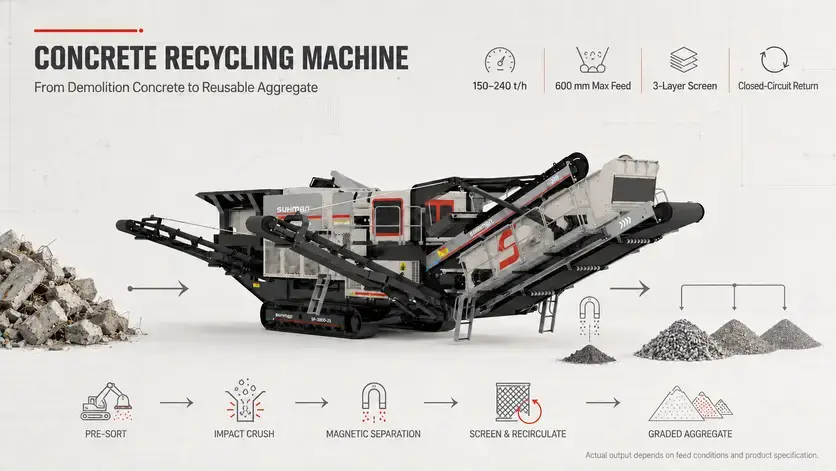
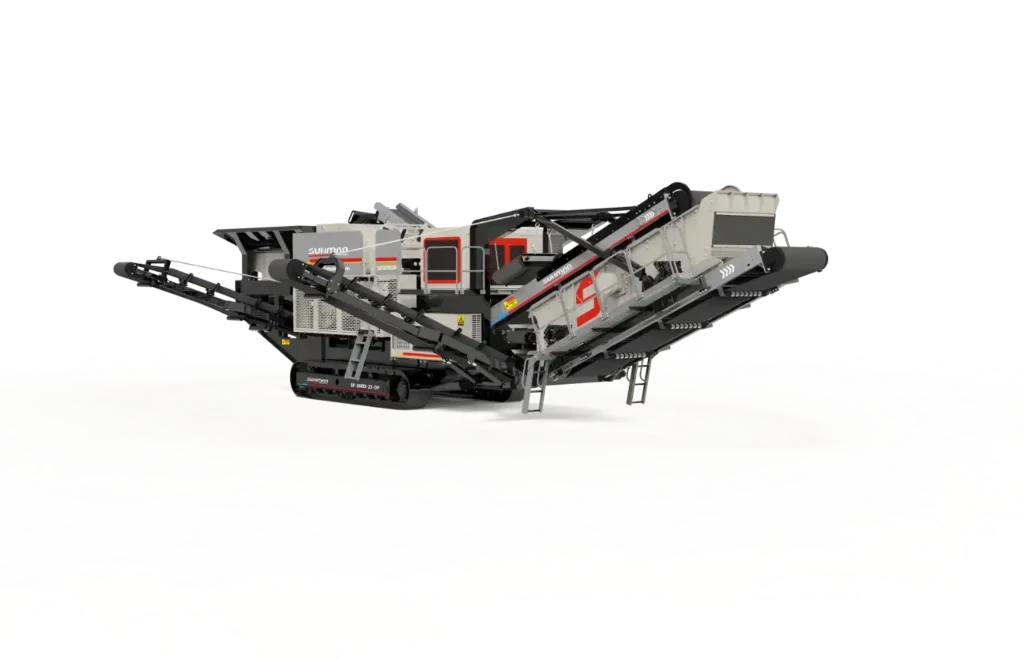
SF-380D-2S Máquina móvil integrada de trituración y cribado
Una máquina de reciclaje de hormigón transforma el hormigón endurecido procedente de demoliciones en material que puede ser cribado y evaluado para su reutilización. En la práctica, esto suele implicar más de una operación de trituración. Un proceso viable puede incluir la preclasificación, la alimentación controlada, la trituración, la separación magnética, el cribado, la recirculación de material de gran tamaño y los controles de calidad finales.
Este artículo se centra en las máquinas paraHormigón endurecido procedente de proyectos de demolición, obras viales y reconstrucción.. No abarca los recuperadores de hormigón húmedo utilizados en plantas de hormigón premezclado. Estos sistemas lavan el hormigón fresco devuelto y recuperan arena, grava y agua de proceso. El equipo y los principios de funcionamiento son diferentes.
La distinción es importante. Una trituradora móvil puede reducir el hormigón con éxito, pero eso no garantiza automáticamente que el material descargado sea un árido reciclado terminado. Es necesario eliminar el acero. Se debe controlar la contaminación. Además, el material debe ser cribado hasta obtener la granulometría requerida y sometido a pruebas para su uso previsto.
¿Qué es una máquina de reciclaje de hormigón?
El término puede describir tanto una máquina integrada individual como una línea de procesamiento completa.
Una trituradora de hormigón independiente reduce principalmente el tamaño del material. Una máquina de reciclaje de hormigón más completa puede combinar:
- una tolva de alimentación y un alimentador vibratorio;
- una preselección o un oso grizzly;
- una trituradora de mandíbulas o una trituradora de impacto de eje horizontal;
- un imán de banda superior;
- una o más plataformas de proyección;
- una cinta transportadora de retorno para material de gran tamaño;
- transportadores de productos;
- supresión de polvo; y
- un chasis de orugas o de ruedas.
Algunas plantas móviles integran la mayoría de estas funciones en un solo chasis. Otros proyectos utilizan una trituradora primaria, una criba independiente y varias cintas transportadoras. Ninguna configuración es automáticamente mejor. La disposición correcta depende de las condiciones de alimentación, la producción requerida y la frecuencia de traslado de la planta.
El término también tiene un segundo significado en la industria del hormigón. Un recuperador de hormigón de una planta de dosificación procesa el hormigón húmedo devuelto y el agua de lavado. Por ejemplo, MEKA describe su sistema de reciclaje de hormigón. como equipo para recuperar el agua residual de los agregados y el cemento del hormigón sin usar. Una trituradora de demolición no puede realizar esa función.
¿Trituradora de mandíbulas o trituradora de impacto para el reciclaje de hormigón?
Se utilizan ambos tipos, pero resuelven problemas diferentes.
| Factor de selección | trituradora de mandíbulas móvil | Trituradora de impacto móvil |
|---|---|---|
| Acción de aplastamiento principal | Compresión | Impacto a alta velocidad |
| rol típico | Reducción primaria | Reducción primaria o secundaria; producción en circuito cerrado |
| Alimentación grande e irregular | A menudo adecuado | Depende en gran medida de la geometría de entrada y del predimensionamiento. |
| Forma del producto | Generalmente más alargados o angulares. | A menudo más cúbico, dependiendo de la alimentación y la configuración. |
| Generación fina | Generalmente más bajo | Puede ser mayor |
| Piezas de desgaste principales | Placas de mandíbula | Barras de impacto y placas de impacto |
| Hormigón armado | Requiere gestión del acero y separación magnética. | Requiere un control cuidadoso del acero y protección contra materiales irrompibles. |
| Opciones de pantalla integrada | Disponible en algunos modelos. | Común en modelos orientados al reciclaje |
Una trituradora de mandíbulas es un punto de partida práctico cuando las piezas de alimentación son grandes, variables o difíciles de orientar. Por ejemplo, la Trituradora de mandíbulas móvil SUHMAN SE-1060 Tiene un tamaño máximo de alimentación publicado de 700 mm y un rango de procesamiento de 200–250 t/h. También incluye un separador de banda superior. Para obtener un producto final clasificado, normalmente necesita una criba aguas abajo y puede requerir una trituradora secundaria.
Una trituradora de impacto se suele elegir cuando el proyecto requiere una mayor reducción de tamaño, una mejor conformación de partículas o un circuito de cribado y recirculación integrado. Sin embargo, no siempre es la opción más económica. El desgaste de las barras de impacto puede aumentar con áridos duros o abrasivos, y el acero sin control puede provocar interrupciones costosas.
La elección práctica se basa en la composición total del material, no solo en la resistencia a la compresión del hormigón. El árido original dentro del hormigón, la cantidad de mortero adherido, el contenido de acero y la granulometría deseada son factores importantes.
Lo que muestra el mercado actual del reciclaje de dispositivos móviles
Las gamas de productos actuales de los fabricantes internacionales muestran varias tendencias claras en cuanto a equipamiento. Se trata de observaciones sobre el diseño, no de una clasificación por cuota de mercado.
El triturado en circuito cerrado es ahora una configuración convencional.
Metso, Kleemann, RUBBLE MASTER, Keestrack, Finlay y otros proveedores ofrecen trituradoras de impacto móviles con cribas integradas y cintas transportadoras de retorno. El objetivo es sencillo: controlar el tamaño máximo de los materiales sin necesidad de instalar una planta de cribado independiente.
Esta disposición resulta útil en emplazamientos temporales. Sin embargo, también tiene sus limitaciones. Las cribas integradas tienen una superficie menor que muchas plantas de cribado independientes. La producción de varias fracciones con un control estricto puede reducir el rendimiento o requerir una criba aparte.
La separación va más allá de un imán básico.
En el reciclaje de hormigón, es común el uso de imanes de banda superior. Algunos fabricantes también ofrecen separadores de aire para eliminar contaminantes ligeros como madera y plástico. Metso ofrece opciones de imanes, separadores de aire y sistemas de supresión de agua para el modelo LT1213S. Kleemann ofrece configuraciones de imanes y separadores de aire para el modelo MR 110 EVO2.
Estas opciones mejoran el proceso, pero no sustituyen la clasificación en origen. Una máquina no puede convertir de forma fiable los residuos de demolición muy mezclados en áridos limpios únicamente mediante trituración.
Las opciones eléctricas e híbridas se están haciendo más visibles.
Keestrack ofrece el R5 en versiones diésel-eléctrica, híbrida enchufable y totalmente eléctrica. RUBBLE MASTER describe el RM 120X como diésel-eléctrico. SUHMAN ofrece opciones con generador eléctrico externo y diésel para sus plantas de impacto integradas.
La mejor opción de suministro eléctrico depende de la disponibilidad de electricidad local, el coste del combustible, las normativas sobre emisiones y las horas de funcionamiento. Un sistema de propulsión eléctrica no es automáticamente más económico cuando la planta carece de un suministro estable.
Los controles y los datos operativos están recibiendo mayor atención.
Las plantas modernas utilizan cada vez más la regulación automática de la alimentación, los controles remotos, el diagnóstico de fallos y la telemática. Estos sistemas ayudan al operador a mantener una carga estable e identificar los tiempos de inactividad. Sin embargo, no eliminan la necesidad de una inspección realizada por personal cualificado, la correcta selección de las piezas de desgaste y el mantenimiento preventivo.
Comparación de trituradoras de impacto móviles representativas
Los siguientes modelos representan la misma categoría de mercado: trituradoras de impacto de eje horizontal montadas sobre orugas, disponibles con cribado o recirculación integrados. No son idénticos. Las capacidades publicadas se basan en diferentes materiales de prueba y configuraciones, por lo que la tabla no debe interpretarse como una clasificación de rendimiento.
| Marca y modelo | Capacidad publicada | Entrada de la trituradora | Control de seguridad a bordo y regreso | Peso operativo o configurado publicado | Observación técnica |
|---|---|---|---|---|---|
| SUHMAN SF-380D-2S | 150–240 t/h | 1.380 × 1.000 mm | Criba de tres capas de 4600 × 1540 mm, cinta transportadora de retorno y separador de hierro. | 54,3 t | Destaca la posibilidad de utilizar varios tamaños de acabado en un chasis integrado. |
| Kleemann MR 110 EVO2 | Aproximadamente 240 t/h para hormigón demolido. | 1100 × 800 mm | Cinta transportadora de retorno y post-criba de una o dos plataformas (opcional) | 44,5 t básico; aprox. 61 t configuración máxima | El fabricante publica una capacidad de hormigón específica para cada material, que resulta más útil que su clasificación de alimentador de 350 t/h. |
| RUBBLE MASTER RM 120X | Hasta 350 t/h | 1.160 × 820 mm | Sistema de fijación y retorno de pantalla de 1480 × 3708 mm | 45,6 t con accesorio de pantalla | Peso de configuración más ligero; propulsión diésel-eléctrica y pantalla desmontable |
| Keestrack R5 | Hasta 350 t/h en la descripción general del producto | 800 × 1050 mm | Pantalla trasera de doble piso opcional con retorno por circuito cerrado | 55,8 t con pantalla trasera de doble piso | Amplia superficie de la luneta trasera; disponibles versiones diésel-eléctricas, híbridas enchufables y totalmente eléctricas. |
| Metso Lokotrack LT1213S | No se indica en la página del producto actual. | 1.320 × 900 mm | Criba de doble pendiente integrada y cinta transportadora de retorno | 55 t | Las opciones de reciclaje incluyen un imán, un tamiz de viento y un sistema de supresión con agua a alta presión. |
| Finlay I-120RS | Potencial de producción de hasta 400 t/h | 1.130 × 800 mm | Criba de dos pisos de 3660 × 1530 mm y transportador de recirculación | 53,5 t incluyendo opciones | Mayor potencia publicada; sistema de recirculación desmontable y telemática. |
Fuentes: SUHMAN SF-380D-2S, Kleemann MR 110 EVO2, RUBBLE MASTER RM 120X, Keestrack R5, Metso Lokotrack LT1213S y Finlay I-120RS.
La tabla revela por qué las comparaciones simples de TPH son poco fiables. Kleemann indica una capacidad de alimentación de 350 t/h, pero proporciona aproximadamente 240 t/h para hormigón demolido. Finlay publica un potencial de producción de hasta 400 t/h. RUBBLE MASTER utiliza una cifra de "hasta". Metso no muestra una cifra de rendimiento en la página de su producto actual. Cada cifra responde a una pregunta diferente.
Para la adquisición, la comparación útil consiste en una prueba o cálculo basado en el material del comprador. Debe incluir la granulometría del material de alimentación, la dureza del hormigón y los agregados, el contenido de acero, la humedad, las aberturas de la criba objetivo y la carga de retorno prevista.
Dónde encaja el SUHMAN SF-380D-2S
Dentro de la gama actual de SUHMAN, el Máquina móvil integrada de trituración y cribado SF-380D-2S Es la opción que más se ajusta al término de búsqueda "máquina móvil de reciclaje de hormigón". Combina alimentación, trituración por impacto, separación magnética, cribado multicapa y retorno de material de gran tamaño en un único chasis sobre orugas.
Sus especificaciones publicadas incluyen:
- Capacidad de procesamiento de la máquina: 150–240 t/h;
- Tamaño máximo de alimentación: 600 mm;
- Entrada de la trituradora de 1.380 × 1.000 mm;
- Potencia de la trituradora: 250 kW;
- Pantalla de tres capas de 4600 × 1540 mm;
- separador de hierro;
- cinta transportadora de retorno;
- Peso de la máquina: 54,3 t; y
- Sistemas de alimentación eléctrica externa o mediante generador diésel.
Esta configuración resulta útil cuando un contratista necesita varios tamaños de áridos sin instalar una criba primaria independiente. Puede ser adecuada para el reciclaje urbano, la reconstrucción de carreteras y las plantas de procesamiento temporales cuando el material ya ha sido clasificado y clasificado por tamaño.
No es la solución para todos los proyectos concretos. Una planta independiente puede ser más práctica cuando:
- El alimento contiene trozos de hormigón grandes e irregulares;
- Para la reducción primaria se necesita una trituradora de mandíbulas;
- El proyecto requiere una mayor superficie de proyección;
- Es necesario producir de forma continua varias fracciones comerciales precisas;
- La contaminación lumínica requiere una separación adicional; o
- La planta debe poder gestionar cambios importantes en la composición de la materia prima.
Para trabajos de mayor rendimiento, SUHMAN también ofrece la Planta integrada de trituración por impacto y cribado SF-580D-S. Otra opción es una trituradora de impacto SF-580D y una criba móvil SS-7018 por separado. Una publicación Proyecto de reciclaje de residuos de construcción y demolición de 230 t/h en Tailandia Utiliza esa configuración de dos máquinas para hormigón, ladrillo y material de demolición mixto.
El título del proyecto describe la capacidad configurada. No debe considerarse como una producción garantizada para otro sitio. El rendimiento real debe recalcularse según los nuevos requisitos de alimentación y producto.
¿Qué determina la capacidad real de reciclaje de hormigón?
La producción sostenible de una planta está controlada por su etapa activa más lenta. Esta puede ser la alimentadora, la trituradora, el imán, la criba, la cinta transportadora de retorno o la cinta transportadora de producto.
Diversas variables pueden hacer que el resultado real se aleje considerablemente de la cifra indicada en el catálogo.
Distribución del tamaño del alimento
Una planta que recibe una mezcla equilibrada de tamaños se comporta de manera diferente a una que recibe principalmente losas cerca del límite máximo de alimentación. Las piezas grandes pueden ralentizar la carga y aumentar la formación de atascos. El exceso de finos puede sobrecargar la criba sin consumir mucha potencia de la trituradora.
Propiedades del hormigón y de los áridos
La resistencia del hormigón por sí sola no determina su capacidad de compresión. El hormigón fabricado con áridos naturales duros y abrasivos puede desgastar las barras de impacto más rápidamente que el hormigón fabricado con áridos más blandos. El contenido de mortero antiguo también influye en la rotura y la generación de finos.
Reforzamiento
Las mallas ligeras y las barras de refuerzo cortas son diferentes de las barras de refuerzo largas y pesadas. El acero puede enredarse en los ejes, acumularse en los puntos de transferencia o dañar las cintas transportadoras. El tiempo dedicado a retirar el acero reduce la productividad.
Humedad y contaminación
Las partículas finas húmedas pueden obstruir las aberturas de las cribas. La arcilla y el yeso pueden reducir la calidad del producto. La madera y el plástico pueden llegar a las pilas de material terminado si no se eliminan mediante clasificación o separación por aire.
Talla superior requerida
Una abertura de malla pequeña suele aumentar la cantidad de material de gran tamaño que regresa a la trituradora. El circuito cerrado procesa entonces parte del material más de una vez. El rendimiento de la trituradora puede mantenerse alto, mientras que la producción neta de producto terminado disminuye.
Disponibilidad y práctica operativa
La producción diaria debe contemplar inspecciones, repostaje, limpieza de filtros, ajuste de piezas de desgaste y paradas no planificadas. Una estimación de producción realista debe basarse en las horas de funcionamiento previstas y la disponibilidad, en lugar de simplemente multiplicar la producción máxima por hora por la duración del turno.
¿Se pueden utilizar áridos de hormigón reciclado en la fabricación de hormigón nuevo?
A veces, pero no automáticamente.
El agregado de hormigón reciclado se considera comúnmente para bases granulares, subbases, rellenos, capas de drenaje, caminos temporales y otras aplicaciones no ligadas. La guía de la FHWA establece que el material de hormigón recuperado debe triturarse y cribarse hasta obtener la granulometría requerida para su uso como base granular. También analiza su uso en varias aplicaciones ligadas, sujeto a los requisitos de procesamiento e ingeniería. Véase la Guía de la FHWA sobre la base de granulado.
Su uso en hormigón estructural nuevo requiere un control más estricto. El hormigón de partida, el mortero adherido, la absorción, la densidad, la granulometría, los cloruros, los materiales perjudiciales y las especificaciones locales son factores importantes. Normalmente se requieren ensayos de laboratorio y el diseño de la mezcla.
Por lo tanto, un fabricante de trituradoras debería evitar prometer que cada producto está “listo para hormigón nuevo”. Una afirmación más precisa sería:
La planta produce áridos de hormigón reciclado triturados y cribados. Su uso final permitido depende de la calidad del material, los ensayos realizados y las especificaciones del proyecto.
Esa distinción protege tanto al proveedor del equipo como al comprador.
¿Planta de reciclaje de hormigón móvil o fija?
| Factor | Planta móvil | Planta estacionaria |
|---|---|---|
| Reubicación | Diseñado para moverse entre sitios o dentro de ellos. | Normalmente permanece en un solo lugar. |
| Instalación | Suele ser más rápido y requiere menos infraestructura permanente. | Requiere una planificación de los cimientos y del flujo de materiales. |
| Área de proyección | Limitado por las dimensiones del transporte y del chasis. | Es más fácil instalar pantallas grandes e independientes. |
| Expansión | Posible, pero limitado por los módulos móviles. | Más fácil añadir etapas y equipos de separación. |
| Uso típico | Contratos de demolición, obras viales y depósitos temporales. | Centros de reciclaje a largo plazo y operaciones fijas de gran volumen |
| Flexibilidad del producto | Funciona bien con pantalla integrada; es posible que aún se necesite una pantalla separada. | Alto cuando se instalan varias trituradoras, cribas y pilas de almacenamiento. |
La movilidad reduce la necesidad de transportar hormigón en bruto desde algunos proyectos. Sin embargo, no elimina el transporte. La maquinaria, la excavadora, la cargadora, las apiladoras y los productos terminados aún requieren un plan logístico.
Información necesaria antes de seleccionar una máquina.
Una recomendación útil de equipos comienza con los datos del proyecto. Los compradores deben proporcionar:
- Origen y tipo de hormigón.
- Dimensiones máximas de la pieza, no solo el diámetro estimado.
- Distribución típica del tamaño del alimento.
- Resistencia del hormigón, si se conoce.
- Tipo de árido original y abrasividad, si se conocen.
- Tipo, cantidad y longitud expuesta del refuerzo.
- Contiene ladrillo, asfalto, tierra, yeso, madera y plástico.
- Condiciones de humedad.
- Capacidad neta de producto terminado requerida.
- Tamaños y tolerancias de producto requeridos.
- Uso previsto de cada producto.
- Condiciones del espacio de trabajo y del terreno.
- Frecuencia de reubicación requerida.
- Disponibilidad de suministro eléctrico y condiciones del combustible.
- Requisitos relativos al transporte local, el ruido, el polvo y las emisiones de los motores.
Las fotos y los videos son útiles. Una prueba de material representativa es aún mejor. Para proyectos de mayor envergadura, se debe preparar un diagrama de flujo y un balance de masas antes de finalizar el pedido del equipo.
Polvo, seguridad y mantenimiento
La trituración de hormigón puede generar sílice cristalina respirable. La Administración de Seguridad y Salud Ocupacional de EE. UU. (OSHA) indica que la trituración de hormigón, ladrillo, bloque y mortero puede generar sílice respirable. Su norma de construcción exige que las máquinas trituradoras utilicen agua pulverizada o nebulizada en la trituradora y otros puntos de generación de polvo, y que el equipo se opere y mantenga para minimizar las emisiones. Los requisitos varían según el país, por lo que también deben consultarse las normas locales. Véase Descripción general de la sílice cristalina según OSHA y 29 CFR 1926.1153.
El sistema de supresión de agua debe diseñarse en función del proceso. Un caudal insuficiente puede no controlar el polvo, mientras que un exceso puede obstruir la malla, generar lodo y dificultar el flujo del material.
Las prioridades de mantenimiento incluyen:
- inspeccionar las barras de impacto o las placas de las mordazas para detectar desgaste y perfiles irregulares;
- comprobar los ajustes de la placa de impacto o los ajustes de descarga de las mandíbulas;
- limpiar y probar el separador magnético;
- inspeccionar las correas para detectar cortes causados por el acero;
- eliminar el refuerzo atrapado en las áreas de transferencia;
- comprobar la tensión y los daños de la pantalla;
- monitorizar la temperatura y la lubricación de los cojinetes;
- comprobar las boquillas de supresión de polvo; y
- registro del coste de desgaste por tonelada procesada.
La vida útil de las piezas de desgaste no debe garantizarse como un número fijo de horas. Depende de la abrasividad del material de alimentación, el refuerzo, los ajustes de la trituradora, la carga de recirculación y la práctica del operario.
Errores comunes en la selección de personal
Elegir únicamente por el máximo de TPH
La capacidad máxima puede referirse al alimentador, la trituradora o el material de prueba ideal. Solicite un presupuesto específico para concreto y las suposiciones en las que se basa.
Ignorando la capacidad de la pantalla
La trituradora puede procesar la materia prima, pero la criba aún puede limitar la producción neta cuando se requieren tamaños finales pequeños.
Tratar el ajuste de descarga como el tamaño del producto
El ajuste de la trituradora influye en la clasificación del producto. No garantiza que todas las partículas sean más pequeñas que el tamaño especificado. El cribado proporciona la separación final por tamaño.
Subestimar el refuerzo
En muchos proyectos es necesario un imán de banda superior, pero aun así, las barras de acero largas deben retirarse o cortarse antes de que puedan obstruir la planta.
Suponiendo que todo el material de demolición sea hormigón limpio
Los residuos mixtos de construcción y demolición requieren una clasificación más exhaustiva y pueden necesitar separación por aire o selección manual. Cuanto más contaminado esté el material de partida, más difícil será obtener un árido uniforme.
Comprar una planta integrada cuando se necesita una criba separada
Una máquina todo en uno ahorra espacio de instalación. Una criba independiente puede ofrecer una mayor superficie de cribado, mayor flexibilidad en el almacenamiento y un ajuste más sencillo para múltiples productos.
Preguntas frecuentes
¿Cuál es la mejor máquina para reciclar hormigón?
No existe un modelo óptimo universal. Una trituradora de impacto integrada con cribado resulta práctica para hormigón clasificado y pre-tamizado, con tamaños finales controlados. Para cargas grandes o irregulares, puede ser necesario utilizar primero una trituradora de mandíbulas. Las plantas de reciclaje de alto volumen pueden beneficiarse de máquinas de trituración y cribado independientes.
¿Puede una trituradora de impacto procesar hormigón armado?
Puede procesar hormigón armado debidamente preparado, pero es necesario controlar el refuerzo. Las barras de acero largas deben retirarse o cortarse antes de la alimentación. Un separador magnético debe eliminar el material ferroso liberado tras la trituración.
¿Qué tamaños finales puede producir una máquina de reciclaje de hormigón?
Los tamaños disponibles dependen de la configuración de la trituradora, el tipo de malla, el número de pisos y la disposición de la cinta transportadora. El tamaño del producto debe elegirse según la aplicación prevista y las especificaciones locales.
¿Una entrada de trituradora más grande garantiza una mayor capacidad?
No. El tamaño de la entrada afecta la aceptación del alimento, pero la capacidad también depende del rendimiento del alimentador, la potencia de la trituradora, las propiedades del material, el área de la criba, la carga de retorno y la disponibilidad operativa.
¿Una máquina de reciclaje de hormigón es lo mismo que una recuperadora de hormigón?
No siempre. En el reciclaje de escombros, el término suele referirse a la trituración y el cribado del hormigón endurecido. En una planta de hormigón premezclado, una recuperadora de hormigón procesa el hormigón húmedo y el agua de lavado.
¿Puede el árido de hormigón reciclado sustituir al árido natural?
En algunas aplicaciones, puede sustituir a los materiales naturales si cumple con las especificaciones pertinentes. El uso aceptable y el nivel de sustitución dependen de las pruebas, las normas locales y el diseño del proyecto.
Conclusión
Una máquina de reciclaje de hormigón se entiende mejor como un sistema de procesamiento de materiales, no solo como una trituradora. Un reciclaje eficaz requiere una preparación controlada de la materia prima, la eliminación del acero, la clasificación por tamaño y las pruebas del producto.
El mercado actual ofrece trituradoras de impacto compactas, plantas de circuito cerrado de tamaño mediano y sistemas multimáquina de mayor tamaño. Sus capacidades de catálogo no son directamente comparables. El método de selección más fiable consiste en adaptar la configuración completa al hormigón, el refuerzo, la granulometría deseada y las condiciones del emplazamiento.
Dentro de la gama SUHMAN, la SF-380D-2S es la más adecuada para proyectos que requieren trituración por impacto, separación magnética y cribado multitamaño integrados en un solo chasis móvil. Los proyectos de mayor envergadura o con características más variables podrían requerir la SF-580D-S, una línea independiente compuesta por la SF-580D y la SS-7018, o una trituradora de mandíbulas SE-1060 como etapa primaria.
Para evaluar un proyecto, proporcione las dimensiones de alimentación, el estado del refuerzo, la capacidad neta requerida y los tamaños de agregados objetivo. Estos cuatro puntos son más útiles que solicitar la máquina con la mayor producción por hora (TPH) del catálogo.
Notas técnicas de la fuente
Las especificaciones y configuraciones del producto se verificaron con las páginas del fabricante disponibles en septiembre de 2026. Las especificaciones del equipo pueden variar según la región, el tipo de motor y la configuración opcional. Confirme la ficha técnica vigente antes de realizar la compra.
- Agencia de Protección Ambiental de EE. UU.: Gestión sostenible de materiales de construcción y demolición
- FHWA: Material de hormigón reciclado
- FHWA: Material de hormigón reciclado en base granular
- OSHA: Sílice cristalina respirable
- ASTM C33/C33M-24a: Áridos para hormigón
- Metso Lokotrack LT1213S
- Kleemann MR 110 EVO2
- RUBBLE MASTER RM 120X
- Keestrack R5
- Finlay I-120RS
- SUHMAN SF-380D-2S