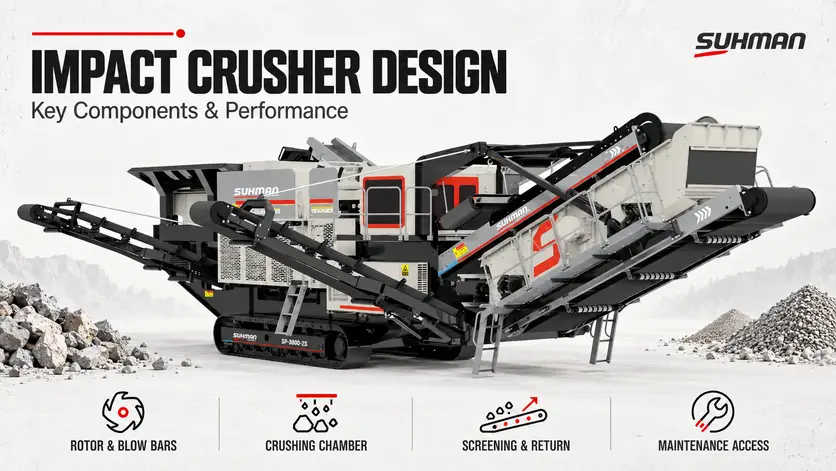
Impact crusher design brings together the rotor, blow bars, crushing chamber, adjustable impact aprons, and drive system. Their arrangement determines how the material is struck, how it moves through the machine, and how operators can adjust and service the crusher. Metso’s NP Series design overview describes the relationship between rotor design, wear materials, and chamber configuration.
For buyers, the useful question is how a proposed design will handle their feed and produce the required aggregate. A larger opening or higher motor rating describes only part of that task.
This guide focuses on horizontal shaft impact crushers, or HSI crushers, and the features worth checking before choosing equipment.
What Does Impact Crusher Design Include?
Evaluate the design at three levels:
- The crushing unit: feed opening, rotor, blow bars, impact aprons, liners, bearings, and drive.
- Adjustment and service features: gap adjustment, load monitoring, access doors, and wear-part handling.
- The plant layout: feeding, screening, conveying, metal separation, and any oversize return circuit.
These levels need to work together. A proposal should explain how each stage supports the required finished product, including the supporting equipment needed around the crusher.
HSI vs VSI: Two Different Impact Crusher Designs
Impact crushers include two main design families. Their internal arrangements differ, so their components and applications should be discussed separately.
| Design feature | Horizontal shaft impact crusher: HSI | Vertical shaft impact crusher: VSI |
|---|---|---|
| Rotor orientation | Horizontal shaft | Vertical shaft |
| Material acceleration | Blow bars strike the incoming feed | A rotor accelerates centrally fed material outward |
| การกระทำที่บดขยี้ | Impacts against aprons and between particles | Rock-on-rock or rock-on-anvil impact, depending on design |
| Typical process role | Primary, secondary, or tertiary reduction, depending on model | Commonly final-stage shaping and fine aggregate production |
Metso explains these distinctions in its impact crusher technology guide. For a VSI example, see SUHMAN’s SC-J85D modular VSI sand making machine.
Main Components of an HSI Impact Crusher
In an HSI, incoming material meets blow bars fixed to a rotating rotor. The bars accelerate the material toward the impact aprons. Further impacts against the aprons and other particles continue the size reduction before the material discharges.
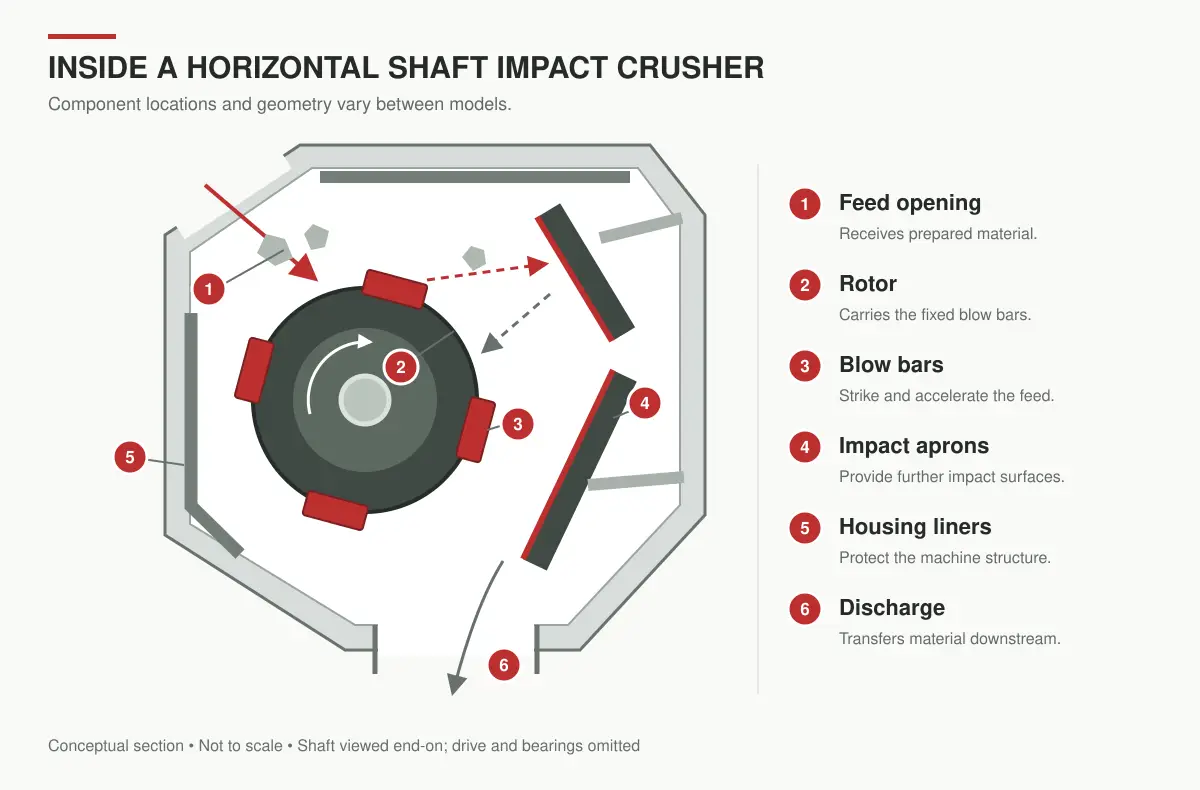
Simplified HSI component layout. Positions and geometry vary by manufacturer; this illustration is not a fabrication drawing.
| ส่วนประกอบ | Main role | What to check |
|---|---|---|
| ช่องป้อนอาหาร | Receives material into the chamber | Opening dimensions and permitted feed size |
| โรเตอร์ | Carries the blow bars and transfers energy | Dimensions, operating range, and wear protection |
| แท่งเป่าลม | Strike and accelerate incoming material | Material grade, mounting system, and replacement method |
| Impact aprons | Provide surfaces for further impact | Arrangement, adjustment, and overload provisions |
| Housing liners | Protect the chamber structure | Replaceable sections and access to fasteners |
| Shaft, bearings, and drive | Support and power the rotor | Lubrication, sealing, drive arrangement, and service access |
For a manufacturer example, Lippmann’s impactor design explains its shaft and rotor assembly, blow-bar mounting, adjustable curtains, and replaceable liners. Specific construction details vary between models.
Design Factors That Affect Crushing Performance
Feed opening and material delivery
Keep the feed opening dimensions separate from the recommended maximum feed size. An opening measurement alone does not describe which lumps, slabs, or mixed materials a machine can accept reliably.
Provide the supplier with maximum piece dimensions and the expected feed size distribution. Photographs with a scale reference can help show awkward shapes that a single size figure misses.
The feeder and discharge arrangement also deserve attention. For example, IROCK’s TC-20 design combines a hopper and grizzly feeder with discharge-point wear protection and an adjustable conveyor. These details show why the material path extends beyond the crusher inlet.
Rotor size, inertia, and tip speed
Rotor diameter, width, mass distribution, and operating speed describe different aspects of the design. A rotor’s inertia helps it resist changes in speed during loading, while its width is part of the feed-handling geometry.
Compare tip speed as well as revolutions per minute. For a circular tip path:
Tip speed in m/s = π × tip-path diameter in metres × rotor rpm ÷ 60.
As an illustration, a 1.0 m tip-path diameter at 600 rpm gives approximately 31.4 m/s. A 1.2 m diameter at the same rpm gives approximately 37.7 m/s. These are arithmetic examples, not recommended crusher settings. Confirm whether a published rotor diameter includes the blow-bar tips.
Use the manufacturer’s operating range and application data to judge suitability. Ask how the proposed speed, feed rate, and chamber settings work together. HAZEMAG identifies this matching process in its blow-bar guidance.
Blow-bar material, shape, and mounting
Blow-bar selection involves a balance between resistance to abrasion and the ability to withstand impact loads. Feed size, abrasive content, and the risk of uncrushable material all matter.
HAZEMAG describes manganese, martensitic, and chrome grades, including insert options for certain applications. Their properties suit different duties; high wear resistance alone does not establish the best choice. HAZEMAG blow-bar materials
Ask the supplier to identify the proposed grade and explain its suitability for your feed. Also check the mounting system, usable wear allowance, and whether the bars can be turned or repositioned.
Replacement access is a design feature worth comparing. HAZEMAG’s rotor designs illustrate how wear caps, holders, and removal directions can differ. A quotation should make clear which tools and access space are needed for the supplied machine.
Crushing chamber and impact aprons
The chamber gives material space to accelerate, strike surfaces, and move toward discharge. Impact aprons, also called curtains, form part of this path. Their positions and settings help influence the resulting size distribution.
Some designs offer an additional breaker plate or grinding path. HAZEMAG publishes separate configuration data and particle-size curves for its HPI with and without a grinding path, demonstrating that optional chamber features affect the selection process. HAZEMAG HPI configurations
Request an expected product grading for the proposed chamber and settings. Include the amount of fines and oversize in that discussion. An apron gap is a mechanical setting; a screen aperture defines a separate size-separation step. Avoid treating them as interchangeable specifications.
If a quotation describes a “two-stage” or “three-stage” impactor, ask for a chamber cross-section. Confirm whether the wording refers to impact zones within one machine or separate machines in the plant. For coarse aggregate production, compare the yield in your saleable size ranges and the fines content. An additional impact surface needs to justify its value against those targets. For a sand application, request separate evidence for sand grading and particle shape.
Drive, adjustment, and controls
Record which power figure a quotation gives: crusher motor rating, engine rating, or total installed plant power. Compare equivalent figures and ask how the supplied power system runs the complete plant.
Then review the controls available on that configuration. Useful questions include how feed is regulated, which loads or temperatures are monitored, how settings are changed, and what information an operator sees during a stoppage.
Hydraulic adjustment and automation are available on some designs, including the Metso NP Series. Confirm the equipment actually included in the offer, together with commissioning and operator training.
Maintenance access and wear protection
Inspect the design as if a wear-part change were due tomorrow. Where will the technician stand? How does the housing open? Can a worn bar be removed without moving surrounding equipment?
Review lifting points, locking arrangements, service clearances, and lubrication access against the manufacturer’s procedures. Include the weight and handling method for the parts your team will replace.
Ask for a service-access drawing alongside the working layout. Detailed fault diagnosis belongs in the maintenance plan; our impact crusher maintenance guide covers common problems with blow bars, aprons, rotors, bearings, and conveyors.
Check the written rotor warranty too. Ask which parts it covers: the rotor body, shaft, bearings, blow bars, or liners. Confirm the duration, maintenance requirements, exclusions, and responsibility for replacement labor. A lifetime-warranty claim needs a clear definition of whose lifetime and which failures are covered.
Matching the Design to the Material and Application
A useful comparison starts with a representative feed description. Material names alone leave questions about abrasion, moisture, clay, and contamination unanswered.
The following priorities are a practical framework for discussing an application with a supplier:
| แอปพลิเคชัน | ข้อมูลที่ต้องให้ | Questions for the proposed design |
|---|---|---|
| Limestone aggregate | Feed sizes, abrasive content, moisture, and required grading | Which chamber and wear parts suit the material? What product distribution is expected? |
| การรีไซเคิลคอนกรีต | Block dimensions, reinforcement, fines, and other contamination | What preparation is required? How are wear parts selected and released steel removed? |
| Asphalt recycling | Feed source, lump sizes, temperature range, and fines | How will material flow and fines production be assessed under the expected conditions? |
For recycling, distinguish metal removal before crushing from recovery after crushing. A magnet downstream can recover released ferrous material, but it cannot protect the rotor from an object that has already passed through the chamber. Ask the supplier to show the location and purpose of each separation stage.
ของเรา คู่มืออุปกรณ์รีไซเคิลคอนกรีต provides further application context. If the crushing technology itself is still undecided, the การเปรียบเทียบเครื่องบดกระแทกกับเครื่องบดกราม explains their different roles.
Mobile Impact Crusher Plant Layout
Mobile impact crusher design also includes how the crusher connects to its feeder, screen, conveyors, and chassis. Compare the working footprint, transport dimensions, service clearances, and planned stockpile positions.
Screening and the oversize return circuit
In a closed circuit, the screen separates product-sized material and sends oversize back for another pass. McCloskey’s I44R impact plant is one example combining crushing, screening, and recirculation.
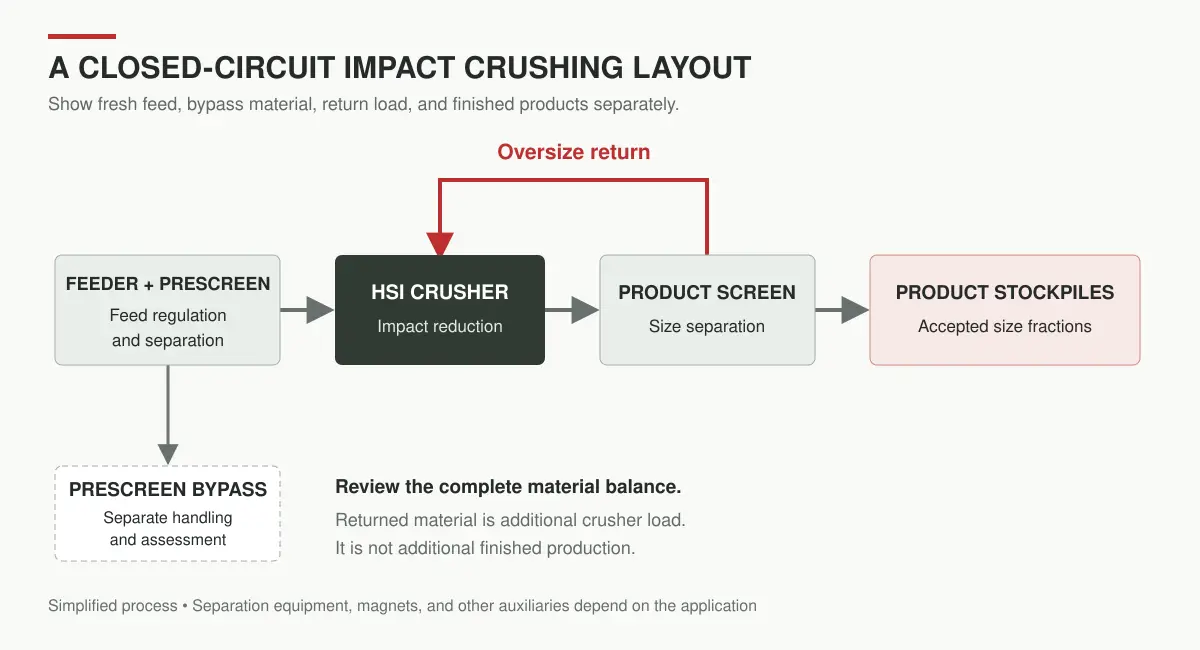
Conceptual material flow. Bypass material needs a suitable destination; auxiliary equipment and exact conveyor positions are application-specific.
Ask for a mass balance that separates fresh feed, returned oversize, and final products. Material passing through the crusher twice should not be counted twice as saleable output. Also clarify what happens to prescreened material: it may need separate handling or testing before blending into a product.
For a simplified example, assume all fresh feed enters the crusher and no material bypasses it. If fresh feed is 180 t/h and returned oversize is 60 t/h, the crusher processes 240 t/h in total. At steady state, with no losses or accumulation, final discharge from the circuit totals 180 t/h. The saleable share depends on which fractions meet the product requirements. These figures illustrate a mass balance; they are not a machine rating.
For a crusher already operating at its practical load limit, extra return material leaves less capacity for fresh feed. The effect depends on the return rate and the plant bottleneck, so request an estimate for the complete closed circuit.
Choosing an onboard screen or a separate screening plant
An onboard post-screen can separate selected size fractions and return oversize. A separate screening plant is another option. Confirm the deck count, apertures, product conveyors, and return routing: these determine which fractions can leave as separate products. A returned oversize stream is not an additional finished product.
An open-circuit crusher produces a discharge grading that may suit an all-in product or feed a downstream process. If your customer needs separately graded aggregates, include a suitable screening stage in the layout.
Compare screen length and width alongside usable area, media, open area, deck angle, feed distribution, and material condition. Ask for performance at the required apertures and allowable misplaced material. Screen length alone is an incomplete basis for selection.
An integrated SUHMAN example
เดอะ SUHMAN SF-380D-2S integrated crushing and screening machine combines impact crushing with a three-deck screen and return conveyor on a tracked plant. It provides a concrete example of how the crushing unit fits into a wider material-handling system.
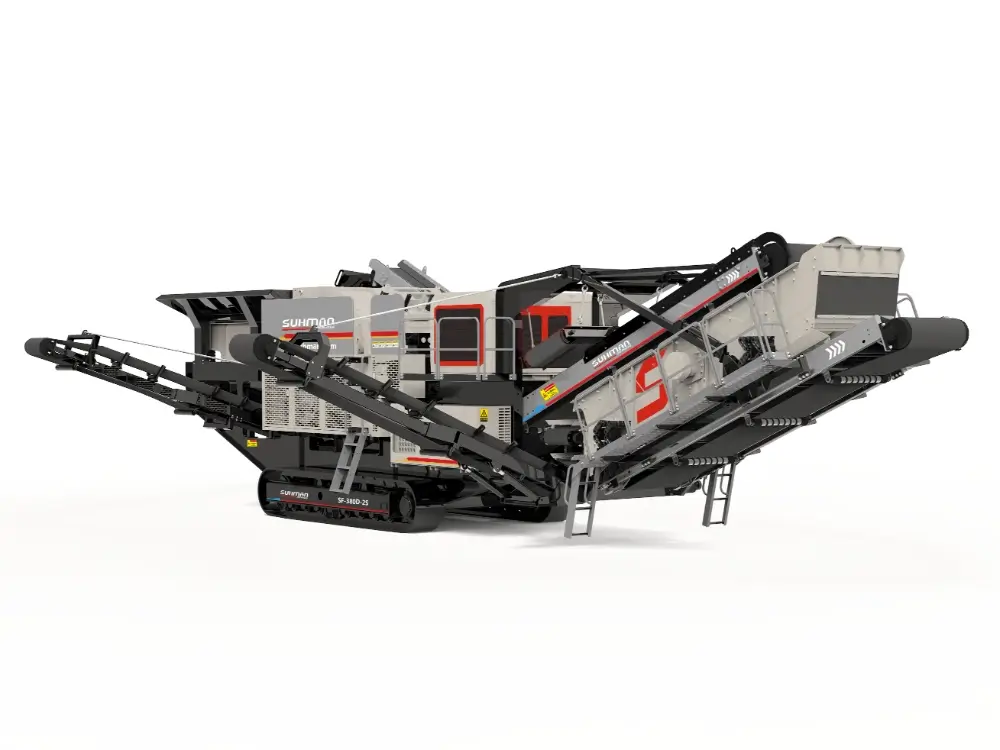
SUHMAN SF-380D-2S. Confirm the supplied configuration and project requirements when evaluating an integrated plant.
Use the proposed flow diagram to check product outlets, return routing, and access. Ask how the arrangement will support your required product mix and what changes are possible if those requirements change.
How to Compare Impact Crusher Capacity Claims
Model labels such as 1214 or 1315 are insufficient for a production estimate. Obtain the exact manufacturer specification, rotor dimensions, power arrangement, chamber configuration, and proposed settings.
Separate three measurements when comparing quotations:
- Fresh feed rate: new material entering the plant.
- Crusher throughput: material passing through the crushing chamber, including any returned oversize.
- Saleable product rate: accepted finished material leaving the circuit, measured by product fraction.
Published ratings can use different conditions. For example, Kleemann’s MR 130i EVO2 technical sheet lists feed capacity separately from material-specific crushing capacities. Its notes identify feed composition, feed size, prescreening, and target final size as relevant conditions. Some crushing figures also allow a stated oversize percentage.
Ask for a production estimate tied to your feed, required grading, and screening circuit. For a site trial, record the weighing method, test duration, stoppages, and output of each accepted fraction. Also check whether “tons per hour” means metric tons or US short tons. These details make the quoted output meaningful for your project.
What to Check Before Selecting an Impact Crusher Design
Give each supplier the same project brief, then request evidence against the same production targets.
| Selection item | Information or evidence to request |
|---|---|
| Feed conditions | Representative grading, maximum dimensions, material tests, moisture, and contaminants |
| ผลิตภัณฑ์สำเร็จรูป | Required sizes, grading limits, shape criteria, and intended use |
| หน่วยบด | Chamber choice, rotor operating range, blow-bar specification, and adjustment method |
| Production estimate | Fresh feed, total crusher load, accepted output by fraction, test duration, and weighing method |
| Wear and maintenance | Wear-life assumptions, replacement procedure, service space, spare parts, and written warranty coverage |
| Power and installation | Complete power requirements, site layout, transport arrangement, and setup scope |
| การตรวจสอบ | Material trial, relevant operating reference, or an agreed performance assessment |
Ask which inputs remain uncertain. If the estimate assumes dry, clean feed, find out how wetter or more variable material would affect the proposal.
For an operating comparison, use consistent costs and accepted finished tonnes. Include energy, wear parts, labor, and maintenance over the same period. Record the product mix as well: tonnes of unsold fines do not have the same business value as the aggregate your customer ordered.
Share your material, feed sizes, target products, and required output with SUHMAN to discuss suitable mobile impact crusher configurations หรือ request a project recommendation.
คำถามที่พบบ่อย
What are the main parts of an impact crusher?
An HSI typically includes a rotor, blow bars, impact aprons, housing liners, feed opening, shaft, bearings, and drive. A complete mobile plant adds equipment such as feeders, conveyors, screens, and a tracked chassis.
How does rotor speed affect impact crusher design?
Rotor speed and tip-path diameter determine tip speed. Suitability also depends on the feed, chamber, blow bars, and operating limits. Compare the full configuration and application data before concluding based on RPM alone.
How should blow-bar material be selected?
Match it to the feed’s abrasion and impact demands, including maximum size and contamination risk. Ask the manufacturer to explain the proposed material grade, mounting requirements, and expected wear under your conditions.
Does the apron gap determine the exact finished size?
The gap helps influence the crusher’s discharge grading. Finished size control also involves the material, operating conditions, and screening arrangement. Request a product grading estimate instead of relying on the gap figure alone.
Can motor power alone determine crusher capacity?
No. A useful capacity estimate needs the feed properties, required reduction, machine configuration, settings, and surrounding equipment. Ask for expected accepted product output under clearly stated conditions.
Can one impact crusher design suit every application?
Different duties need different configurations. HSI and VSI designs have distinct material paths, while chamber options, wear materials, and plant layouts vary within each family. Select based on the actual feed and finished product.