Limonite is a common name for earthy, yellow-brown iron-rich material found in weathered rocks and mineral deposits. Its composition varies, so the name alone gives limited guidance for processing. A useful project assessment starts with the minerals present, the distribution of iron, and the behavior of the ore when wet.
This guide explains limonite properties and uses, then connects them to crushing, washing, screening, and equipment selection. It also compares mobile and stationary plant arrangements and identifies SUHMAN machines that may suit specific ore preparation duties.
What Is Limonite?
Limonite is a general term for a mixture of fine-grained iron oxides and oxyhydroxides. Goethite commonly dominates, while hematite and other minerals may also occur. This variable composition explains why limonite samples can look and behave differently. The Wisconsin Geological and Natural History Survey describes the term in this broad mineralogical sense.
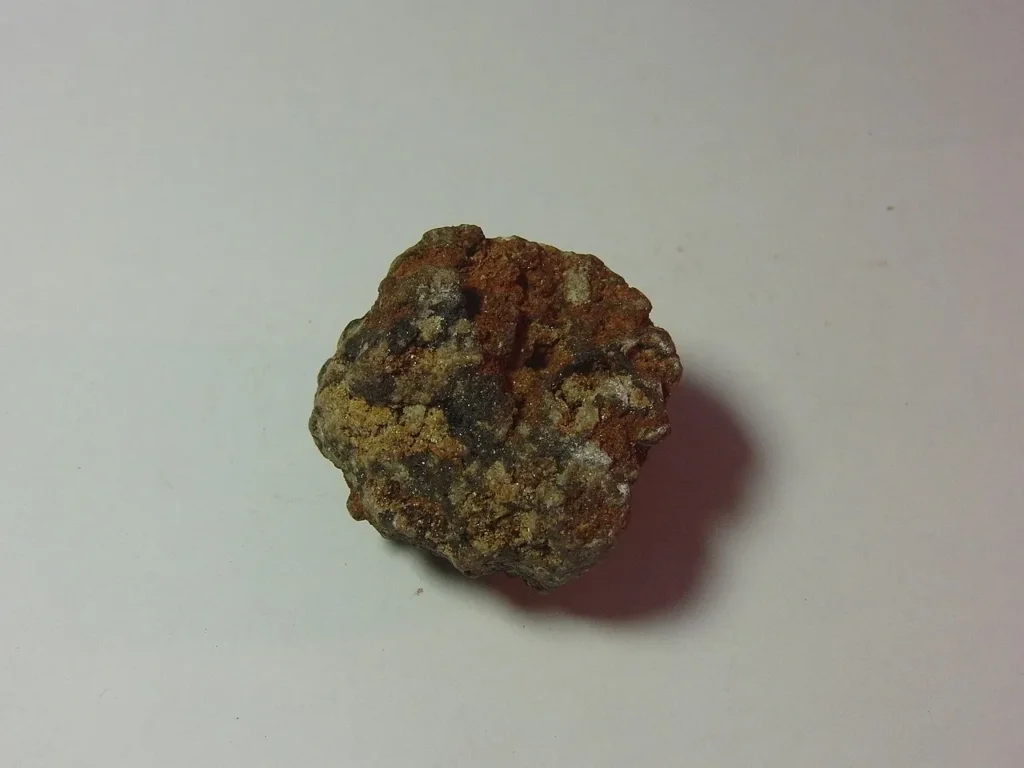
A limonite hand specimen with earthy brown and yellow coloration.
The formula FeO(OH)·nH₂O is often used as a general description. It should not be treated as a fixed composition for every ore sample. Commercial ore can also contain clay, quartz, and other gangue minerals that affect its iron content. The Missouri Geological Survey’s limonite factsheet explains its variable composition.
For a processing project, distinguish the material’s field name from its measured composition. Ask what minerals carry the iron and how they are mixed with the waste minerals.
Limonite Properties and Identification
The following features can help with initial identification:
| Свойство | Typical field observation | Practical limitation |
|---|---|---|
| Цвет | Yellow-brown to dark brown | Surface coatings can hide the underlying rock. |
| Streak | Yellow-brown | A streak test supports identification but does not measure iron grade. |
| Luster | Commonly dull or earthy | Appearance varies with the material’s texture. |
| Твердость | Highly variable | A soft surface does not establish the strength of the whole lump. |
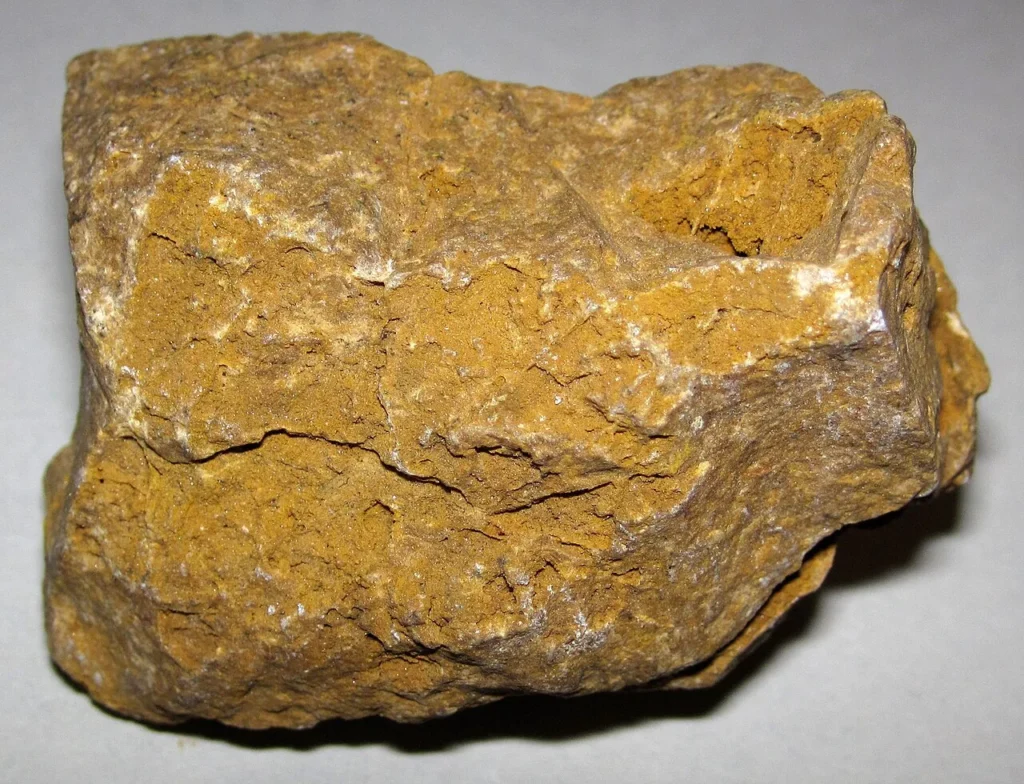
A hard limonite specimen, illustrating the variation in limonite texture.
These observations follow the Missouri Geological Survey description. Treat them as field clues.
Photos help document color and texture. They cannot establish iron grade, liberation size, moisture content, or crusher suitability. Before choosing equipment, obtain representative samples for chemical analysis and mineral identification. Ask the laboratory to explain which tests are needed for your target product.
How Does Limonite Form, and Where Is It Found?
Iron-bearing minerals can weather and oxidize near the surface. Goethite also forms through the oxidation of dissolved iron and occurs in weathered iron deposits, according to the Handbook of Mineralogy.
Limonitic material may therefore occur as coatings, earthy masses, or iron-rich accumulations in weathered ground. Its setting matters: a sample from a hard residual lump may represent a different processing problem from fine material collected nearby.
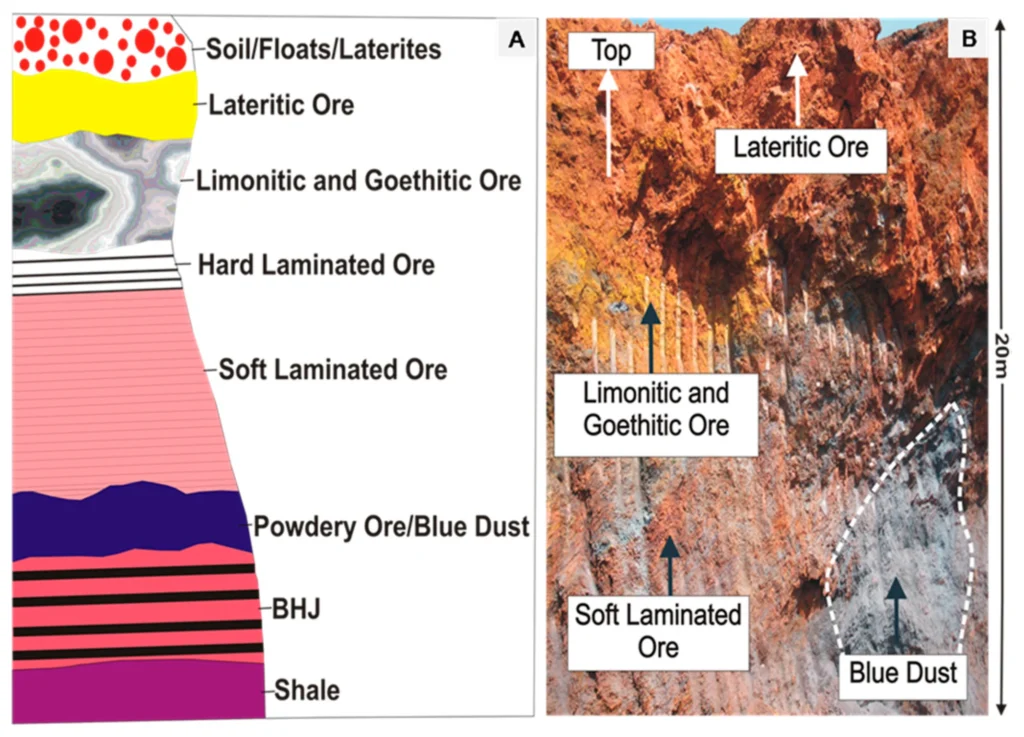
Iron-ore succession at Kiriburu, India, including lateritic, limonitic and goethitic horizons.
In nickel-cobalt laterites, “limonite” describes an upper weathering zone that can contain nickel-bearing goethite. The USGS nickel-cobalt laterite deposit model distinguishes this zone from deeper saprolite and other horizons. Keep samples from different geological units separate during the first assessment.
What Is Limonite Used For?
Iron-bearing feed
Limonite-bearing ore can provide material for iron recovery when its grade, impurities, and processing response meet the project’s requirements. A published mixed-ore beneficiation case appears later in this guide.
Mineral pigments
Limonite and goethite provide yellow-brown natural iron oxide pigments. Virginia Energy describes their use within the iron oxide pigment industry, including applications in coatings and building materials. A pigment project needs its own product specification and quality tests.
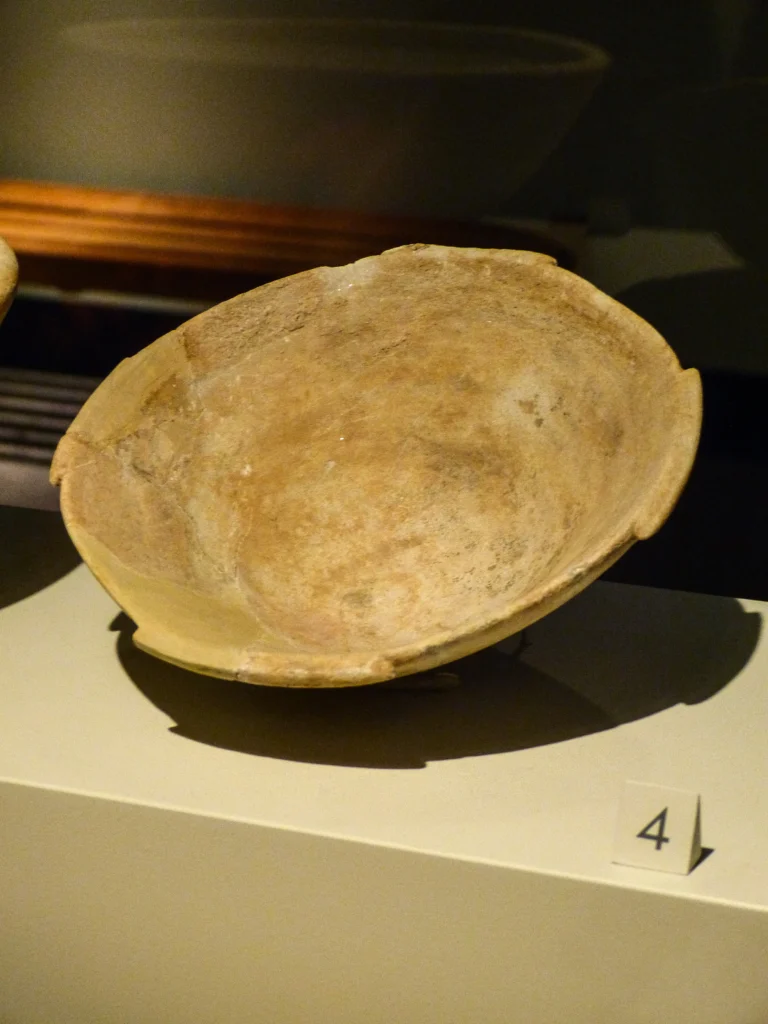
Yellow ochre pigment residue preserved in an ancient marble bowl.
Nickel-cobalt projects
Some lateritic limonite zones contain nickel and cobalt resources. Their evaluation follows a different metallurgical objective from producing an iron concentrate. The USGS deposit model emphasizes the importance of mineralogy in these deposits. Establish the metal-recovery objective before developing a flowsheet.
Limonite vs. Goethite, Hematite, and Magnetite
| Материал | Mineralogical description | Useful identification feature | Processing question |
|---|---|---|---|
| Limonite | Variable mixture, commonly rich in goethite | Often earthy and yellow-brown | Which minerals and size fractions carry the iron? |
| Goethite | Iron oxyhydroxide, α-FeO(OH) | Brown to yellow-orange or ocher streak | How fine must it be liberated from gangue? |
| Hematite | Iron oxide, α-Fe₂O₃ | Characteristic red-brown streak | Which separation method suits its association with other minerals? |
| Magnetite | Iron oxide, Fe₃O₄ | Black streak and strong magnetism | Can magnetic separation recover the liberated magnetite? |
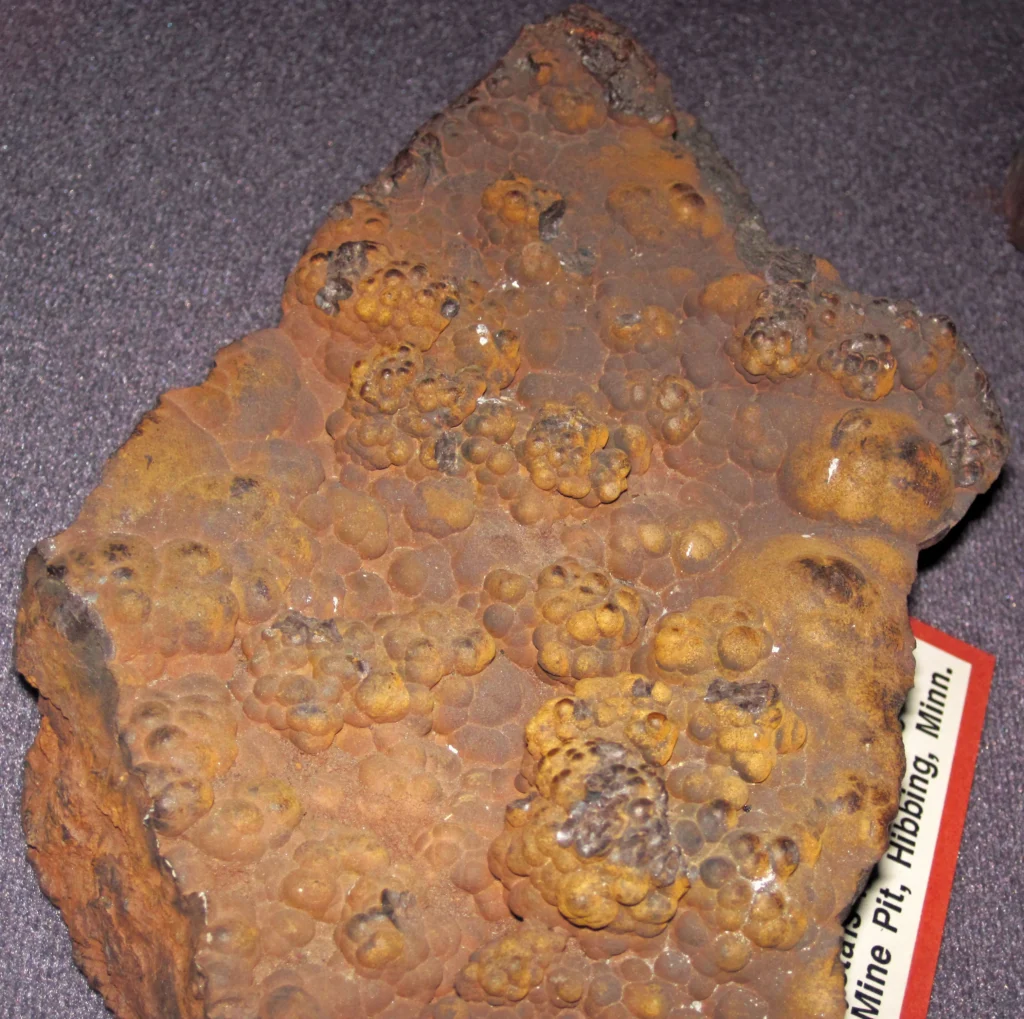
Limonite and goethite occur together in this specimen from the Hull-Rust Mine, Minnesota.
Mineral descriptions come from the Handbook of Mineralogy entries for goethite, hematite, и magnetite, alongside the survey descriptions above.
The processing questions are a practical interpretation of these differences. A magnetic circuit developed for magnetite needs fresh testwork before use on goethite-rich ore. Research on limonite magnetization roasting illustrates why mineral composition can change the required treatment route.
What Makes Limonite Ore Difficult to Process?
The main challenge is variation within the deposit and through the plant feed. A single dry sample leaves important questions unanswered.
| Observed ore condition | Question to resolve | Candidate preparation step to test |
|---|---|---|
| Lumps mixed with abundant fines | How much feed already meets the next stage’s size requirement? | Scalping before crushing |
| Wet, clay-rich feed | Does the feed flow, separate, and drain adequately? | Suitable feeding, scrubbing, or wet screening |
| Hard lumps mixed with softer material | Which fraction needs further size reduction? | Separate size routes or selective crushing |
| Fine iron-bearing material | How much iron would leave with the fines? | Size-by-size assays before selecting a slime cut |
This table is a test-planning guide. Each option needs confirmation on the actual ore.
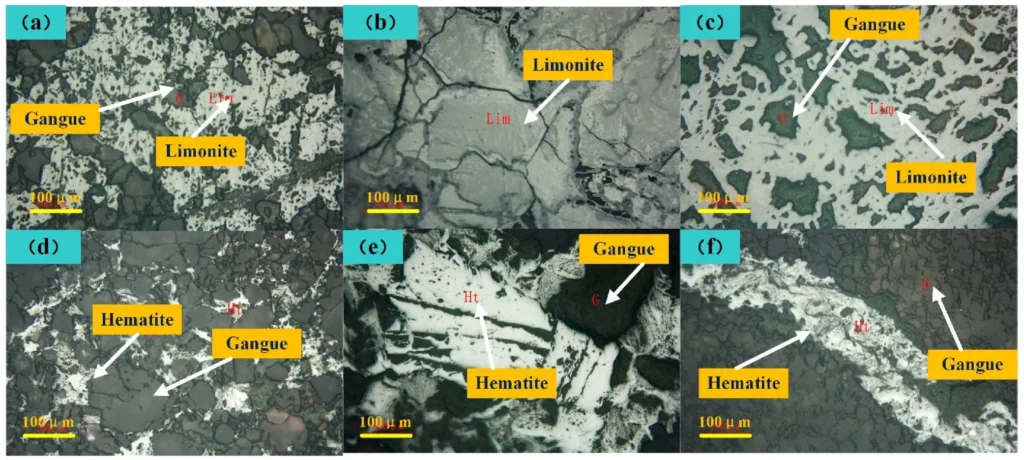
Microscope images reveal mineral associations within the limonite ore studied by Jin et al.
Use the test results to identify the main constraint at each stage. Ask whether the proposed circuit still works when the feed moves toward the wetter, finer, or harder end of the sampled range.
Crushing, Washing, and Screening Limonite Ore
Build the preparation circuit around the next process stage. Start by defining its feed size, acceptable moisture, and impurity limits.
1. Assess the incoming material
Measure the maximum lump size and full particle size distribution. Record both normal moisture and the wettest expected operating condition. Sample different ore zones and seasons where those changes could affect the feed.
Compare the feed size distribution with the required product. This reveals how much material needs crushing and how much may be routed around it.
2. Test scalping and feeding arrangements
Scalping can separate selected sizes before primary crushing. Equipment must match the feed’s handling behavior. For example, Metso’s wobbler feeders use driven bars to feed and separate difficult wet or sticky materials; listed applications include iron ore and laterite.
This is a useful reminder to test the feeding stage carefully. A conventional dry screen should earn its place through performance on the expected material.
3. Crush only where size reduction is required
A jaw crusher is a candidate for primary reduction of competent, oversized lumps. A cone crusher may suit a subsequent reduction stage if the prepared feed and target product justify it. Review the broader cone crusher vs. jaw crusher comparison when considering these roles.
Ask suppliers to demonstrate the expected product size distribution. Closed-side setting, or CSS, describes a crusher gap. It does not establish a screen-controlled maximum product size. Metso’s cone chamber guidance explains how chamber choice and CSS influence product gradation.
4. Place washing where tests show a benefit
Washing or scrubbing may help remove adhering clay and break up suitable agglomerates. Whether this belongs before crushing, after crushing, or in a separate size stream depends on the feed. JXSC’s limonite processing guidance includes washing and desliming among the available preparation steps.
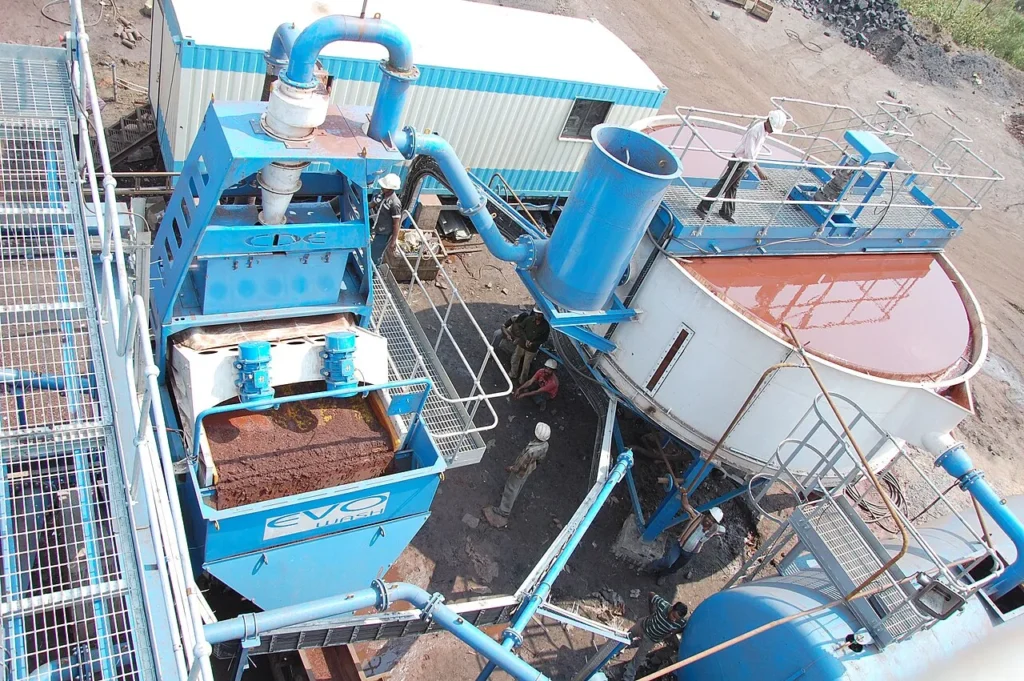
An iron ore washing plant with an AquaCycle thickener and connected water-handling equipment.
Test the washed coarse product and the fine stream. Measure iron and impurities in both. A cleaner-looking coarse product can still come with a costly loss of valuable fine material.
5. Control screening, recycle, and water together
Use screening to separate the required fractions, and return oversize only where further crushing is needed. Select screen openings and operating conditions through trials; deck dimensions alone cannot establish separation performance.
For circuit sizing, record fresh feed and circulating material separately. The crusher, screen, and conveyors must handle the streams that actually pass through them. For wet circuits, also define process-water supply, drainage, and the treatment of fine slurry. Our material screening equipment guide provides related equipment context.
Limonite Beneficiation Methods
Beneficiation aims to meet a defined product specification while retaining enough valuable metal. The available methods have different feed requirements. Liberation means freeing useful mineral particles from the surrounding waste minerals, also called gangue.
Гравитационное разделение
Jigs, spirals, and other gravity devices may be candidates where valuable minerals can be separated from gangue by their behavior under the chosen operating conditions. Liberation and particle size need testing. JXSC describes gravity separation among the routes considered for limonite-bearing ore.
Магнитная сепарация
Select the magnetic method around the minerals actually present. Magnetite’s strong magnetic response supports a different starting point from goethite-rich material. For the latter, testwork may investigate stronger-field separation or a route that changes mineral properties before separation. The Jin et al. study discusses this distinction.
Флотация
Flotation may be evaluated where selective separation remains difficult after preparation. The need for desliming, reagent conditions, and the response of each product stream must be established experimentally. It is among the options described in JXSC’s limonite flowsheet guidance.
Magnetization roasting followed by separation
Jin et al. investigated suspension magnetization roasting followed by magnetic separation in laboratory tests. Under controlled reducing conditions, the treatment converted iron minerals toward a more magnetically recoverable form. This is evidence for a tested treatment route on that study’s ore. Scale-up, energy demand, gas control, and economics require separate assessment. See the 2022 research paper.
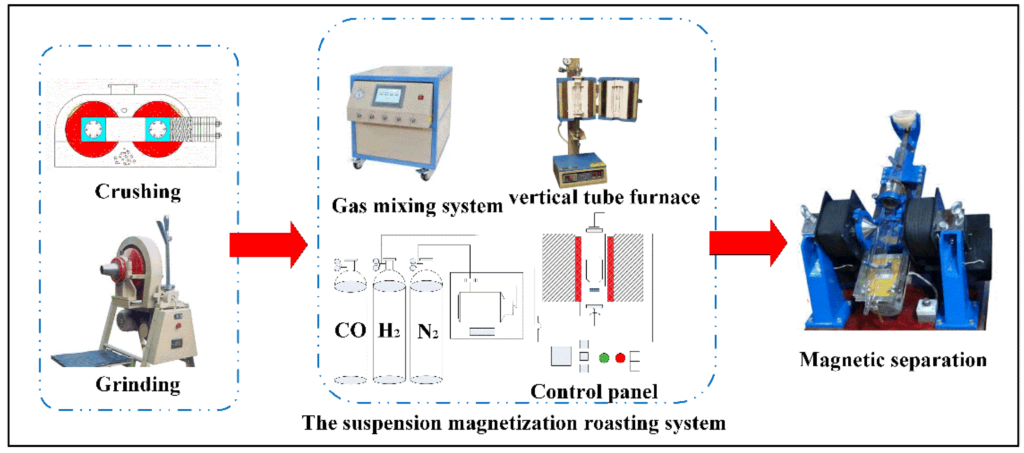
Experimental flowsheet used in the limonite magnetization-roasting study by Jin et al.
For nickel-cobalt laterites, commission metallurgical work around the nickel and cobalt objectives. An iron-concentrate flowsheet cannot establish their recovery performance.
Mobile vs. Stationary Crushers for Limonite Processing
Mobile crushing can suit limonite ore preparation when relocation and feed conditions support it. The decision depends on the mine plan and the required process. A tracked chassis provides mobility; the installed crusher and feeder still need to handle the ore.
Metso’s plant overview describes mobile, stationary, and modular arrangements. Its mobile sizer range also illustrates that mobile plants can use different crushing mechanisms for different materials.
Use the following comparison as a project decision framework:
| Decision factor | Mobile arrangement deserves evaluation when… | Stationary arrangement deserves evaluation when… |
|---|---|---|
| Working locations | Feed sources change and relocation has a clear purpose. | Feed can reach a stable processing location efficiently. |
| Material transport | Moving preparation closer to the face may reduce haulage. | Existing transport supports a central plant. |
| Process integration | The required preparation stages can move together. | Washing, slurry handling, and downstream treatment favor a central layout. |
| Project horizon | Phased development or changing locations matter. | A long operating horizon supports permanent infrastructure. |
| Utilities and access | Power, fuel, access, and service can follow the plant. | Permanent utility connections and maintenance facilities offer value. |
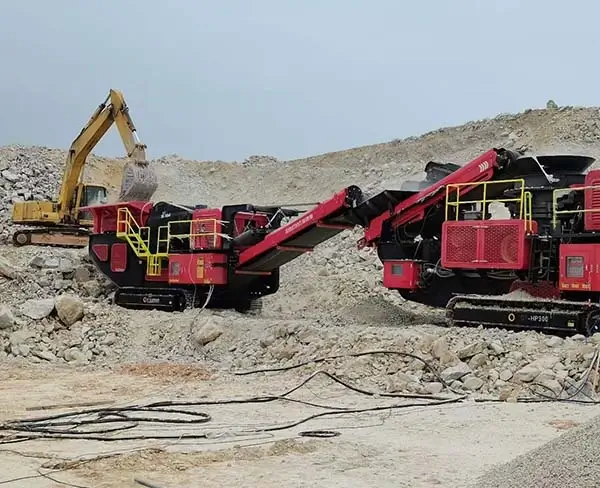
SUHMAN mobile equipment at a granite aggregate site in Guangdong, shown as a plant-layout example.
Compare total project cost using actual site data: transport, civil works, relocation, labor, energy, maintenance, water, and downstream infrastructure. Request a production commitment tied to an agreed feed and product specification.
A hybrid arrangement also deserves consideration. A published Metso aggregate quarry case combines mobile primary crushing with stationary downstream equipment. It demonstrates a layout option; the case does not validate a limonite flowsheet.
SUHMAN Equipment Options for Limonite Ore Preparation
The machines below are candidates for specific preparation duties, subject to ore tests and plant design. They do not form a mandatory four-machine line.
Specifications come from the linked SUHMAN Europe product pages, checked on October 9, 2026. Some values differ from Crushplant listings. Confirm the offered configuration in the technical quotation. Catalogue capacity ranges are omitted here because they do not establish limonite throughput.
SE-1060 Mobile Jaw Crusher — Primary Size Reduction
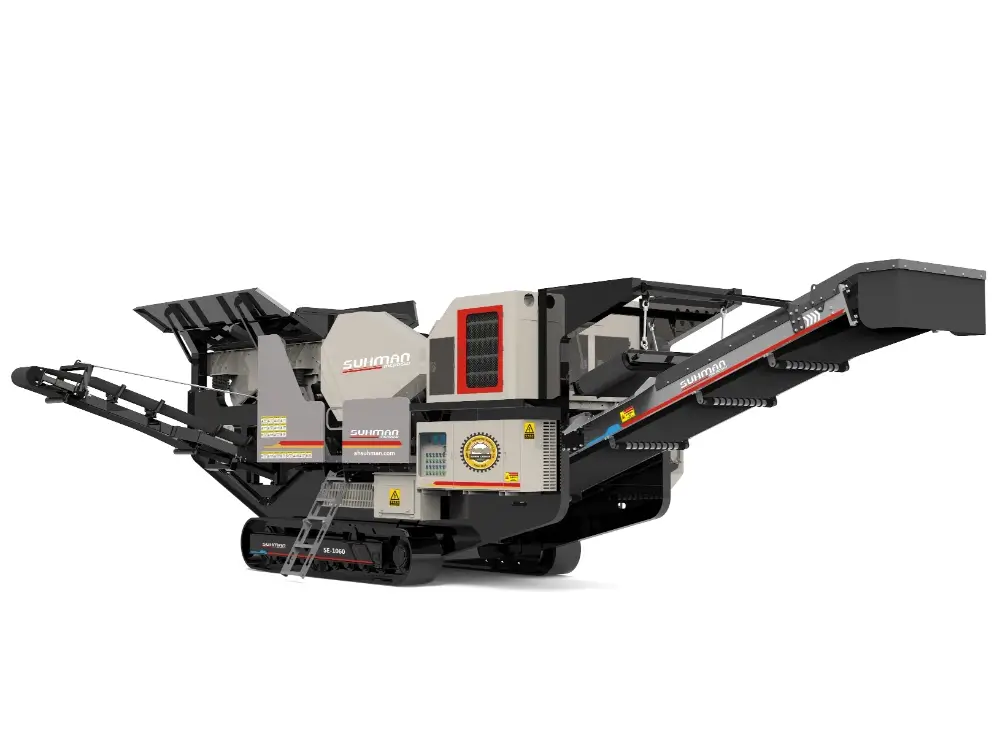
Evaluate the SE-1060 where the feed contains competent lumps that require primary crushing. Check feeding behavior and the resulting product distribution with representative ore.
| Published EU specification | Value |
|---|---|
| Загрузочное отверстие | 750 × 1,060 mm |
| Максимальный размер корма | 700 мм |
| CSS range | 70–200 мм |
SZ-450D Mobile Heavy-Duty Screen — Feed Separation
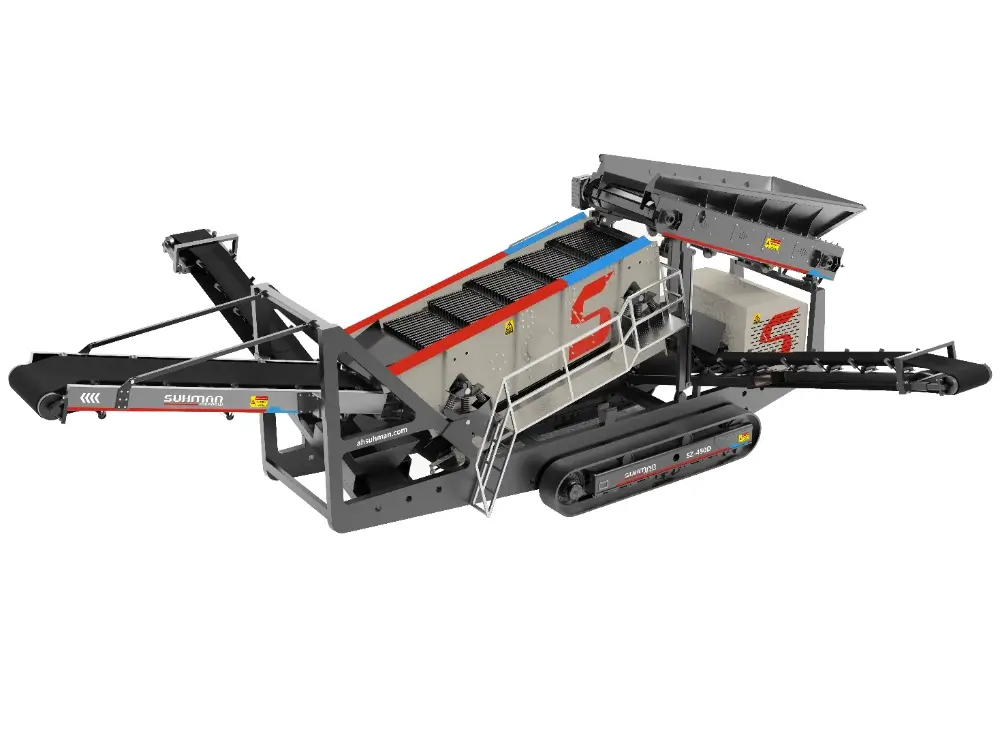
Evaluate the SZ-450D for separating feed fractions before the next stage. For clay-rich ore, specify a trial that measures separation quality and stable feeding under the expected moisture conditions.
| Published EU specification | Value |
|---|---|
| Максимальный размер корма | 600 мм |
| Screen dimensions | 5,000 × 1,500 mm |
| Screen decks | 2 |
SY-HP300 Mobile Cone Crusher — Further Reduction
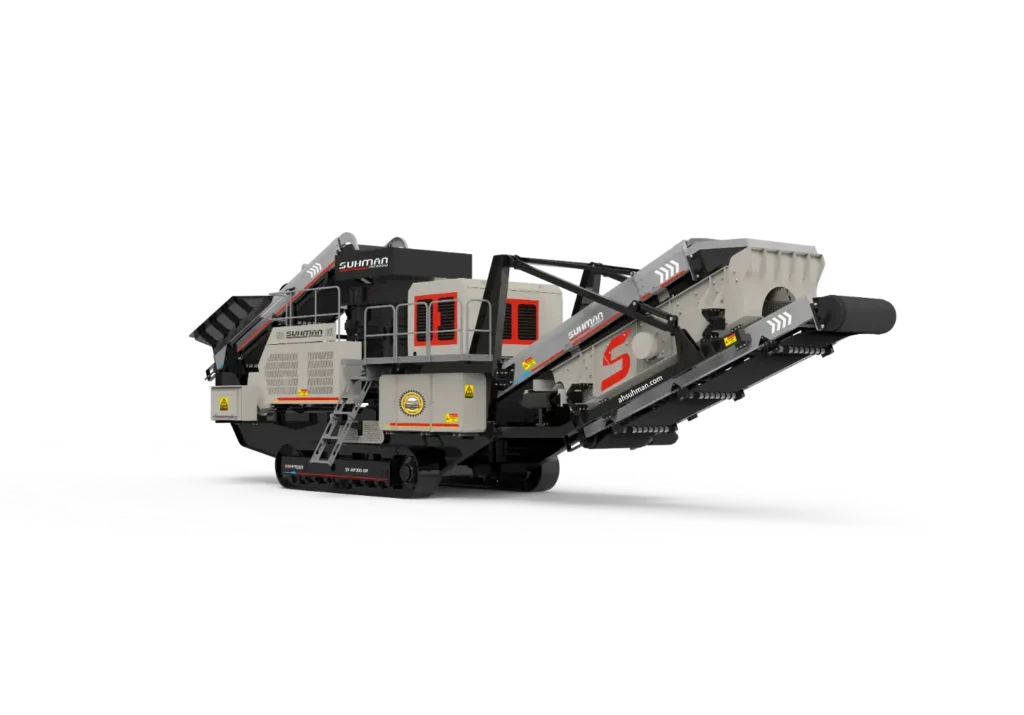
Evaluate the SY-HP300 when prepared feed needs further crushing and its material properties support a cone-crushing stage. The jaw-crusher product must meet the cone’s actual feed requirements.
| Published EU specification | Value |
|---|---|
| Максимальный размер корма | 240 mm |
| CSS range | 10–45 mm |
| Crusher motor power | 250 кВт |
SS-7018 Mobile Inclined Screen — Prepared Material Sizing
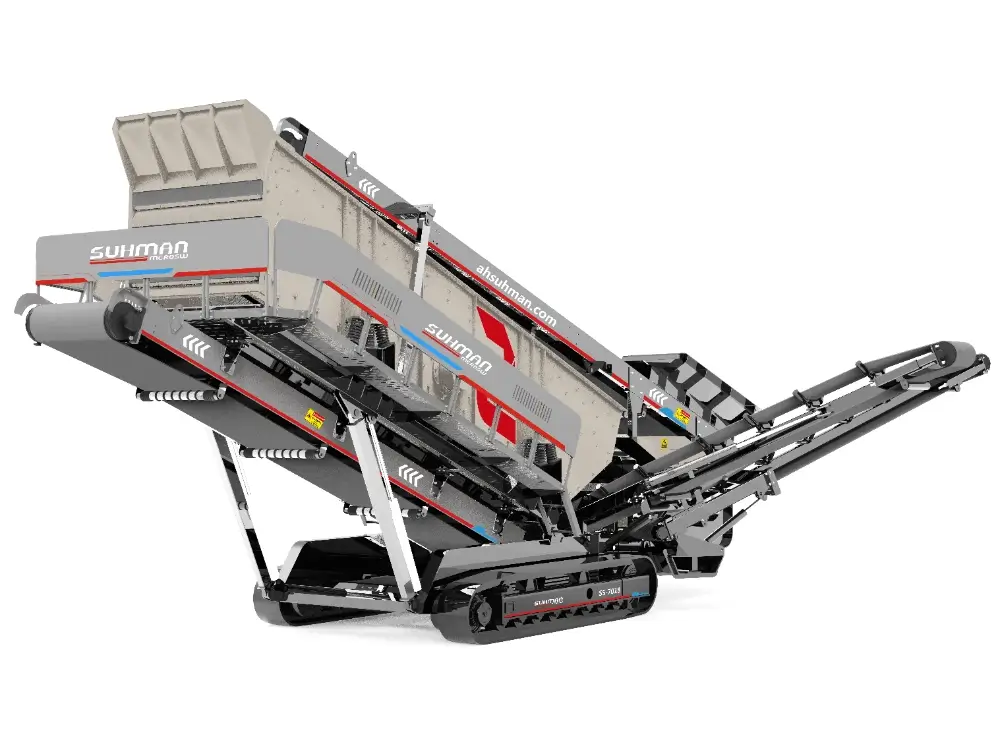
Evaluate the SS-7018 for separating prepared material into required size fractions. Confirm the feed fits the screen’s limits and test whether the proposed screening arrangement suits its moisture and clay content.
| Published EU specification | Value |
|---|---|
| Максимальный размер корма | 100 мм |
| Screen dimensions | 7000 × 1800 мм |
| Screen decks | 3 |
Check every transfer point. The listed feed limits differ between machines. For example, the SS-7018’s 100 mm maximum feed requires an upstream size-control check. The SZ-450D’s published 600 mm limit also matters if it is considered ahead of a jaw crusher rated for larger feed. Obtain one consistent plant specification before ordering.
Evaluate Grade, Mass Yield, and Iron Recovery Together
A higher concentrate grade answers only part of the performance question. Track three measures on the same reporting basis:
- Grade: the iron content of a stream.
- Mass yield: concentrate mass divided by feed mass.
- Iron recovery: iron in the concentrate divided by iron in the feed.
В Umadevi et al.’s 2018 study, a combined circuit treated goethite-rich mixed ore from India. The published abstract reports:
| Measure | Reported result |
|---|---|
| Feed iron grade | 49.2% Fe |
| Concentrate iron grade | 63.5% Fe |
| Concentrate mass yield | 50.6% |
| Tailings mass share | 49.4% |
| Tailings iron grade | 34.3% Fe |
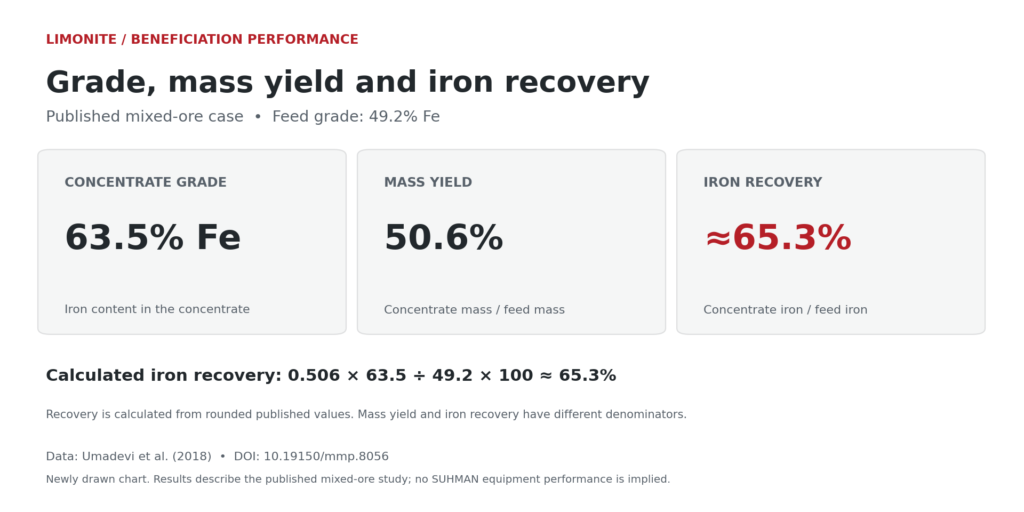
Concentrate grade, mass yield and calculated iron recovery for the mixed-ore case reported by Umadevi et al. (2018).
Using the rounded published figures:
Iron recovery = mass yield × concentrate grade ÷ feed grade
0.506 × 63.5 ÷ 49.2 × 100 ≈ 65.3%
The approximately 65.3% recovery is calculated here; 50.6% is the reported mass yield. These measures answer different questions.
The results cover a combined beneficiation flowsheet. They cannot establish the iron loss from desliming alone. The ore contained several minerals, and the study provides no performance guarantee for another deposit or for SUHMAN equipment.
For your project, request a stream-by-stream mass and iron balance. Include fines, wash-water solids, and final tailings so the evaluation captures where the iron goes.
What to Check Before Selecting Processing Equipment
Prepare the following information before requesting a plant quotation:
| Информация для предоставления | Decision it supports |
|---|---|
| Representative samples from relevant ore zones | Whether one circuit can accommodate expected variation |
| Chemical assays and mineralogy | Target minerals, impurities, and treatment options |
| Particle size distribution and size-by-size assays | Bypass, crushing, screening, and fines-treatment choices |
| Moisture range and clay behavior | Feeding, cleaning, washing, and water-handling requirements |
| Maximum lump size and material strength data | Crusher selection and feed limits |
| Required product size and chemical specification | Circuit targets and acceptance criteria |
| Fresh-feed target and estimated recycle streams | Equipment and conveyor duties |
| Mine layout, relocation schedule, and utilities | Mobile, stationary, or hybrid configuration |
| Agreed test conditions and sampling procedure | A measurable basis for accepting performance |
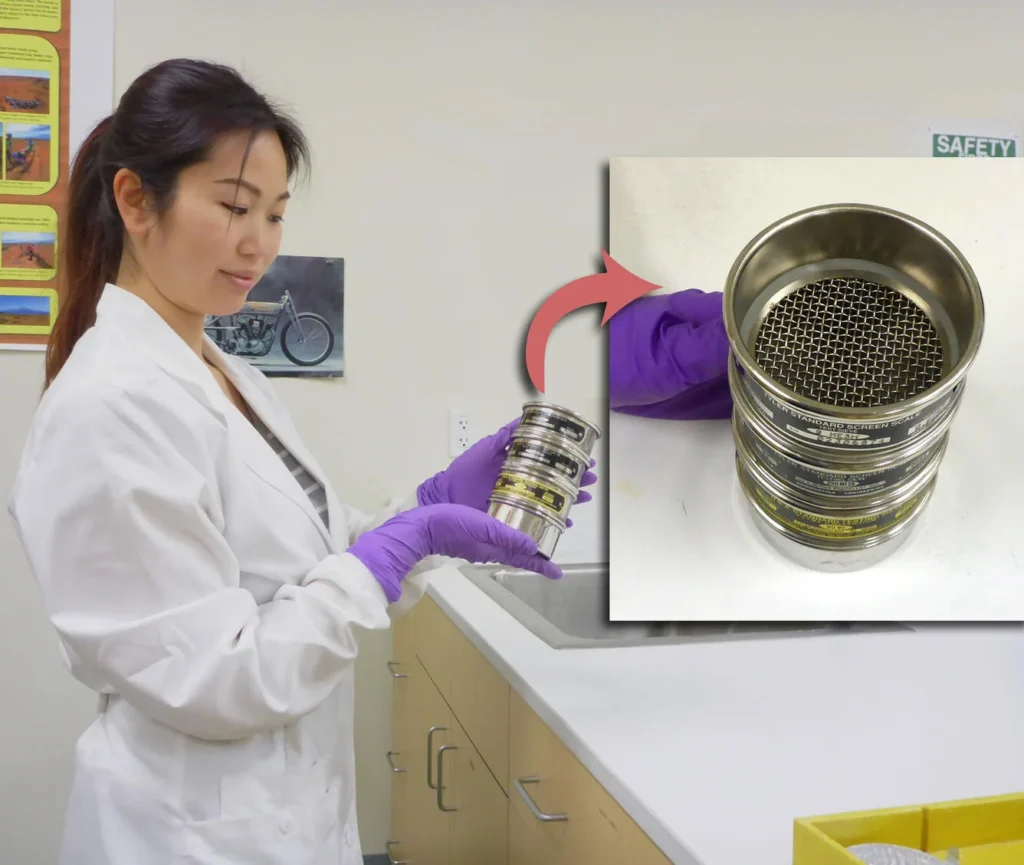
Laboratory sieves illustrate particle-size testing; this USGS photograph shows sediment analysis.
Define throughput on a clear basis, including whether tonnes are wet or dry. State the feed specification, required product quality, operating period, and treatment of downtime in the acceptance test.
For a SUHMAN proposal, send the test results and site requirements with your equipment enquiry. This gives the supplier a practical basis for choosing a configuration and identifying any further trials needed.
Часто задаваемые вопросы
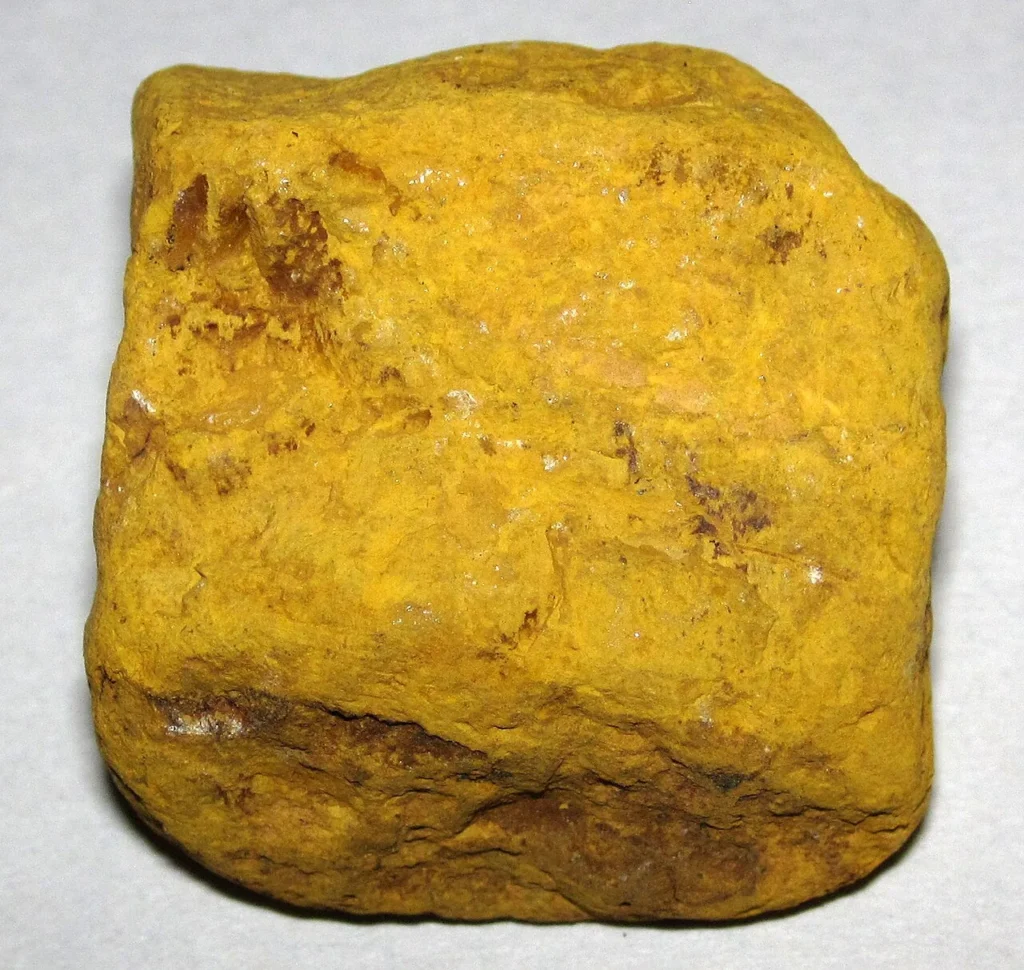
A soft limonite specimen with an earthy surface texture.
Is limonite a mineral or a mixture?
Limonite is commonly used as a general name for a mixture of iron-rich minerals, often dominated by goethite. Its composition varies. The Wisconsin Geological and Natural History Survey explains this usage.
Is limonite magnetic?
Magnetic response depends on the sample’s minerals. Goethite-rich ore needs different assessment from strongly magnetic magnetite. Use mineral identification and separation tests before specifying a magnetic circuit; the limonite roasting study discusses relevant mineral behavior.
Can limonite be used as iron ore?
It can contribute to an iron-bearing feed when testing shows that the ore can meet the intended product and economic requirements. The published mixed-ore beneficiation study provides one documented example.
Is washing always required for limonite ore?
Decide through trials. Assess whether washing improves the required product and measure the iron carried into the fine stream. Include water use and slurry treatment in the comparison.
Is a mobile jaw crusher suitable for limonite?
It is a candidate when competent oversized lumps require primary reduction and the feed suits the proposed machine. Confirm material handling, product size distribution, and throughput through representative testing.
Should a limonite project use mobile or stationary crushing?
Compare relocation needs, haulage, utilities, process integration, and whole-project cost. A hybrid arrangement may also deserve evaluation. Choose the layout after defining the processing duties.
Does limonite contain nickel?
Some lateritic limonite zones contain nickel-bearing goethite. The term “limonite” alone does not establish nickel content. See the USGS nickel-cobalt laterite deposit model, and confirm composition through sampling and assays.
How much limonite can a mobile plant process per hour?
A defensible figure requires defined feed and product conditions. Ask for testing or a contractual performance basis that includes moisture, feed size distribution, recirculation, and separation quality. A general equipment capacity range cannot establish the rate for your ore.